2 months ago
63
2 months ago
63
The Dutch government discriminated against people in one of its most vulnerable territories by not helping them adapt to climate change, a court has found.
The judgment, announced on Wednesday in The Hague, chastises the Netherlands for treating people on the island of Bonaire, in the Caribbean, differently to inhabitants of the European part of the country and for not doing its fair share to cut national emissions.
To address this, the court has ordered the state to develop a proper adaptation plan for Bonaire and put in place tougher greenhouse gas targets.
The lawsuit was initially brought by a group of people from Bonaire, with Greenpeace Nederland, in early 2024. Although the court rejected the complaints by individuals, it did admit Greenpeace’s claim as an organisation.
“They really listened to us,” said Jackie Bernabela, one of the original claimants, who spoke at the court’s October hearing about how climate change was already affecting her life. “Not only us, but all the other Caribbean islands in the world – if we join as one unity we can make things happen.”

The court ruled that the government was breaching articles 8 and 14 of the European convention on human rights, which protect the right to respect for private and family life and prohibit discrimination.
Bonaire, a Dutch special municipality since 2010 – though the Netherlands has been present on the island for about 400 years – is particularly vulnerable to sea-level rise, extreme heat and other climate-related impacts, and its local authorities do not have enough people, resources or specialist knowledge to tackle them fully. These risks had been clear for decades, the court ruled, but there was still no coherent plan to address them.
Furthermore, the court ruled that the Netherlands was not doing its fair share to cut national greenhouse gas emissions.
The Dutch government was ordered to put in place a concrete adaptation plan. And it was given six months to set a national carbon budget that expressed a fair share of the remaining global carbon budget in line with a threshold of 1.5C global heating above preindustrial levels, which must be done in a transparent way. It must also set legally binding interim targets to cut emissions, the court said.
The Netherlands has acknowledged that Bonaire is at risk from climate change. But in court, the government’s legal team said the nation was already doing more to reduce its greenhouse gas emissions than many other countries. The court did not agree, noting that, under international climate agreements, countries are expected to contribute according to their capacity to pay and taking into account their historical emissions.
“This is an incredible victory for the people in Bonaire,” said Eefje de Kroon, a climate justice expert at Greenpeace Nederlands. “Not only has the court established that people from Bonaire are being discriminated against because of the climate crisis but also the Dutch government needs to do much more to protect them.”
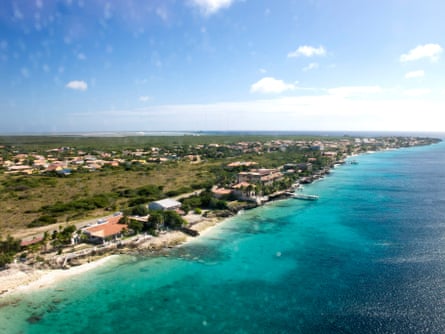
Bernabela was particularly moved by the court’s statement that Bonaire citizens were being discriminated against. “The Netherlands are engineers number one in the world, especially in water management – but they have no plan for us,” she said. “So we feel already – and not only with climate change – that we are second-class citizens.”
Just over a decade ago, the same Hague court made history by ordering the Dutch government to cut its emissions by at least 25% within five years – a landmark ruling that was upheld by the country’s top judges in 2019. That judgment inspired a wave of climate litigation across the world.
As well as previous domestic rulings, Greenpeace’s legal team relied on recent advisory opinions on climate change by the International Court of Justice and the Inter-American Court of Human Rights, both of which said states had clear legal duties to address climate change and to help communities adapt.
In a statement, Sophie Hermans, the Dutch minister for climate policy and green growth, said the court had delivered a “ruling of significance for the residents of Bonaire and the European Netherlands”. She said she and colleagues from the ministry of infrastructure and water management and the ministry of the interior and kingdom relations would now carefully review it.
The ruling can be appealed against.