3 months ago
75
3 months ago
75
It was hailed by campaigners around the world as a game-changing piece of legislation that would help stop deforestation.
But when a bullet-ridden version of the EU’s deforestation regulation, once supposed to be the crown of the Green Deal, finally limped across the legislative line this month, not even its architect was smiling, and one politician said it had been pretty much “dismantled”.
Hugo Schally, the law’s original author who has since retired from the European Commission, told the Guardian he believed it had been “hollowed out” by the removal of obligations on downstream traders to verify the origin of commodities such as palm oil, soy, wood, beef, rubber, cocoa and coffee.
“There now will be fewer actors with direct obligations, fewer data points along the value chain and less precise origin data, which will make enforcement and eventual prosecution more difficult,” he said.
The Green party’s vice-president in the European Parliament, Marie Toussaint, went further, saying that delays, loopholes and an added exemption for printed products – an apparent sop to appease President Donald Trump – amounted to the “political dismantling” of the law. She called on the commission to withdraw the proposal.
It is a far cry from the hopes of the 1.2 million EU citizens who signed the petition kickstarting the process to ban deforestation-linked products from Europe’s market in 2020. Launching the proposal in 2021, the EU’s then-Green Deal commissioner, Frans Timmermans, trumpeted it as “the most ambitious … ever put forward” to combat forest loss.
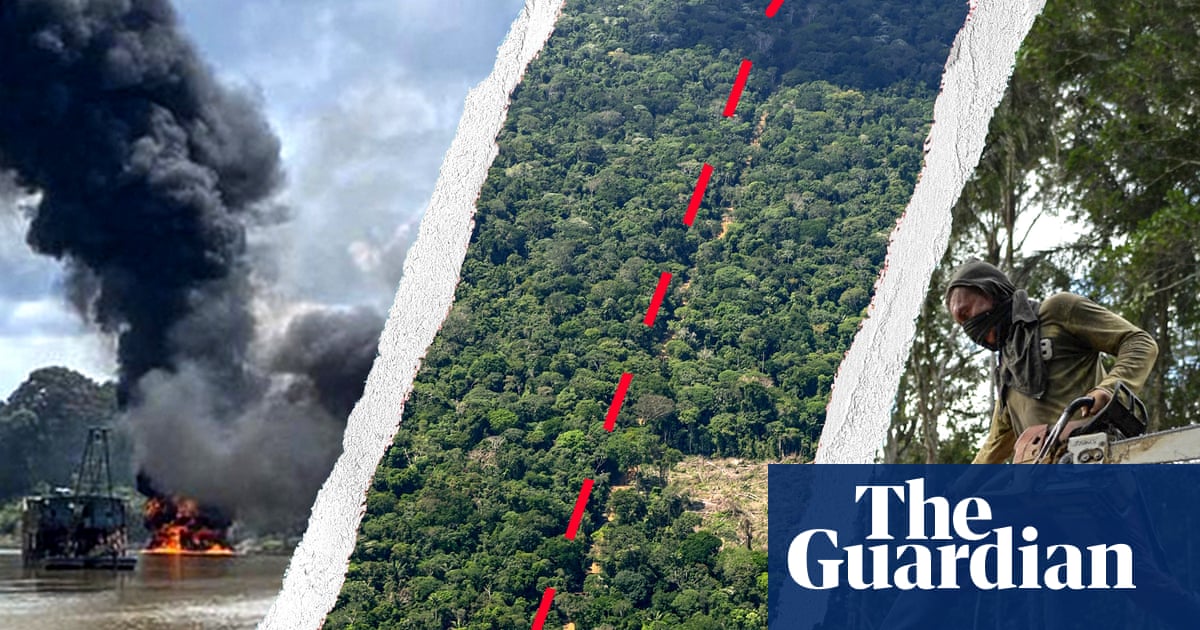
Four hundred and 20 million hectares of forest – an area larger than the EU itself – have disappeared since 1990, in part thanks to Europe’s consumption patterns. Timmermans said that the draft law showed “our willingness to walk our ‘green talks’ globally”.
But critics say that the proposal’s unravelling shows the EU’s willingness to walk back the green talk. The law was twice delayed, for 12 months each time, over IT issues, drawing condemnation even from the environment commissioner who initially oversaw it. “By reopening this file instead of solving a simple IT problem, the commission opened Pandora’s box,” Toussaint said.
In its original form, the law required companies to monitor their third-party contractors and trace the origin of commodities destined for Europe back to their original plot of land, using geolocation data. The idea was to make companies that allowed deforestation along their supply chains liable for punishment with criminal charges and fines of up to 4% of annual turnover.
“It wasn’t bureaucracy for its own sake,” Schally said. “It was the mechanism that made the rules enforceable, created a verifiable paper trail, and stopped companies from hiding behind complexity in the supply chain.”
However, the due diligence involved triggered a Brussels backlash with multinationals, producer countries, rightwing parties and EU logging states all brandishing axes. Last year’s EU elections were pinpointed as a “a decisive moment because there is now a different majority [in parliament]” by Andreas Rasche, a corporate sustainability professor and associate dean at the Copenhagen Business School. “The conservatives of the European Peoples party (EPP) are building an alliance with far-right parties [which] hate the Green Deal and want some of these regulations gone altogether.” It was this alliance that passed the legislation in the European parliament.
There was also intense pressure from some of the biggest exporters to the EU. Rasche said: “The other pressure on the deforestation regulation has come from big trading partners outside the EU – particularly the US – and there is a feeling that the commission gave in to some of their demands in trade talks earlier this year.”
In the final legislation downstream operators were largely freed from an obligation to submit due diligence statements, another exemption was introduced for a “low risk” category of small operators, and a new window was opened for further “simplifications” next spring.
Meanwhile, the only countries that will be subjected to “high risk” scrutiny for deforestation are four geopolitical adversaries of the EU: Russia, Belarus, North Korea and Myanmar.
“Instead of tightening downstream obligations to close loopholes, it stripped them back,” said Schally. “By shifting responsibilities upstream, creating a lighter ‘downstream operator’ category and cutting repeat attestations, it reduced the number of companies that are directly accountable in the system. By allowing less precise origin information for some operators, it weakened the very transparency the regulation relied on to detect laundering, mixing and deforestation-by-proxy.”
Xavier Rombouts, who runs a family-owned Belgian coffee company that complied early with the EUDR, said the uncertainty created by delays and revisions to the legislation had affected his business .
“We feel very annoyed because we put a lot of effort into complying with it. We invested in the software, followed the seminars and built a team to set it up and now they’re saying it will be postponed again or that it may be changed. It’s a big frustration.”
A commission spokesperson said: “The commission has responded to this feedback and taken action to ensure a simple, fair and cost-efficient implementation of this key piece of legislation. The EU deforestation regulation has already led to positive developments and action on the ground to fight deforestation, climate change and biodiversity loss.”
“The new text provides for predictability of the regulatory framework, which is key for business and competent authorities in order to successfully implement this very important regulation.”