3 months ago
74
3 months ago
74
Morning opening: 'Money today or blood tomorrow'

Jakub Krupa
EU leaders are meeting in Brussels today for end-of-year talks with a key decision to make on using frozen Russian assets to boost Ukraine’s defence against Russia.
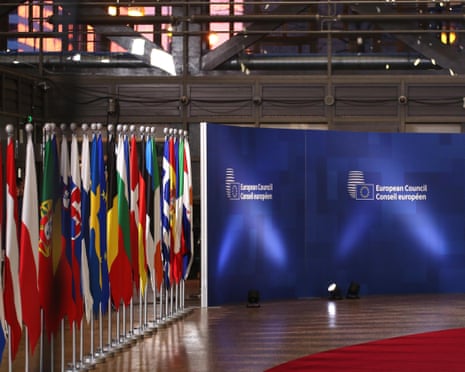
The 27-nation bloc scrambles to strengthen Kyiv’s hand while Donald Trump pushes for a quick deal to end the fighting as the war drags towards the four-year mark.
The EU estimates Ukraine needs an extra €135bn ($159bn) to stay afloat over the next two years, with the cash crunch set to start in April. To plug the gap the European Commission has put forward a plan to tap some €210bn of Russian central bank assets frozen in the bloc.
German chancellor Friedrich Merz said the assets plan was essential to increase pressure on Vladimir Putin and send “a clear signal to Russia”.
Poland’s Donald Tusk went even further this morning, warning: “we have a simple choice: either money today, or blood tomorrow,” adding: “I’m not talking about Ukraine only, I’m talking about Europe.”
Belgium, the home of Euroclear which holds most Russian assets, has been leading the opposition bloc asking questions about potential legal issues, with Bulgaria, Czech Republic, Italy, Malta, Slovakia also expressing doubts.
Technically it’s not enough to bloc the proposal if a vote gets called under qualified majority rules, but politically it makes it very awkward for everyone involved.
But there is no sign of compromise, as the only other option – focusing on EU debt - would require unanimity, and would get blocked by Hungary, which flatly denies any further help for Ukraine.
European officials have insisted the Brussels talks will last as long as it takes to reach agreement, warning that Ukraine’s survival and Europe’s credibility are at stake.
European Commission president Ursula von der Leyen said this morning she won’t leave the meeting before an agreement is reached. But the Slovak prime minister, Robert Fico, joked earlier this week that they can keep him there until the New Year, and he won’t back it either.
Ukrainian president Volodymyr Zelenskyy is to also join the summit in a last-ditch attempt to convince the critics.
I will bring you all the key developments here. But get ready for a long, long day.
It’s Thursday, 18 December 2025, it’s Jakub Krupa here, and this is Europe Live.
Good morning.
Key events Show key events only Please turn on JavaScript to use this feature
All eyes on Belgium's de Wever as he faces pressure from all directions
All eyes are on Belgium’s Bart de Wever today, who has been very outspoken about what he sees as risks arising from the reparations loan, and quite open about the pressure he and his government has faced from both European allies, and from Russia.
We may not get a doorstep reaction from him this morning, though, as he appears to be keen to keep his cards close to his chest, Euronews is reporting.
A poll earlier this week showed he was broadly supported by the Belgian public, with more than 60% backing his opposition to the EU’s plan.
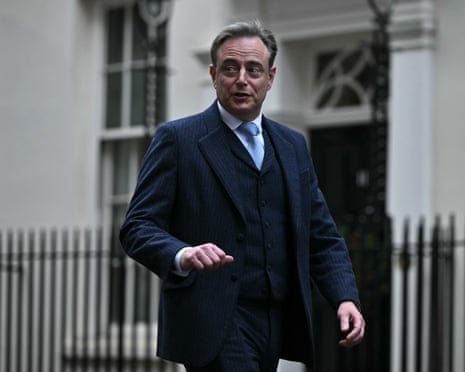
Earlier this month, he caused quite a stir saying at a public event that it was “complete illusion” to believe Russia would lose the war, as he complained about “incredible” pressure around the issue.
In an edited transcript of the event, the La Libre newspaper quoted him as saying that “Moscow has let us know that … Belgium and I personally will feel the effect [of seizing Russian assets] for eternity,” adding: “That seems like a pretty long time.”
But that’s not the only form of pressure experienced by Belgium.
Belgian politicians and senior finance executives have been subject to a campaign of intimidation orchestrated by Russian intelligence aimed at persuading the country to block the use of €185bn assets for Ukraine, according to European intelligence agencies.
Security officials indicated to the Guardian that there had been deliberate targeting of key figures at Euroclear, the securities depository holding the majority of Russia’s frozen assets, and leaders of the country.
Ukraine’s Volodymyr Zelenskyy has arrived at the council building.
Hopefully, we will hear from him shortly.
Germany's Merz wants to 'send signal of strength and resolve' to Moscow
Germany’s chancellor Friedrich Merz confirms his support for the EU’s reparations loan, saying he sees “no better option.”
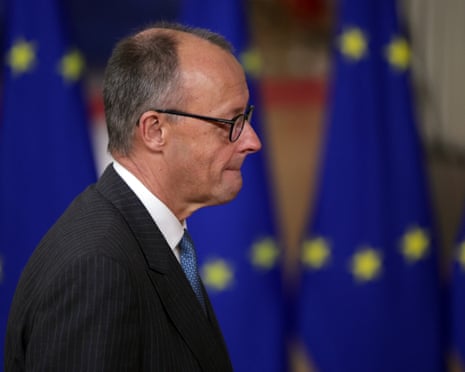
He diplomatically acknowledges Belgium’s concerns, and says he hopes “we can address them together” to “send a signal of strength and resolve … towards Russia.”
'No time to hesitate,' Lithuania's Nausėda says
The Lithuanian president, Gitanas Nausėda, says “this is not the time to hesitate” as he says “we have to make a decision on the reparations loan”, and urges the EU to “touch untouchables” like Gazprom, Novatek, Lukoil, “because only those bold decisions hurt and [have] big impact on Russian economy”.
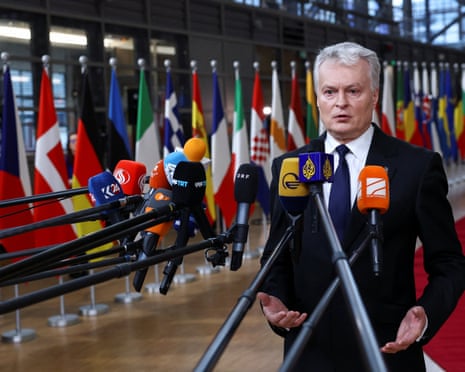
“We have to put more efforts into making Russia feel the cost and price of its aggression,” he says.
No deal on frozen Russian assets would pose 'big problems for Ukraine,' Zelenskyy says
Meanwhile, Ukrainian president Volodymyr Zelenskyy says that a failure to agree on the use of frozen Russian assets would pose a serious challenge for Ukraine.
“I will speak with all the leaders, present our arguments, and I very much hope we can obtain a positive decision. Without it, there will be a big problem for Ukraine,” Zelenskyy told reporters, quoted by AFP.
'Don't think we're going to move without Belgium feeling comfortable,' EU's foreign policy chief Kallas says
EU foreign policy chief Kaja Kallas stresses that “we haven’t seen any willingness from the Russian side to move or seriously talk about peace,” as she explains the need to move on reparations loan to put more pressure on Moscow.
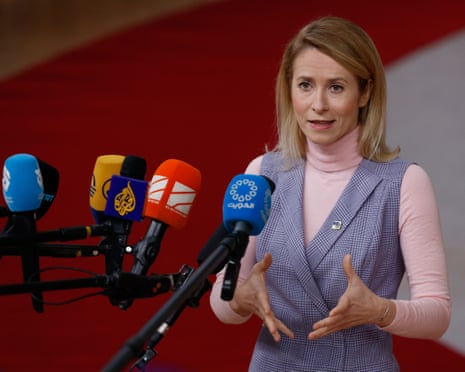
She says the EU have been working on proposals addressing Belgium’s concerns so “the risk and the burden is shared equally.”
“I hope that we get this over the finishing line. Putin is banking on us to fail, so we should not give him that,” she says.
She also makes the practical argument, saying “the reparations loan is the most viable option right now, on the table, [and] we need to work with that as we have tried other things before.”
She says a decision on this would “sent a strong signal to Russia” that the EU is prepared to support Ukraine for the next two years, raising the pressure on Moscow to come to the negotiating table.
Curiously, she appears to rule out the idea of voting the proposal through without Belgium’s consent.
She says “many member states have said that Belgium’s consent is very important,” so “I don’t think that we are going to move without Belgium feeling comfortable.”
She says the chances of getting a deal are “50/50.”
Greek prime minister Kyriakos Mitsotakis says Greece favours the idea of a reparations loan for Ukraine, and joins the group of leaders saying “we should not leave Brussels without … finding a solution,” adding that whatever is decided needs to be “legally sound.”
Work on finding compromise 'ongoing,' EU's von der Leyen says
The European Commission president, Ursula von der Leyen, is also very clear as to what she wants from this meeting, as she says “we have one ultimate goal in this European Council, and that is peace for Ukraine, peace through strength, and for that, Ukraine needs to have a secure funding for the next two years, 2026 and 2027.”
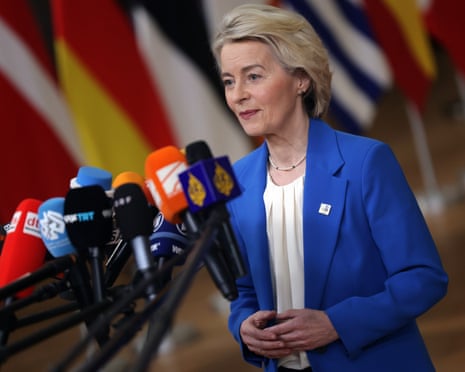
She acknowledges the talks will be “intensive,” but says “for me, the most important part is that, at the end of the day, we have secured the funding for Ukraine for the next two years.”
Striking a conciliatory note, she says she “fully supports Belgium’s demands and asks” to share the risks of the reparations loan, and says the work to find a compromise is “ongoing.”
We will not leave without decision to ensure Ukraine's financial needs are met, EU's Costa says
The European Council president António Costa is clear that the talks will go on for as long as it’s needed to get an agreement.
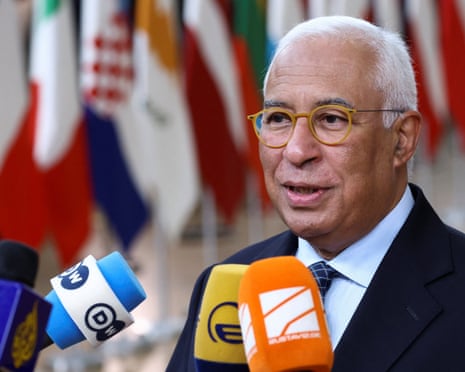
He seeks to maintain a largely neutral position, but says:
“What I can ensure that we will work on this during the today, [and] if it’s necessary tomorrow, but we will never leave the Council without a final decision to ensure the financial needs of Ukraine for 2026 and 2027.”
Ireland's Martin backs use of frozen Russian assets
Ireland’s Micheál Martin says he is expecting a “very comprehensive” meeting with an update on Ukraine peace talks and a discussion on the use of frozen Russian assets.
“Ceasefire situation is very, very challenging, and linked to that is the future financing of Ukraine, and obviously the debate around immobilised assets. We’re very much in favour of the utilisation of immobilised assets,” he says.
He says the principle at stake is that “countries can’t simply destroy another country and expect others to pay for all of the reconstruction of that country.”
Martin says “it is important that we get agreement today,” as “it’s important that Europe … [shows] unity today.”
He says he can’t predict what’s going to happen with “certainty,” but felt there was a momentum behind the proposal for using frozen Russian assets.
Idea of using frozen assets is 'stupid' and amount to 'marching into war,' Orbán says
The chief opponent of sending any further money to Ukraine, Hungary’s Viktor Orbán, just told reporters in Brussels that the idea of using frozen Russian assets was “stupid.”
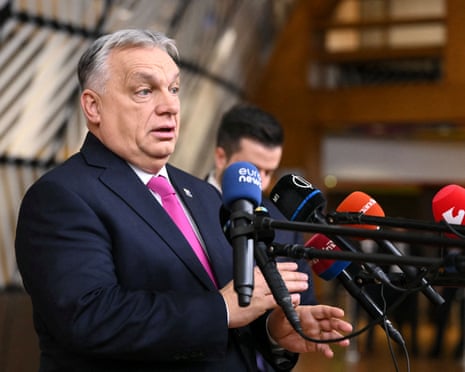
“The whole idea is stupid. … There are two countries which are at war – it’s not European Union, [it’s] Russia and Ukraine – and the European Union would like to take away the money of one of the warring party and then to give it to another one.
It’s marching into the war. The Belgian prime minister is right, we should not do that.”
Morning opening: 'Money today or blood tomorrow'
Jakub Krupa
EU leaders are meeting in Brussels today for end-of-year talks with a key decision to make on using frozen Russian assets to boost Ukraine’s defence against Russia.
The 27-nation bloc scrambles to strengthen Kyiv’s hand while Donald Trump pushes for a quick deal to end the fighting as the war drags towards the four-year mark.
The EU estimates Ukraine needs an extra €135bn ($159bn) to stay afloat over the next two years, with the cash crunch set to start in April. To plug the gap the European Commission has put forward a plan to tap some €210bn of Russian central bank assets frozen in the bloc.
German chancellor Friedrich Merz said the assets plan was essential to increase pressure on Vladimir Putin and send “a clear signal to Russia”.
Poland’s Donald Tusk went even further this morning, warning: “we have a simple choice: either money today, or blood tomorrow,” adding: “I’m not talking about Ukraine only, I’m talking about Europe.”
Belgium, the home of Euroclear which holds most Russian assets, has been leading the opposition bloc asking questions about potential legal issues, with Bulgaria, Czech Republic, Italy, Malta, Slovakia also expressing doubts.
Technically it’s not enough to bloc the proposal if a vote gets called under qualified majority rules, but politically it makes it very awkward for everyone involved.
But there is no sign of compromise, as the only other option – focusing on EU debt - would require unanimity, and would get blocked by Hungary, which flatly denies any further help for Ukraine.
European officials have insisted the Brussels talks will last as long as it takes to reach agreement, warning that Ukraine’s survival and Europe’s credibility are at stake.
European Commission president Ursula von der Leyen said this morning she won’t leave the meeting before an agreement is reached. But the Slovak prime minister, Robert Fico, joked earlier this week that they can keep him there until the New Year, and he won’t back it either.
Ukrainian president Volodymyr Zelenskyy is to also join the summit in a last-ditch attempt to convince the critics.
I will bring you all the key developments here. But get ready for a long, long day.
It’s Thursday, 18 December 2025, it’s Jakub Krupa here, and this is Europe Live.
Good morning.