3 months ago
63
3 months ago
63
By the time Ilia Malinin reached the closing stretch of his Olympic free skate, the outcome was no longer really the story. The story was the expression on his face – not panic, not shock, but the dawning realization that a destiny he had controlled for nearly three years had slipped beyond his reach in the blinding span of four and a half catastrophic minutes.
For the rising generation of men’s skaters, the 21-year-old Malinin has existed less as a rival than as a moving technical horizon. The Quad God. The skater who built programs around jumps others still treated as theory, who pushed the sport into something closer to applied physics. Much like Simone Biles, who took in Friday’s contest from the arena’s VIP seats, his only competition was himself.
The three-year unbeaten run that stretched back through 14 competitions was only the baseline of the Malinin mythos. The prodigy from the northern Virginia suburbs wasn’t beating his opponents so much as bringing them to heel. Twenty-three months ago in Montreal after winning his first world title with his buzzy Succession-theme routine, Malinin sat only feet away while Japan’s Yuma Kagiyama volunteered an extraordinary confession to reporters: “If we both perform at 100% of our ability, I don’t think that I will be able to win.”
On Friday, as Kagiyama repeated the Olympic silver he won in Beijing despite an error-strewn performance of his own, Malinin did not simply lose gold. He lost the version of himself that had made losing feel almost abstract.
The shock was not that he made mistakes as he finished unthinkably far off the podium in eighth place. Olympic champions lose titles on single edges and mistimed takeoffs all the time. What made this a meltdown for the ages was how quickly the program stopped resembling the thing Malinin had built his dominance on and disintegrated into chaos. A popped axel where the hardest jump in the sport was supposed to live. A botched combination. A clattering fall where recovery usually followed. Another missed jumping pass at the point where his programs normally become inevitable. By the end, Malinin’s coach and father, watching from near the kiss-and-cry area, could only turn away.
For most of the last three seasons, Malinin’s skating has been a controlled detonation. Drill the early quads and the rest of the program expands outward, each element building pressure on the field. On Friday, the detonation never came. Instead, Malinin simply folded inward.
“The pressure of the Olympics really gets you,” he said afterward. “The pressure is unreal. It’s really not easy.”
Pressure – a word he repeated at least two dozen times while facing the music in a febrile mixed zone late on Friday night – is often treated as cliche. But in sports built on timing and muscle memory, pressure is physical as much as emotional. It speeds time up. It narrows decision windows. It turns instinct into hesitation. The greatest athletes frequently describe the biggest moments as strangely calm: the game slowing down, the mind going quiet. Malinin’s brutal self-assessment hinted at the exact opposite.
“Definitely not a pleasant feeling,” he said. “Training up all these years, going up to it, it honestly went by so fast. I didn’t have time to process what to do or anything. It all happens so fast.”
He added: “My life has been through a lot of ups and downs, and just before getting into my starting pose, I just felt all of those experiences, memories, thoughts really just rush in. It just felt so overwhelming. I didn’t really know how to handle it in that moment.”
Malinin arrived in Milan not just as the favorite, but as the architect of the sport’s technical future: the only skater landing the quad axel, the only one building programs around seven quads, the only one capable of making “clean enough” look like domination. He’d even suggested that he’d been working on a quintuple jump to be debuted at some point in the not-so-distant future. But there were hints of his struggles throughout the week, from the team event programs that were each below his standards to the restless TikTok activity at 3am. At the highest level, performance is built on instinct. And when instinct fractures, even slightly, the entire system can come crashing down.
Instead, the gold went to Kazakhstan’s Mikhail Shaidorov, fifth after the short program, who delivered the kind of performance the Olympics has always quietly rewarded: clean, efficient, ambitious but controlled. Four quads. Positive execution. No deductions. No drama. Outside the arena, several dozen fans draped in Kazakh flags sang and celebrated past midnight in a steady downpour, feting their national hero: Gennady Golovkin on ice.
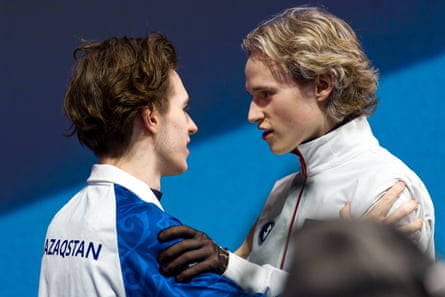
The contrast between Shaidorov and Malinin was almost philosophical. Malinin represents skating’s outer frontier: maximum difficulty, maximum risk, maximum possibility. Shaidorov, also 21, represented its oldest truth: the skater who survives their own program often comes out on top. That tension is not new. Olympic skating has always been less about theoretical peak difficulty and more about reproducing excellence under unbearable scrutiny.
“Coming into the free program, I was really confident,” Malinin said. “And then it’s like it’s right there … and it just left your hands.”
Malinin, who now faces a four-year wait before a shot at redemption at the 2030 Winter Games in the French Alps, when he will be 25, learned Friday the Olympics don’t care about momentum or narrative or technical revolutions. They care about what happens in a single performance window. For the Quad God, that window slammed shut faster than he could adjust.
The loss, while a deeply traumatic event, will not define his career. He won gold in the team event earlier in these Olympics, remains the sport’s most technically gifted skater and the one most likely to define where it goes next. Nathan Chen, who took in Friday’s proceedings from a seat in the press tribute, is proof that the lessons from an Olympic crash-out can lead to a brighter tomorrow.
But if Malinin represents the outer limit of what skating can become, Friday night was a reminder of what it still is. A sport decided, ruthlessly and without sentiment, by who can hold themselves together long enough to reach the final pose.