3 months ago
70
3 months ago
70
Adrian Horton: I know you were showing your prior film, 20 Days in Mariupol, to western audiences when you began working on this film. What brought you back to the frontlines?
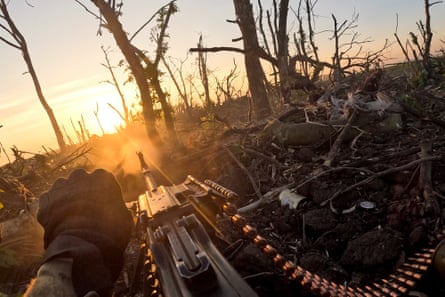
Mstyslav Chernov: What brought me back was not speaking to the audiences, even, but just coming out of Mariupol, we were so devastated and so scarred by what happened. And then we went off to Bucha, where we saw more war crimes. And then I went to Kharkiv, my home town, which was bombed every day, just as Mariupol was. So even when we were starting to edit 20 Days in Mariupol, I was already looking for a story that would be, in a way, a response to that feeling I had, of devastation and helplessness. I kept seeing Ukraine as a victim of this brutal invasion, and I wanted to tell another story which would have an opposite direction – to show some sort of agency, some sort of strength and response to that violence, when Ukrainians push back.
AH: And that was when Mariupol was already out? What was that dissonance like for you – being on the Oscar circuit, then filming on the frontlines?
MC: That was when the theatrical release started in July. It was the same time as Barbie and Oppenheimer, and it was the same time when we had dozens and dozens of Q&As for the wider public. It was when the first receptions and red carpets started. But of course, at the same time, the frontline was on fire. Ukraine was fighting this counteroffensive. And I would go from those places in the United States, in the UK, in Europe, these beautiful, peaceful cities, back to Ukraine – fly to the border, get a car, get a train, get another car, get in a trench. And in that trench, I would see a world that was so different. It would be like another planet, or 100 years backward in time. That collision of two worlds – I just tried to express it. I tried to comprehend it, how we live in a world where both war and peace and humanity and violence exist. And so 2000 Meters to Andriivka naturally became a film about distances, not just about the reality of war, not just about the humanity of people who are pinned down in those foxholes. But also about the distance between Europe and Ukraine, between Ukrainian society and people in the trenches. Hopefully that comes through.
AH: How does that distance feel in the aftermath of this movie, particularly between Ukrainian society and the frontlines. Have you seen it widen? Narrow?
MC: I have to say, since the beginning of 2025, a lot of people in Ukraine, especially those on the frontline, but also Ukrainian civilians who were increasingly bombed by the missiles and drones, have a feeling of abandonment by the international society. That brought a lot of people together. That’s what I find amazing about Ukrainians, but it’s amazing about humans in general. When we feel distressed, when we feel abandoned, we unite. And then we give each other strength through that. The harder things become, the closer people feel. I think it’s a huge mistake, that Russia thinks that bombing Ukrainian cities with ballistic missiles is going to help them negotiate the deal that they want, on the terms they want, and that the Ukrainian public will just distance themselves from soldiers or distance themselves from the government. That’s not going to be the case.
AH: Makes sense.
MC: I also think that the Ukrainians – I mean, I’ve seen more than 70,000 people come to cinemas to see 2000 Meters to Andriivka, which is extraordinary during a wartime. I’ve seen how they appreciate the realism and truth of the film, the acknowledgment of sacrifice and pain that Ukrainian soldiers, civilians, everyone is giving to this war – especially at a time when there’s a large consensus around the world, even with Ukrainian allies, that Ukrainians should just give away this land. Andriivka would also be gone. So just the knowledge of how important that place is, and what it was worth to liberate it, is crucial.
AH: I attended the Sundance premiere in January, and I remember you said then that you don’t want to be prescriptive. You’re more interested in questions, and that this film is first and foremost a memorial document. But I’m wondering, in showing this film to audiences around the world, do you find yourself wanting to impart a certain message?
MC: My main message is to make sure the film is interpreted in the right way. Again, because this film is not a simple film, it’s not a propaganda film. It’s a film that is about more — it’s about Ukraine, it’s about the war itself, it’s about us in this moment in history, where we’re on the verge of a war. And how do we survive that moment in our history? I want the audience to see how futile and terrible this entire concept of war is, and how we, as humans, shouldn’t do it to ourselves. But at the same time, that the self-defence of Ukrainians isn’t futile.
AH: That seems like a crucial distinction.
MC: When I speak to Ukrainian audiences [about the film], it’s about memory – remembering those men and their sacrifice. But the international conversation is that too many people, too many politicians around the world, are saying that this war is futile. I couldn’t agree more, but the self-defence isn’t.
AH: It’s tough, with something like this, to talk about hope. Things can’t be wrapped up neatly. But where do you find hope right now for 2026?
MC: What I learned through the making of this film, and one of the reasons why I embarked on it, is to find hope myself, to understand that even in the moments when it feels dark everywhere, there is light in people who we are standing with, together. Each one of the men we meet throughout the film brought me that hope. I went into that forest where this entire film takes place with a sense of hopelessness. And I found my hope. I found trees that have been destroyed by artillery already growing back. I’ve seen people who, despite knowing that they might lose their friends, lose their life, that they might set the flag and it still might fall, are still doing it. They’re still defending their families. That gives me hope that Ukraine, however hard it will be, will remain.