2 months ago
61
2 months ago
61
I have just witnessed a murder. Spattered against the white walls of the Almeida theatre are several thin streaks of blood. Underneath them a particularly gruesome-looking hand axe rests on a table. And on the other side of the room, a clue to who the perpetrator might be. Discarded next to someone’s laptop is a business card – bone-coloured, raised black lettering – bearing a familiar name: Patrick Bateman.
Him again.
It’s 35 years since Bret Easton Ellis’s third novel, American Psycho, unleashed Bateman on his rampage of sadistic violence, and it seems we’ve never stopped wanting more. In the decades since, Bateman has stabbed and slashed his way through a Hollywood movie, an unlikely hit musical and all kinds of internet memes (“I have to return some videotapes”). A remake of the film, reportedly starring Austin Butler as Bateman, is in the works, but before that a reworked musical is returning to the place it first appeared, hence my visit to rehearsals at the Almeida today. As I watch the cast perfect harmonies around the names of typefaces (“Tiiiimes, New Roh-oh-man”), I wonder how a story about 1980s Wall Street bankers – complete with oversized mobile phones and references to Sony Walkmans – has remained so relevant? Should we be worried that it has?
To answer this question we have to understand Bateman himself. Obsessed with designer labels, male grooming and ludicrous fine dining (swordfish meatloaf with onion marmalade, anyone?), Bateman’s money and status-obsessed existence was a pitch-perfect send up of US capitalism during the Reagan era. Yet the satirical element seemed to be lost on critics at the time. The Guardian’s Joan Smith, using a line as brutal as any Bateman murder, dismissed the novel as “nasty, brutish and long”, whereas a moral panic about the book’s graphic acts of violence against women prompted Simon & Schuster to pull out from publishing it at the last minute (Ellis kept his $300,000 advance, then found a new home with Vintage). The controversy has never entirely gone away – even now, the novel can only be sold in Australia if shrink-wrapped.

Perhaps unnerved by all the fuss, Ellis himself claimed the novel was inspired largely by his property developer father and the bankers he hung out with for research. He wasn’t being entirely honest. “I didn’t want to own up to the responsibility of being Patrick Bateman,” he said in 2010, “so I laid it on my father, I laid it on Wall Street.” In reality, Ellis admitted he was writing about his own “rage … boredom … my loneliness, my alienation”.
It wasn’t just Ellis who related to Bateman and the book’s themes of alienation and despair; as time went by the novel transcended the controversy to become a slow-burn success. “I don’t think it would be as widely read if the point of the book was specifically an attack on yuppie culture,” Ellis said. “I think there’s a larger feeling that people respond to in the book.” So what, exactly, is this dark energy that it holds?
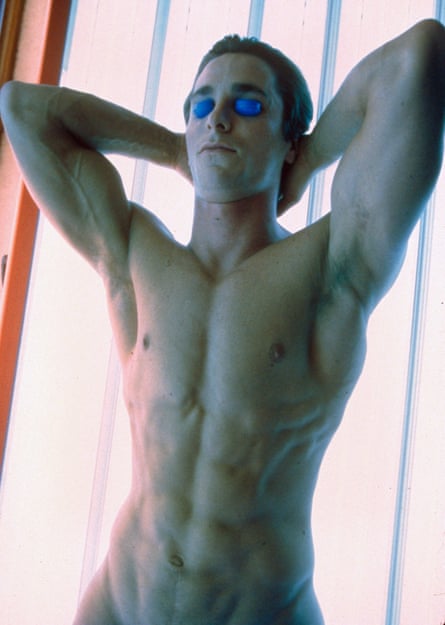
Arty Froushan, who plays the lead in the new musical, says he was slightly offended by how many of his friends said Bateman was the “perfect role” for him. But you can see what they mean. Froushan has the requisite preppy looks and, from watching him rehearse, he really gets across Bateman’s constant sense of status-anxiety. Is his business card stylish enough? Why doesn’t he own his own tanning bed? The references might have changed, but Froushan believes these issues have only got worse with the rise of the internet. “Instagram is such a horrific amplifier of it, this constant neurotic comparison that we carry out with our peers and the sort of disconnection that fosters,” he says. “It offers the illusion of connection and connectivity, but actually you end up feeling completely isolated and it discourages empathy.”
It’s a horrible thought, that there might be some Bateman in all of us – obsessing about our frown lines, or scheming how to make our holiday look better than it really is on social media, all while the world burns. But maybe we don’t need to be so hard on ourselves. Because surely much of the reason why we still turn to American Psycho after all this time is that – perhaps before anything else – it is unremittingly hilarious. Over its 400-plus pages, there is little in the way of plot or character progression, and a lot in the way of bitchy dialogue and endless running jokes such as the increasingly deranged topics – eg toddler murderers – discussed on Bateman’s beloved Patty Winters Show. When he brings up the real-life serial killer Ed Gein during drinks with his friends, one of them replies: “Is he the maitre’d at Canal Bar?” At a U2 concert, a bored Bateman spends the show trying to work out if The Edge is wearing Armani or Emporio, before it emerges he doesn’t actually know which one The Edge even is. Perhaps the most telling running joke is the way nobody seems to recognise anyone else – Bateman is mistaken for one of his peers on virtually every other page, the implication being that all these people blur into one.
By keeping the dialogue virtually unchanged and condensing the story into just over 100 minutes with something approaching a story arc, Mary Harron’s film should improve on the novel. It has certainly become what defines American Psycho in the eyes of the public, cleverly incorporating Bateman’s earnest reviews of Whitney Houston and Huey Lewis and the News with his scenes of unhinged violence. And yet there’s something about the novel’s seemingly unnecessary length – the way Ellis, just 22 when he started writing it, masterfully maintains the voice page after page – that really drags you into the inanity of Bateman’s world.
Ellis was hugely influenced by style mags such as GQ (“A bold striped shirt calls for solid coloured or discreetly patterned suits and ties,” says Bateman) and today you hear that same detached tone as TikTok’s auto-generated voice talks you through people’s mundane daily routines. Ellis was intrigued by how gay tropes and rituals, such as working out and waxing, were being adopted by straight alpha males, and has claimed his book was “probably the first novel about a metrosexual”. What the public didn’t know at the time was that the man who conceived Bateman – a massive homophobe – was gay himself.
In so many ways, American Psycho crashes headfirst into today’s cautious debates around identity politics. It enraged feminists on publication and you certainly couldn’t imagine a writer getting away with some of the gratuitous sex and violence scenes today. Ellis trawled through autopsy reports for his research, dragged himself into a place that repulsed him: sex workers get maimed with coathangers; heads are stored in freezers. Yet often it’s Bateman’s intrusive thoughts that are more chilling to the reader than his gory actions: while discussing gossip columnists and bistros, Bateman casually tells the reader about a waitress he “raped with a can of hairspray last Christmas when I was skiing … over the holidays” before returning to his thoughts on the lousy acoustics of the venue he’s in.
Reading the book still carries with it the frisson of a guilty secret. “You wouldn’t tell a first date you were reading it,” is how one colleague puts it, and it’s true I didn’t feel entirely comfortable reading it on the commute to work. But is it really misogynistic? Harron believed her film was really an attack on male fragility, asking a question that particularly resonates today: what on earth is going on with men right now?
That means all men. One obvious comparison to Bateman are the members of Oxford University’s Bullingdon Club, which produced two recent British prime ministers in David Cameron and Boris Johnson. In 2013, the Mirror reported that one initiation ceremony for joining the club involved burning a £50 note in front of a beggar, a taunt beloved by Bateman and his pals. But American Psycho’s targets are broader than just society’s elite. Perhaps Bateman’s true representative in 2026 is Andrew Tate and his followers, who share his fetishisation of status, working out and the dehumanisation of women. When you look at the rise of “incel” communities, pickup artists, grindset culture, tech bros and wellness gurus slapping beef tallow on their faces, American Psycho’s message seems depressingly more pertinent than ever.
Rupert Goold, the director who first brought American Psycho to the Almeida and who is restaging it as his swansong before heading off to take charge at the Old Vic, says the book has an “almost Dostoevsky quality” that evokes “a kind of loneliness”. This means it can map on to all sorts of modern malaises, and Goold is attempting to use this incarnation of the musical to examine the modern manosphere. “People like [fitness influencer] Ashton Hall, who has millions of followers and lives this totally Patrick Bateman life where he wakes up at five in the morning, puts his face in ice and then reads self-help books and works out.”

And yet there is a huge irony at play. Because in recent years Patrick Bateman – specifically Christian Bale’s movie persona – has become a kind of aspirational figure for the very same men he was designed to mock. In some quarters he is held up as being the ultimate “sigma male”, a masculine archetype who sits at the top of the food chain, yet also slightly outside it, refusing to conform to society’s rules like the typical alpha male. (It should be noted that Bateman isn’t really a sigma male, given he is driven by a relentless need to fit in.) The “sigma face” – a smug pout while simultaneously frowning, modelled on one of Bale’s expressions in the film – has become a huge meme.
How has this misunderstanding taken place? Kanye West’s Love Lockdown video was inspired by Bateman’s sterile apartment, and the journey the musician has been on since then seems pertinent. Ellis was interested in writing a book that was all about surface, yet it’s now being read by some on this same surface level; Bateman as a good looking, muscular, rich idol who gets the girls and does what he wants to them. The fact Bateman’s descriptions of sex sound pretty teenage and virginal probably helps them to appeal to a younger audience. It’s hard to know what Ron DeSantis’s excuse is, though: the Florida governor used Bateman footage in a 2023 video aimed at promoting his anti-LGBT credentials while running for the Republican presidential nomination.
Which brings us, of course, to DeSantis’s rival in that race. There aren’t many things Bateman authentically loves, but – along with Les Misérables and the 1980s output of Genesis – he is a huge admirer of Donald Trump, even recommending the then businessman’s The Art of the Deal to the detective investigating one of his murders. Ellis chose Trump to be Bateman’s idol because back then he was a distilled representation of the elite – a showman who loved money. But now he’s president, the comparisons are even stronger. Like Bateman, Trump is obsessed with surface: the TV ratings, the prizes, the sycophancy. Also like Bateman, Trump has constructed his own reality. In American Psycho, we’re never quite sure whether or not what Bateman is telling us is happening is actually happening. Sound familiar?
When I first read the book, it seemed fairly obvious to me the murders were only happening in Bateman’s addled mind as he approached a nervous breakdown. He made little effort to cover them up, after all, leaving his apartment with body bags and with blood on his clothes. But, of course, Bateman is rich and privileged. Even when he tells people what he does in his spare time they don’t listen. Like Trump, Bateman could “stand in the middle of Fifth Avenue and shoot somebody” and get away with it. In other words, he’s hiding in plain sight. Forget not all heroes wear capes; Bateman shows that not all villains wear masks.
A common line about the politics we find ourselves saddled with these days is that it’s “beyond satire”. How could you make, say, a Veep-style comedy about a US administration far more ludicrous than anything the writers could ever come up with? It’s a question I pondered while writing this piece, the backdrop to which was Trump seizing Venezuela’s president, threatening to invade Greenland and defending the shooting of a mother by ICE agents. Ellis was warning us where hyper-masculine capitalism was heading, but we got distracted by all the blood and gore on the surface. Now that we have a real life American Psycho in charge of the world, his darkly comic novel looks like the most lethal satire of all.
American Psycho is at the Almeida theatre, London, to 14 March.