3 months ago
78
3 months ago
78
If you ask any Iranian to name the most important female pop star in our country’s history, they’ll say Googoosh. Nobody else comes close. Over six decades of revolution, suppression and exile, Googoosh has gone from singer to cultural icon, a symbol of a country’s grief for its murdered, imprisoned, and muzzled artists, and a living link between pre-revolutionary Iran and the diaspora.
Googoosh was just three years old when she started singing in small halls and cabaret venues where her father worked. By her teens she was a film actor and a fashion icon. In the 60s and 70s, when my mother was a teenager, Googoosh was everywhere: on television, in films, magazines, on the radio. She kept recreating herself – her style, her moves, her hair. (My mother and many of her university classmates copied Googosh’s famous wispy haircut.) For a while, this bold, creative young woman shaped how westerners saw Iran, and how a generation of Iranian women understood modernity, femininity and public life.
Then the 1979 revolution arrived, and cultural crackdowns pushed secular art and music underground. In 1980, Googoosh was arrested and (along with other singers and actors) banned from performing, recording or appearing publicly. She withdrew into private life, but her songs continued to circulate underground, and my generation played her music just as much as our parents had: to dance, to grieve, to fall in love. I listen to Nafas on repeat after every heartbreak, or when I just need a big, dramatic cry. Even after she went quiet, Googoosh was the emblem of a lost Iran, its joyful culture, rich artistic history, and its bold, powerful women.
Her memoir uses her 1980 arrest as a framing device. After a series of interrogations, she is thrown into a cell with her old friend, the singer and film actor Marjan, and the narrative shifts between prison and the past. In prison, Googoosh’s treatment by the clerics is terrifying, but crammed together in filthy, unpredictable conditions, the women make do, telling each other their stories to distract themselves.
Googoosh describes a pitiless childhood: the pain of her mother’s departure, days spent serving her father’s abusive new wife, Mouness, and protecting her brothers from their stepmother’s wrath. In those days, the stage was her only reliable refuge and her sole power (as breadwinner) against Mouness. But Googoosh soon left home and, at 17, she married, the first of many unions that crumbled under the pressures of celebrity, public scrutiny and repressive expectations.
In public, though, she was free: she wore what she wanted, moved how she wanted, spoke about love in ways most women couldn’t. Her short haircut, her miniskirts, her bold eyeliner and her vulnerability on stage were enthralling to other women. After the crackdowns on secular music, Iranian women equated the silencing of their most beloved performer with their own, and her disappearance from public life turned her into a kind of lost saint. They remembered her privately through old cassette tapes: the pretty face of their unspent youth, their desires and their yearning to be heard.
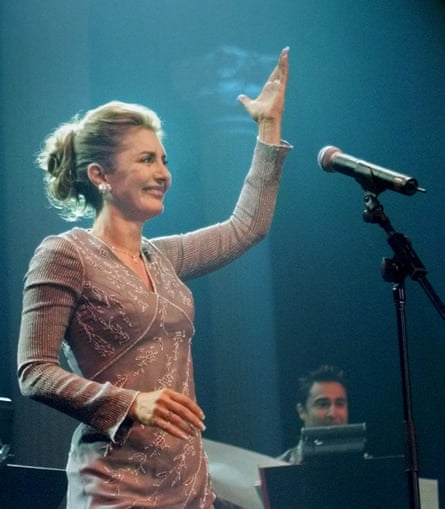
Clearly, then, a memoir from Googoosh is exciting for her fans and an important part of our cultural archive. And it’s a genuine pleasure to read her stories, with their infuriating power imbalances and dramatic turns. But Googoosh deserved a more seasoned memoirist as her co-writer. Her (lived) story is a complicated one, full of cultural texture and interpersonal nuance, and it carries historical weight. It merits a sophisticated telling with a powerfully crafted narrative and attention to the particulars of Googoosh’s voice. With its Iranian inflection stripped or mangled, the writing tips constantly into cliche, one-note characters and melodrama. (At a concert: “It felt like there was a giant octopus with tentacles spreading all over the massive space, causing a wave to form, a wave of energy that grew exponentially as it rushed toward the stage before hitting me and the musicians.”) How much more subtle and luminous this memoir might have been if given to a skilled literary hand. Still, it’s Googoosh and she deserves our attention. She has lived a brave and remarkable life that everyone should know about.
She was finally allowed to leave Iran in 2000. In exile, she rebuilt her life from the ground up, releasing new music and touring worldwide. Googoosh’s first performance (in Toronto) after two silent decades was historic: audiences wept, remembering all that had been lost. Soon her concerts became intergenerational gatherings again: older Iranians reconnecting with pre-revolutionary memories and their third-culture kids (and grandkids) discovering a piece of their identity through her music. For Iranian women of my mother’s generation, though, the ones who suffered most at the hands of brutish men, watching their idol reclaim her spotlight was a kind of revival – as if they, too, were getting another shot at everything they’d missed.