3 months ago
63
3 months ago
63
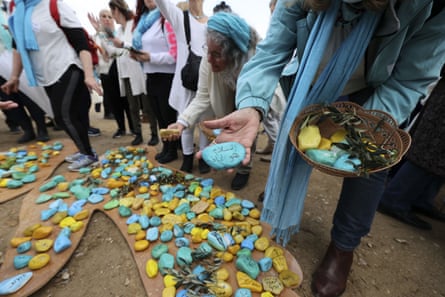
On the shores of the Dead Sea, about 1,500 Israeli and Palestinian women had gathered, holding hands and calling for an end to what they called a “vicious cycle of bloodshed”. It was an October evening in 2023 and they had travelled from villages, settlements and refugee camps around the region for a mass peace rally jointly organised by the Israeli movement Women Wage Peace and the Palestinian group Women of the Sun.
Two of the organisers were friends: Yael Admi, 66, an Israeli mother of six, and Reem al-Hajajreh, 43, a Palestinian mother of four. The women had hoped their message would cut through decades of violence and mistrust. But three days later, Hamas launched its deadly attack on southern Israel, killing 1,200 people, followed swiftly by what turned into a genocidal war by Israel on Gaza which left more than 70,000 dead, most of whom were women and children. The fragile hope embodied by the Dead Sea event was overtaken overnight by grief, fear and fury.
“It was like a punch in the gut,” says Admi, glancing towards al-Hajajreh, who nods agreement. The events of 7 October, al-Hajajreh says, had a devastating impact on their lives. Both women faced intense criticism for continuing to work together.
“When we first met in 2019, we understood that we need to establish a deep and intentional partnership. We learned from other conflicts and understood this partnership is essential,” says Admi.

“People were opposed to my working with an Israeli after the 7 October attack,” says al-Hajajreh. “Not only my private life, but my fight for peace also cost me my social life. But here we are together, not only as Israeli and Palestinian, but as mothers wanting to protect our children.”
Admi and al-Hajajreh spoke to the Guardian from the Women and Peace conference held in The Hague in December on Human Rights Day.
For al-Hajajreh lives in Bethlehem, in the West Bank, the larger of the two Palestinian territories occupied by Israel, where life is shaped by checkpoints, military incursions and the constant threat of conflict escalation. “It was a rather difficult journey for me to reach The Hague and double down on our joint peace message. It took me over 30 hours in total to just reach here,” says al-Hajajreh. She had to pass through multiple checkpoints, each involving long, unpredictable waiting for periods of six to seven hours.
“This constant uncertainty, never knowing whether I would be allowed to proceed or turned back is an emotional burden that Palestinians face regularly.
“Despite the hardship, I felt strongly that attending the conference was essential, but not only for me but for the women whose voices I carry with me,” says al-Hajajreh.
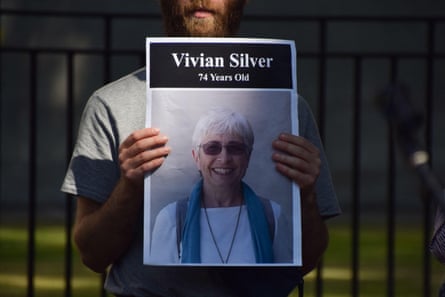
Both women have lost friends and fellow activists in the past two years of brutal conflict. Among them was Vivian Silver, 74, an Israeli-Canadian peace activist and one of the founders of Women Wage Peace.
“Vivian’s loss was devastating, as was the loss of three more of our fellow activists and over 40 Palestinian women [from Women of the Sun] who worked alongside us,” Admi says.
Admi, was 12 when she lost her eldest brother, Ishai Ron, during the 1969 fighting between Egypt and Israel. His death shaped her activism she says.
“It’s our losses that have pushed us to choose this path of peace. It’s to protect our children and their future. As mothers, we do not accept a future where our sons will either be the killed or the killers,” says Admi.
Despite their grief and backlash, both women remain determined to send a message to global leaders about the urgency of including women in peace negotiations.
“Talking about peace in the middle of war was not easy, but we stood our ground and all I want to tell the world is that as women, we are more than half of society, but no one takes into account if we want war or not. On the contrary, people don’t realise that women always oppose war. We want to watch our children grow up and have a bright future,” says al-Hajajreh.
Admi echoes the call, urging leaders to listen to women who live with the consequences of war every day.
“When a mother wants to protect her child, no power in the world can stop her. And I want to ask the world leaders to please listen to us. We hope the peace negotiations last and the situation doesn’t get worse. Relationships can be rebuilt. Just as we did with Egypt and Jordan. Continuing hostility will cause the situation to explode again,” Admi says, adding: “We are sitting on a ticking timebomb. And partnership between Israelis and Palestinians is of utmost importance.”
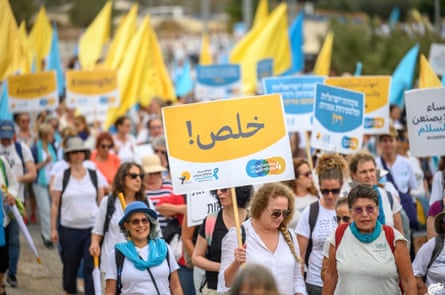
Admi and al-Hajajreh have now launched Mothers’ Call, a joint Israeli-Palestinian women’s movement urging leaders to “show courage and vision to bring about” historic change.
“To relay this message together we will be walking barefoot from Rome to Jerusalem in March 2026 and we invite world leaders and women of the world to join us in this walk for peace and to secure the future of our children. Too many lives have been lost and it’s time to end this cycle of violence,” says Admi.
For al-Hajajreh, the differences between her life and Admi’s are undeniable, as are the wounds they carry. Yet common ground, she says, emerged naturally. “Our motherhood and our hope,” she says, bind them together across the divide.
“At this stage in my life, I feel a deep responsibility to ensure that the next generation inherits a reality better than we have lived,” says al-Hajajreh.