
 3 months ago
65
3 months ago
65
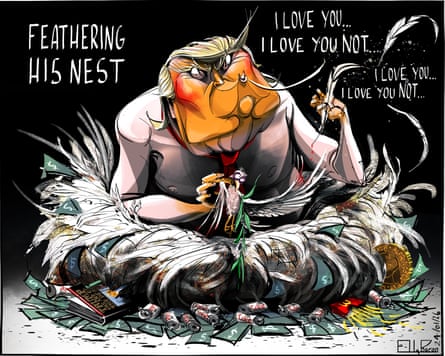
Martin Rowson and Ella Baron are both regular contributors to the Guardian’s daily political cartoon. Martin has been with the Guardian for decades; Ella has been contributing since 2022. This week, we challenged the pair to draw on the same subject (Trump and a world in turmoil), on the same day, to see what each – with their different styles, tools and perspectives – would come up with. Martin landed on a Shakespearean scene, with a warped “King Leer” flanked by snickering world leaders. Ella proposed him squatting in a dystopian nest, surrounded by his spoils. Below, each reflects on their process, the challenges and joys of political cartoons, and what they have learned from one another.
Martin Rowson
I’m old school. In the same way humans have for at least 67,800 years, I make marks with something runny on a flattish surface. Despite the growth of digital imaging over the past 40 years, I can’t even do Photoshop. That’s why I wanted to see what would happen if my friend and colleague Ella Baron and I had a “cartoon-off”, drawing the same topic to the same deadline, because she works exclusively digitally.
My ludditism lies in my love of the tactility of the pencils, pens and brushes I use caressing and snagging on the paper. I also like the jeopardy, dancing with deadlines or not knowing if doing that wash in that way at this point is going to work or completely ruin the image. This lack of certainty is what makes my job fun (it’s standard seat-of-your-pants journalism). And I can’t be arsed to learn how to do it any other way.
My hope is that all this makes the cartoon look good while implying there’s been a bit of a scrap between me and the piece of paper. It’s something I learned from the genius of Ronald Searle and Ralph Steadman, who miraculously reveal the soul through the chaotic messiness.
Thus equipped, I approach each cartoon the same way, never thinking about it until the day I’m filing (Guardian political cartoons are pitched, drawn and published within a single day), nor immersing myself too deeply in the surrounding analyses. I haven’t listened to the Today programme for more than 30 years; what the paper and its readers want is my analysis, not theirs.
After listening to the 7am news headlines (on BBC Radio 3), within about 20 minutes, in ways I really don’t understand, I’ll have collided images and scenarios together in my mind’s eye enough to have created a clear image, which I then describe via email to my editors. So the most gruelling part of my day’s work is over by 7.30am.
Next is the tricky bit, getting what’s in my head on to paper. I sketch it in pencil, ink over the outlines and then start painting, using a mixture of gouache and watercolour. This is specifically painting, in layers, washes and tones. Apart from anything else, and considering the perpetual state of the news, four or five hours doing watercolours is awfully restful.
I work in the great English tradition of James Gillray and William Hogarth, filling the canvas. The image is drawn 50% larger than it appears when printed, allowing for lots of detail and space to add things if the story I’m covering develops during the day. Very occasionally a bigger, better story breaks. Then I’ll start again and just work quicker.
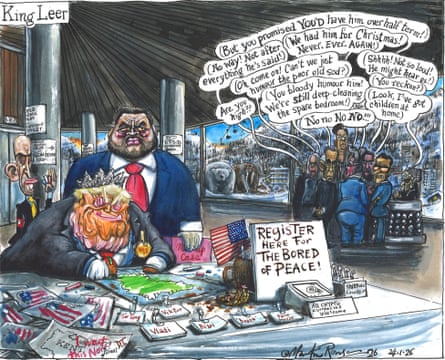
From blank sheet of paper to completion, it takes around six hours for each cartoon.
How Ella produces her extraordinary work is a total mystery to me. I’ve long appreciated she’s special, with seriously mad shit in her head she can get out on to a screen to share with us. But if she spent for ever telling us how she does it, it would still be like someone screaming Sanskrit into a pillow for all the sense it made to me.
She and most of my other colleagues are, I know, the way forward. This won’t make much difference to the content of visual satire, which has been around for as long as we’ve had elites that require satirising. I’ll regret the loss of the messiness of my method, because I feel mess should be our natural habitat, but so what?
President Trump shows why we’re still needed, to enrage his cultists but comfort and empower the rest of us, the victims of his increasing, capricious madness. My Trump No 2 is older, flappier, fleshier and madder than the first iteration 10 years ago. I’m still using just as much orange paint though.
Ella Baron
I draw with a Wacom Cintiq tablet and stylus. It’s frustrating when people say this isn’t drawing by hand: I have hands and my stylus is more sensitive to pressure and barrel rotation than an ordinary pen. I don’t have any formal art training, but grew up drawing digitally as part of the first generation with easy access to that technology. It’s intrinsic to my style, but it’s hard to pin down how because I’ve never known anything different.
You don’t make smudges when you draw on a screen, but you do make mistakes. The outlines of previous forms are a record of your hand movements and lend dynamism to the figures they represent. I think it’s good to leave them in. Politics is messy and political cartoons should be too. I’m very jealous of the evocative (in his own words) mess of Martin’s work – I don’t think it’s something I could ever achieve with my tools. What I can do with them is refine: zoom in on individual lines and tweak them to such an extent that if you’d be working on paper you’d have made a hole in it and in the desk below. It’s helpful when you’re trying to pin down the expression of a caricature, where the thickness and angle of an eyebrow can be the difference between a smile and a frown.
The juxtaposition of these pared-down, fragile lines and bold, confident ones can be helpful in evoking the power dynamics which are important to political cartoons. Cartoons offer a rare opportunity to put the powerful into close proximity on the page with the people whose lives they dictate – it’s a way of holding that power to account.
A cartoon can’t encapsulate the news, but I think it can cut through it. It is hypothetical: a twist on reality that makes you look back at it from a different perspective. That twist is what I’m looking for when I’m surfing through the news for cartoon ideas in the morning. I find symbols and idioms really helpful here – and feathered nests and their figurative ilk are much more fun to draw than men in suits.
Once I have several visuals I shuffle them like a deck of cards in my head until they form a composition that makes a point. The pointyness of that point is important to me. Frustrating as tight deadlines are, they force you to streamline the image around your message, because there’s rarely time for anything else. If you need to draw a crowd scene in 20 minutes then you have to distill it into the few lines that evoke “essence of crowd”. This distillation is also key to caricatures: of all the many lines that make up Trump, which are yours? I’m interested in the ways in which the image he projects of himself slips. The orange tan that doesn’t extend beyond the neckline or wrists; the pale bald patches showing through his yellow comb-over. It’s a way to undermine his ego, like plucking the feathers off. I think the best caricatures capture not just a politician’s face but their whole body and its movement. I hoped that the finger motion of plucking feathers would evoke Trump’s pincer-like hand gestures.
When I’m drawing a political cartoon I’m always slightly in awe of the fact I’m working from and into a tradition. I’ve admired Martin’s work all my life and his caricatures have deeply shaped how I see politicians and inspired how I’ve gone on to draw them. I now have the more complicated task of working out how my cartoons could and should be different. At the beginning it felt necessary to prove that I could do the job of the (almost exclusively) men who came before me, even when it wasn’t International Women’s Day, by rinsing most of the femininity out of my cartoons; both in concept and in style. Gradually, with a bit more confidence and experience, I’ve been trying to bring it back.

























.jpg&mp4-video=https%3A%2F%2Fuploads.guim.co.uk%2F2026%2F01%2F23%2F260123CartoonistAnimation_2.mp4)