2 months ago
61
2 months ago
61
‘We wanted to visit disappointing tourist attractions’
Grayson Perry, artist
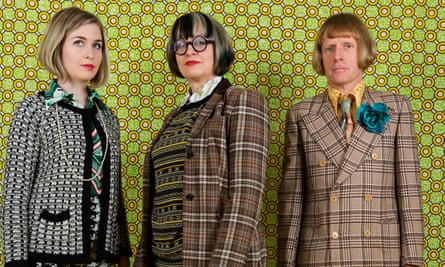
I’ve never really been a fanboy, but the first time I saw Martin Parr I ran up and drunkenly hugged him. I said: “I love you Martin Parr!” I couldn’t help it. He was a hero of mine. And over the years he became my best artist friend.
We were fellow travellers. He was funny, very dry and a big fan of comedy. One of the things we shared is that we both took comedy seriously. The problem with British culture, especially in the art world, is that it suffers from what I call “performative seriousness”. We tend to privilege misery. If you think of someone like Don McCullin – another great British photographer – it’s all about suffering and doom and we are being told it is very important photography. Whereas Martin’s work was funny, albeit in a very discomfiting way, which I think is why he got a lot of pushback from the British cultural establishment.
Like me, Martin was an equal-opportunities piss-taker. Nobody was safe. He travelled the entire country taking pictures, which is why I consider him to be our national photographer.
He had an amazing eye for details. His book Luxury involved him going to all these vulgar events full of wealthy people. He might photograph a woman in a beautiful satin suit, but he would focus on the grease stain on her lapel, or a fly that had landed on a hat. That’s what made it a Martin Parr photograph.
We did a kind of collaboration for my show Super Rich Interior Decoration, which was all about art collectors and money laundering and tax evasion. I asked if I could use some of his pictures of rich people and he gave me the key to his digital archive. I went through it and really loved the ones he’d taken of rich women’s hands. They’d be covered in diamonds, holding glasses of champagne, and you could see all the veiny, grasping details, with these lurid nails on the end. They looked like little claws and they were perfectly suited to the subject matter of my works.
I was a fan of so many of his images. His early black-and-white stuff, before he made his super-saturated colour photographs in the 1980s, was also brilliant. People aren’t so familiar with that – his work up in Yorkshire, in the Methodist chapels. But he served his time as an excellent black-and-white photographer before he became famous with The Last Resort.
Martin travelled the world as well as the UK – he accrued so many air miles that he was able to take his wife Susie around the world for a month on them. We always said that we should do a travel series together, where we visited the 10 most disappointing tourist attractions in the world. That would have been hilarious. He was always saying: “Oh you should go to Machu Picchu, it’s just a crowded misty mountain top!”
He would often dispense advice on photography to people when he was at events. I remember him telling people they shouldn’t smile in their holiday photographs, and that they should take pictures of their food. Well, look at Instagram now. He was certainly a very early adopter of that one.
He did whole books about food, and all sorts. The last book he gave me was all about smoking. He would get obsessed with things, like the last parking space in a car park, and make a book out of it. He was an obsessive collector as well. When I used to stay with him in Bristol he always had five or 10 bids going on eBay at once, for Saddam Hussein watches or Barack Obama potato chip packets, or whatever it was he was collecting that week. He had space memorabilia, political memorabilia, a huge collection of stuff on the miners’ strike.
Martin always liked to complain about how he was an absolute celebrity abroad but that nobody in Britain knew who he was. I think that helped him, though. I went out with him once on a shoot and got to see how he worked. He was this invisible character wandering around. Nobody noticed him. Then suddenly he would pounce. He’d get in really close, push the button and then walk away. He’d be gone before the person had even realised they’d had their photograph taken!
‘I often noticed he was in a hurry’
Wendy Jones, collaborator on Parr’s biography
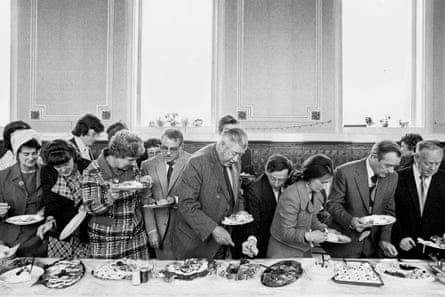
Working with Martin Parr on his biography Utterly Lazy and Inattentive: Martin Parr in Words and Pictures was first and foremost fun. Martin was drily witty and able to turn a good phrase. The photographs – of which we had 50,000 on Magnum to choose from – were also funny, some laugh-out-loud funny, most notably The Conservative Midsummer Madness Party. It’s an iconic picture of Conservatives looking uptight and not at all relaxed in 1980s Bath.
I worked with Martin concertedly and continually for the last two years to write the biography. When it came to choosing the photos, Martin would politely ask me first, I would defer to him, then he would be decisive. He knew immediately which photos worked, which illustrated a particular part in his life best, which of his photographs were technically the most accomplished. I discovered he was reluctant to talk about himself. It took 250,000 words of interviews to get a 40,000-word biography, often asking the same question in different ways to encourage him to tell his life story.
And Martin was humble. Though one of our greatest photographers and social documentarians, he was awed and delighted when other celebrated photographers turned up at the Martin Parr Foundation in Bristol. He would smile, chat away and discuss new photo books, for which he had a lifelong passion. I often noticed Martin was in a hurry. “Next photo!” he would call as we skipped through his archive trying to choose. “Next question!” he would say. We worked together with alacrity, and I am so glad we did. The book was published 10 weeks ago, in the nick of time before his death.
I can only think now of all the trends, fashions and changes in society that will happen over the next decades, which we won’t have Martin to document for us. Most of all, I liked how Martin looked anonymous and invisible in his nice Marks & Spencer jumper, dressed like a conventional accountant from the suburbs, someone’s slightly boring dad. We didn’t see him, but he was seeing us. I was with Martin last Monday, six days before he died. “I haven’t taken any photos today!” he said in exasperation. “Right, let’s go!” he said. Then he got in a cab and was whisked away.
Maria Balshaw, director of Tate
Martin’s photographic world was the changing spectacle of UK life in all its ordinary extraordinariness. From his earliest work in a still postwar Manchester, to British coastal towns from Blackpool to Rothesay on Bute, his cool eye has always captured the something more of daily life. His knowledge and passion for photography was also capacious and his wry humour and candour mean he will be a much-missed and hugely influential force in British visual culture. In addition to his own work he was a passionate collector and his extraordinary photobook collection is held jointly by Tate and the Luma Foundation, Arles, a fitting legacy to his truly international influence.
‘We were chalk and cheese – but it wasn’t a problem’
Don McCullin, photographer
Photography had been wallowing around the black-and-white world for years but Martin brought it into the modern world. He had a very powerful way of looking. He slicked it up a bit with this rather gaudy colour. We all have our timings in life and Martin was the man who came along at the right time.
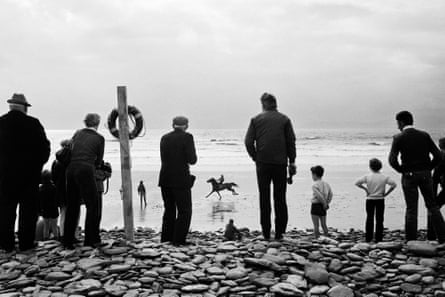
He’d been a very good black-and-white photographer in the early days of his career. But when he took up colour he became a kind of David Hockney of the photographic world. It was a real right-hand turn. And he didn’t have an easy time of it. In the early days his work was seen as a bit of a joke. A lot of photographers at the time – and I include myself in this – thought photography should be black and white. It shouldn’t be, of course, because there are seven colours in the spectrum.
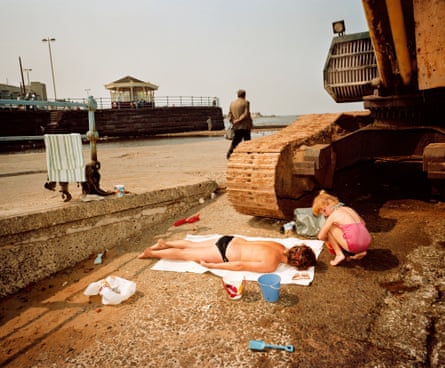
Martin had a very good eye. He was sophisticated, an intelligent man. There was a great deal of humour in his work. He wasn’t taking the mickey, but he was showing us all that there’s humour in human life. The seaside was his grazing ground, and his work was in the similar vein of those saucy old postcards you’d see of fat ladies on the beach.
He would visit me in Somerset with a load of my books to sign. He was an extremely nice man, totally unselfish. With his foundation he did his utmost to keep photography alive. It’s a tragedy we’ve lost him, because he would have gone on supporting and promoting photography.
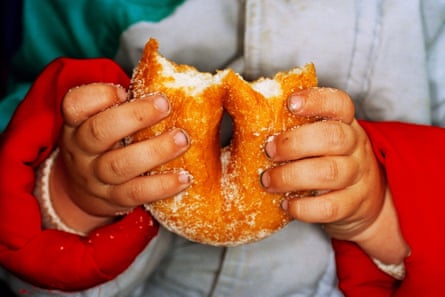
His output was extraordinary. He produced dozens upon dozens of books and there are people out there who absolutely adore him. He attracted huge crowds, much bigger than I ever could. He brought a lot of pleasure to people who didn’t necessarily want to look at the kind of pictures that I take, the downside of humanity.
Our work was in total contrast – it didn’t gel together. We were chalk and cheese. But we exhibited together in France last year at La Gacilly Photo festival in Brittany. I have no problems with people doing things differently to me. Life should be a bit of a fruit salad. And that’s exactly what Martin’s work looked like: a glorious fruit salad.
‘He never lost a sense of wonder’
Jamie Hawkesworth, photographer
I remember getting an email from Martin when I was first starting out. It was completely out of the blue. I’d just finished my series on Preston Bus Station and he got in touch to request a copy and some prints. I thought: Jesus, an email from Martin Parr! It felt really special.
From time to time he would contact me to say he had liked some work I’d done. Then, when my British Isles book came out, I ended up going to the Martin Parr Foundation to do a talk there. He, his team and I finished the evening eating a curry cooked by his wife, which is a lovely moment to remember.
The key to Martin’s success was that he never lost that sense of wonder. In my experience the hardest thing with photography is holding on to the curiosity and naivety you had when you first fell in love with it. Martin never lost that, he always had a curious eye.
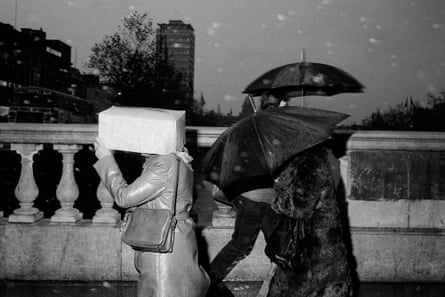
I came to photography quite late. I remember going to Preston library and going through an A to Z of all the photographers out there. The first thing I found of his was a book of his early black-and-white stuff. It had this picture of a guy with an umbrella walking in the rain. That’s the image that has always stood out for me, even though it’s not what you would call a classic Martin Parr photograph.
He inspired me in a strange way: his work made me realise that I wanted to take pictures differently to the way he did. I realised I needed to go up to people and ask to take their picture. But it was seeing his work that helped me arrive at that.
Photography can be a fragile thing. If you take on board what other people say you can get a bit lost. But Martin always remained very honest and true to himself. His way of seeing was just this unwavering force.
‘He helped me edit a book, then we played poker’
Ewen Spencer, photographer
My first photography teacher was the brilliant Geoff Weston. He introduced me to Martin’s work and shortly afterwards described the meaning of photography as “death”. Quite a dark concept when the technical act of making a picture is about the manipulation of light.
Martin became a household name in the 90s. It can be argued that he also increased the acceptance of photography as an artistic pursuit in the UK.
I am still in awe of him and was very pleased to meet him and befriend him via our mutual friend Elaine Constantine in 2002. Both Martin and Elaine are rare kinds within the world of photography in that they readily celebrated and promoted other artists. Martin celebrated so many people and gave many a start by his recommendation. I was fortunate to benefit from his praise, I enjoyed the plaudits but I relished the approval.
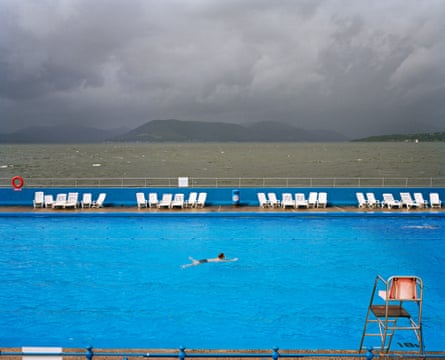
As a young upstart, while working on my first photobook Martin helped me edit the images in one intense meeting at Elaine’s house on Essex Road in London. We then all played poker together.
He sat front row in a lecture I gave at Newport photography course and proceeded to heckle me, taking the piss as I watched the room swell with people and then as the lecture came to a close proceeded to ask insightful and tender questions in front of almost every student and staff member on the course. I’m convinced he had something to do with the numbers on that day.
We contacted one another often to discuss forthcoming work. He’d buy prints and books for the foundation and I’d try desperately to swap a print for one of his, always very early morning emails.
There are so many encounters and meetings they all seem slightly odd and hilarious now. I’ll miss him but he’s never really gone is he? The king is dead, long live the king.
‘The rhubarb farmers loved his pictures of them’
Simon Wallis, secretary and chief executive, Royal Academy of Arts, London
Martin was a passionate and engaging advocate for the power of photography as a vital and evolving art form. He spent untold hours with me sharing his wide-ranging enthusiasms embodied in his peerless library of tens of thousands of photography books. I hugely enjoyed working with him on his exhibition The Rhubarb Triangle and Other Stories at the Hepworth Wakefield gallery in 2016.
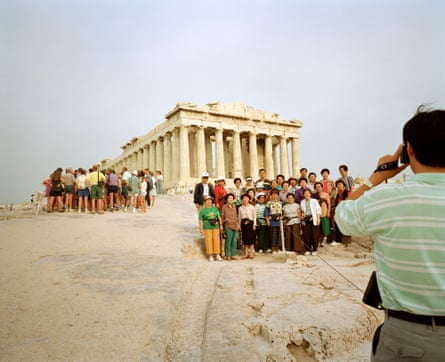
Martin had a longstanding connection to Yorkshire and his seminal series The Non-Conformists was created at the beginning of his career when he lived in the county. He immersed himself in exploring the local area of Wakefield and his photographs captured fascinating aspects of the rhubarb business. From the back-breaking work of moving the rhubarb from field to forcing shed, the freezing cold and exhausting labour of picking the vegetable by candlelight (or occasionally by head-torch), and the consumption of rhubarb by coach parties and food tourists, his work told a compelling visual narrative. At the show’s packed opening it was so heartening to see all the rhubarb farmers and workers proudly looking at what he had captured of their lives and work.
He had boundless energy, generosity and curiosity in the world and the local cultures around him. His huge body of photography leaves us a rich and varied legacy brought together in his many publications. He helped us see the world around us in such a vivid and acute way: laced with humour, irony and insatiable curiosity. So many of his images are intensely etched in my memory; he’ll be greatly missed.
‘He didn’t just take photographs – he built worlds’
Hans Ulrich Obrist, curator
There are so many dimensions to Martin Parr’s practice. He was not only one of the great photographers of our time but also a chronicler of the quotidian, a historian, a collector, editor, curator and importantly also an institution builder. He didn’t just take photographs – he built worlds. The radiance of his work will continue to be felt and appreciated for many generations to come.
‘I was fortunate to call him a friend’
Paul Smith, fashion designer
I’m very sad to learn of the passing of Martin Parr, a joyful photographer and someone who I was fortunate to call a friend. It was an honour to know him and observe his brilliant wit and skill of the “caught moment”.
‘He provoked laughter and discomfort at the same time’
Michael Benson and Fariba Farshad, co-founders of Photo London
It is with deep sadness that we learned of the passing of Martin Parr, a photographer whose sharp wit, bright colour and unflinching eye reshaped the story of British photography. Few artists have held a mirror to a nation with such clarity and affection. His influence has been profound, and his loss will be felt throughout the global photography community.
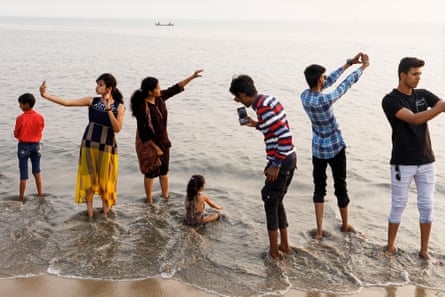
Martin’s connection with Photo London has been central to our history. He was our Master of Photography in 2023, presenting a remarkable exhibition of new work created across the British Isles. True to his lifelong fascination with the rituals and contradictions of everyday life, this presentation captured all that defined him as an artist. His generosity to the fair was longstanding. He was a frequent exhibitor, a regular visitor and an enduring champion of our mission to broaden the public understanding of photography.
For more than 50 years, Martin chronicled Britain with a gaze that was humorous, empathic and deeply observant. From chapel communities and summer fetes to supermarket aisles and seaside towns, he revealed the idiosyncrasies that shape our shared experience. Photobooks such as The Last Resort and The Cost of Living shifted the language of documentary photography, bringing colour, satire and anthropological precision into a field dominated by black-and-white reportage. His images could provoke laughter and discomfort at the same time, a duality he embraced with characteristic candour. As he once said: he made serious photographs, disguised as entertainment.
Martin also transformed the wider photography ecosystem. His presidency at Magnum marked an important moment of renewal for the agency. His unwavering support for emerging artists helped new voices to flourish. The establishment of the Martin Parr Foundation in Bristol created a vital home for British and Irish photography, ensuring that future generations will have access to an extraordinary archive and a beacon for the study of visual culture.
Above all, Martin believed in the importance of looking closely at the world around us. He understood the camera as a tool for curiosity. He understood the value of the ordinary. He understood that photography could hold humour and humanity in the same frame.
A world without Martin’s gimlet eye observing each of its twists and eccentricities is a much-impoverished place. British photography has lost one of its great champions and we have lost a treasured friend whose tireless enthusiasm ensured that we never, ever, rested on our laurels.