3 months ago
68
3 months ago
68
I am lying in bed listening to the radio at my boarding school as my roommate is getting dressed. As she walks out of the door she says, “See you at breakfast – don’t be late.” I’m about to get up when the early morning news comes on the radio, and I hear the announcer saying my parents’ names.
By the time my roommate arrives at breakfast, everyone has heard. My friends run to be with me. The housemaster and his wife stand in the corridor outside my bedroom, not allowing anyone in. All they can hear are my screams and the smashing of furniture. It is beyond comprehension, but then everything from now on is beyond comprehension.
On this sunny May bank holiday in 1978, my mother, father and sister had flown to Le Touquet in France for lunch, a journey my father had made many times, piloting his helicopter. On their return, air traffic control lost contact with them over the Channel. They never arrived back in UK airspace and were all presumed dead.
A few weeks before it happened, a girlfriend and I had tied our sheets together and used them to shimmy out of our bedroom window, meet our boyfriends and go up to London for the night. The head girl reported us, but the teachers had no proof of what we had done, so we denied it and avoided being expelled.
If I had been, I would have been with my parents and I would not be here today.
My memory after hearing the news becomes like a comic strip, frames of events with little speech. My bedroom door opens and my aunt Bunny, my father’s sister, walks in. I get into my father’s car and his driver, Isaac, whom I adore and have known all my life, sits immaculate in a suit and tie, sobbing uncontrollably; my friends are standing by the car crying and hugging each other. The car drives away, everything is in slow motion, and I stare out of the window looking at all the faces staring back at me, not knowing what is happening.
The drive back to my family home in Harpenden, Hertfordshire, takes just under an hour. I sit alone in the back seat – my aunt never touching or speaking to me. The only recollection of the journey that I have is the smell of leather, Isaac sobbing and his aftershave.
When we arrive, my other sisters are there – Louise, 19, and Sophie, six. Emma, who was in the helicopter, was 14 and I am 16. The house is full of strangers and the phone is ringing constantly; people arriving; rushing; staring; crying; asking, “Where are the girls – is the doctor coming to give them something?” I feel like I am on a tightrope high above them – I dare not move or talk, I just have to keep still so I can stop myself from falling.
At one stage two policemen arrive. I stare at them, wondering why they are here. Their shiny shoes and tight-fitting uniforms seem out of place in the chaos.
The rest of the day is a blank. I don’t know what I did or who I spoke to. I don’t recall anyone telling me what had happened; I only know because of hearing the news.
That night, Louise and I sleep in our parents’ bed. I still used to get in with my mother when my father was away – I would creep in and she’d say, “Oh no, you’re not sleeping in here.” I would reply, “OK, I’ll watch telly with you, then go to my bed.” I always fell asleep.
Now, I lie on my father’s side of the bed but don’t sleep. I stare at his shoes all lined up in his dressing room and go through every pair, imagining him in each one, wondering what socks he would wear. His shoes were beautifully looked after, containing shoe trees to keep the shape of the leather, and I imagine my body shrinking and sleeping in one.
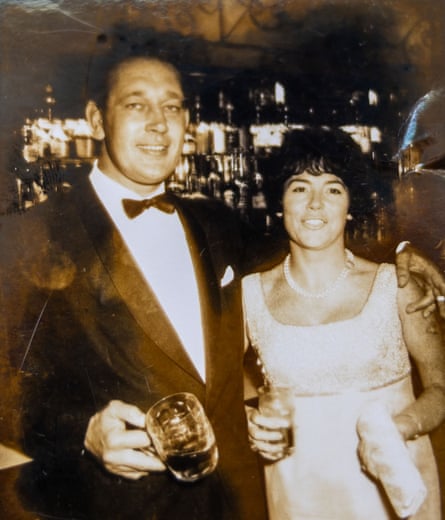
My father ran a plant-hire and earth-moving business which was involved in the construction of a section of the M5 near Bristol. He sold the business and invested in various projects. Like my mother, he was always immaculately dressed. I would watch him polishing his shoes, placing a hand inside to turn them as he massaged in the polish, then buffed the leather until it shone.
Over the next few days, there is a massive air and sea search by both the French and English military. To this day, no one knows what happened. It had been a beautifully clear day, with no fog, according to local fishermen who had been out that day.
My father’s last call before he left the house had been to check the floats on the helicopter – which allowed you to land on water – were working. They were. This makes me believe the helicopter is floating in the Channel and it is only a matter of time before they find them. Louise and I joke about how my mother will be complaining about her hair being flat if it has got wet. They will soon be home, my father in his shoes, my mother with a new hairdo, and Emma and I back playing together.
A few days after the accident, I am in my father’s study and I open a drawer. I find a gold necklace of his with a fish on that he used to wear in the summer and thought he had lost. We would spend the summers in Portugal, and he would wear bell bottom jeans and a denim jacket, bare chested, and his goldfish necklace. In the 70s, this was a cool look. I pick it up and run into the hall, shouting, “Daddy, I’ve found your necklace.” The au pair, who is looking after Sophie, who has special needs, appears and stares at me in horror.
We had a “pool room” at home – it looked out over the kidney-shaped pool, had a great music system and was decorated with low, orange corduroy sofas, cork walls and frosted mirrors. In the summer, the music was turned up – usually the Beach Boys or David Bowie on full volume. Sliding glass doors opened on to the pool – full of our friends; my mother, in her pale pink floral bikini, cork wedges and large straw hat, often sitting among them. Sophie would also be there, jumping off the side of the pool into the arms of one of my friends.
After two weeks, it becomes real. My father’s body is found on a beach in France. Another two weeks and my mother’s body is found, another two and Emma is found, still strapped into her seat. My understanding of the delay is that it has something to do with the tides.
When my father is found, I am alone at my family home. The phone goes and Bunny says, “They have found your father.” I scream, “Where is he?” She replies, “No, Fiona, he is dead.”
I remember very little of the next four months before I moved out. There were three separate funerals and a memorial service in Harpenden. The local shops closed, and I wore an outfit of my mother’s. I remember thinking she would be cross if she found out. She was very fashionable and her clothes were haute couture, stylish and extremely beautiful, as was she. During the service, I started to laugh uncontrollably, and I couldn’t stop. This was the first time I felt out of control. There were some young girls there from the local prep school Louise, Emma and I had gone to, wearing cream straw hats with a red ribbon and bright red wool blazers.
With no warning, people came to pack up our home. I walked into our kitchen and women from a removal company were emptying cupboards. There were no men: it was all elderly women. One, in a thick industrial apron, looked at me and said, “We will be very careful.” She was holding my father’s crystal tumbler.
When I was about five years old, it was a ritual that when my father arrived back from work, I would push a chair up to the drinks cabinet, reach up for the bottles and make him a whisky and water. He would take my thumb and show me how much whisky to put in the tumbler by marking to just above the joint in my thumb. After handing the glass to him, I would climb on to his lap, lay my head against his chest and listen to the whisky travelling inside him, like a tiny wave.
A few days after the accident, Bunny had come to our family home, opened a safe and taken the contents. Some of my mother’s jewellery was in it. My mother adored jewellery and my father loved buying it for her. You could hear her before she entered a room by the tinkling of her charm bracelet – gold, with 26 charms, each given to her by my father to remember a moment in their life. A gondola when they honeymooned in Venice; a rabbit on skis from their first skiing holiday; a wishbone for luck; a charm each for their four daughters; and Pegasus, representing freedom and the soul’s ability to rise above ordinary limits.
My father had a substantial wine collection. My aunt told me she would look after it, so, along with two of my friends, we spent a day transporting case after case to her house. One evening I was there and she took two bottles out of the rack. When I said, “Auntie Bunny, those are Daddy’s,” she replied, “Your parents are dead” and walked out. I stood looking at the door wishing she had hit me with the bottles rather than said those words.
My grandparents had a house in Praia da Luz in Portugal. My paternal grandmother was Australian and this area of Portugal reminded her of home. In the 60s, it was a quiet fishing village with very few tourists. Most of the buildings were simple whitewashed houses and locals travelled by donkeys and wooden carts pulled by mules. The gentle daily rhythm of life was set by the fishermen, who were the backbone of the community. Sardines, mackerel and octopus would be cooked for lunch on an open fire, and we regularly ate with them. Sardines were charged by the number of tails left on our plates. Emma and I would eat the whole fish, making marks in the sand to count how many we had eaten.
My parents fell in love with the area and bought a house next to my grandparents, where we spent the summer holidays.
Louise and I and two friends flew there a few weeks after the accident. It was a mistake. My mother had a large lockable cupboard in her bedroom containing all her personal belongings, along with sun creams, sun hats, Calamine lotion and a medicine chest. She had treatments for everything, brought out from England – there were few doctors locally and antibiotics were extremely hard to get hold of. When we arrived, the cupboard was empty.
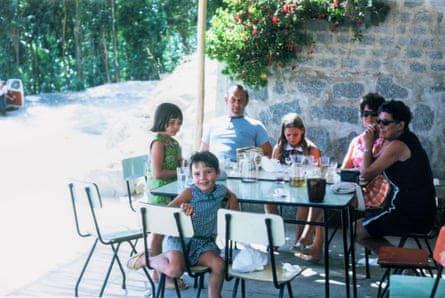
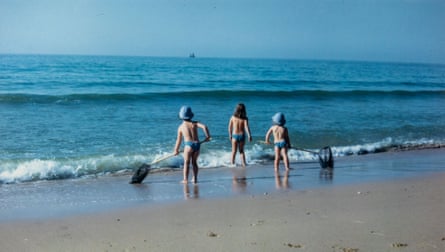
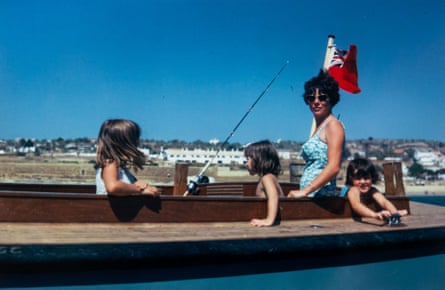
All my parents’ clothes were gone and an outside building that contained our fishing, waterskiing and boating equipment had been emptied. My father, Emma and I spent hours in here – it was like our cave. We would come back from fishing, rinse the salt water off our rods and lean them against the wall.
I ran across to my grandparents’ old house, which Bunny now owned. They were no longer alive but a wonderful local couple, Maria and Jao, had looked after them and the house and garden. Maria would teach us Portuguese and cook local dishes for us. She opened the door crying and hugged me tight. I said, “Everything has gone, Maria.” Bunny had taken it all and told Maria that if she let me into the house, she would fire her.
Four months later, I am on a one-year residential secretarial course in Cambridge. My family home has been sold. Bunny had said I must go back to school, but I couldn’t contemplate ever seeing it again; it held unbearable memories now. No one knew what to do with me, so secretarial college seemed the only option.
The house I am staying in is large, Victorian, run by an elderly lady and her husband, who is a doctor. Twelve girls are staying here – all of them sharing bedrooms. As the 13th, I have an attic room on my own. It has no curtains and bare floorboards. I have no home comforts, but I don’t want any – I want to be lying alone, naked, in the Himalayas. This would be a comfort to me.
I think people fear me. I stare at them intently and barely talk. My senses have become heightened and I feel more animal than human.
I can read people just by their body language. I want to close my eyes and put my hands over my ears when someone talks to me – the only voices I want to hear are my parents’ and Emma’s.
At weekends, I go to London to be with my friends. I feel more able to understand the world around me when I am with them, although I am unable to speak to them about what has happened or how I feel. I said to one recently, “I must have been so weird, and you were all so unbelievably kind to me.” She said with great tenderness, “Oh Fiona, you weren’t weird, you just never spoke.” If my parents’ or sister’s names are mentioned, I walk out of the room.
We party and hang out. One of my closest friends is a punk rocker. I help her to dress up – egg white to make her hair stand on end; leopard-print bodysuit; dark lipstick; loads of makeup – and we walk down Kings Road. Tina demands attention and is very beautiful. I never dress up; I want no attention.
The year at Cambridge went. The only connection I made was to my typewriter. I loved everything about the heavy lump of metal on my desk. The paddle slapped on to the paper when you pressed a key, making a loud “clack” noise. I didn’t have to speak – I could clack.
After Cambridge, I moved to a two-bedroom house, with five girls, off the Kings Road. It was a fun time. There was always a party and inevitably there were drugs and alcohol. If I touched either, there would be a sudden, uncontrolled release of pain. I felt like a piece of blotting paper – one small drop seeped into every cell.
I worked as a secretary and it suited me. I could hide behind my typewriter and was out of the door at 5.30pm. I started to have what were referred to as “fits” – “Fiona is having one of her fits.” There were warning signs – I could feel the hackles on my neck rise and my scalp become numb. Then I’d scream, smash things and run away. The trigger was often someone saying something like, “Where do your parents live?” or, “How many sisters do you have?” In these moments, I felt I could kill.
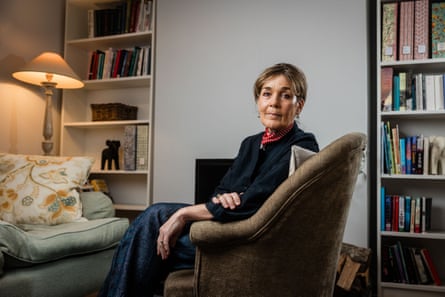
My husband says when we first met it would happen often, and he would regularly be driving around London trying to find me. Once, he found me running barefoot down Earl’s Court Road. When he caught up, he said, “Fiona, your feet.” I had run over glass but felt nothing.
My way of dealing with the fits was to chuck in my job, jump on a plane and disappear. The first time, I flew to Bangkok and met a friend, Cara, who I had lived with on the Kings Road, and was travelling around the far east. We travelled together for three months, going to Thailand, the Philippines, Nepal, Burma and India. I studied Buddhism, and met people who had found enlightenment while staying at ashrams, but I always left them feeling more isolated, heightened by others having discovered what they were looking for.
I have never been able to talk about what happened, not even to my husband. He says that, after 35 years of marriage, it is only through my writing about it that he has truly been able to understand me.
My daughter, Emma – whom I named after my sister – used to be a journalist. When she read that I had heard about the deaths on the radio, she pointed out that today this would never have been allowed to happen. There are strict regulations in place, preventing any media outlet reporting on someone’s death without the next of kin being informed. In 1978, these laws didn’t exist.
Bunny died quite a few years ago, and I heard before she died, she had wanted to see me. I would have met with her, but it was too late. She was a tall, handsome woman, with high cheekbones and piercing blue-green eyes. My father’s relationship with her was complex. He was adored and dearly loved by his mother, and Bunny had a difficult relationship with her. I don’t feel she was shown a lot of love. Their father was a big presence in their life but not a “hands on” parent. My grandmother – her mother – also adored me, and we were very close. It must have been difficult for Bunny to see this.
I also wonder if she lived a life that was expected of a woman in the 70s, where you largely had to prioritise marriage, motherhood and domestic work, and was never able to live the life she wanted. She was also suffering immense grief, losing the younger brother who had looked after her financially and emotionally. I think my father understood her and gave her a lot of love. I was a child who was feisty, outspoken, and who challenged her behaviour. Was taking everything of ours she could a way of trying to hold on to my father?
She became Sophie’s guardian, and although Sophie had been sent to a residential school in Wales for children with special needs, it was a huge responsibility. But this raised more complicated behaviour – if Sophie misbehaved, Bunny often stopped me seeing her. On one occasion, a few months after the accident, Bunny went for me, and we ended up rolling on the floor having a physical fight, like two wild animals. I ran upstairs and locked myself in a room, calling the police, but when they arrived she had gone.
Sophie still has severe special needs and lives in a residential care home. Louise and I are both in London and see each other regularly. There is no doubt the shared trauma has affected our relationship. We dealt with it in very different ways, and I was never able to talk about it. I wonder if we both know we only kept our heads above water for the first few days and weeks because of each other. All I wanted was to join my parents and Emma, but I couldn’t have contemplated putting Louise and Sophie through any more loss.
People say time is a healer, and I am not sure that this is true. I believe love is a healer. I have desperately wanted to bring love back into my life and it has been an enormous challenge to both love and be loved again. The fear of losing someone is deep-rooted in every cell of my body. Over the years, I have questioned if I should live alone in some wild place away from civilisation and not expect to have any happiness in my life again.
As I write this, my husband is sitting in the kitchen, I have two children, two grandchildren and a daughter-in-law. And I am studying for an MA in children’s literature and creative writing at Goldsmiths. When I leave college, I stand on the platform at New Cross station and look up at the Amersham Arms which towers over the station on the bridge above it. Huge red neon lights shine with two words: “Take Courage.”