2 months ago
60
2 months ago
60
As Emily Waldorf languished in an Arkansas hospital, she felt like “a ticking time bomb”. It was 2024, and the physical therapist was in the midst of miscarrying a much-wanted pregnancy. But because her fetus still had a heartbeat, hospital officials said Arkansas’s near-total abortion ban blocked them from taking steps to induce labor and end her pregnancy.
Instead, Waldorf had to wait and hope that she didn’t develop a deadly infection.
Waldorf’s sister, Elizabeth, called the office of Sarah Huckabee Sanders, the Republican governor of Arkansas, to ask for help. “What do you expect the governor to do?” a male official from Sanders’s office asked. Waldorf, the official said, should “find a lawyer”.
Waldorf took the advice, as a sweeping new lawsuit shows. On Wednesday, Waldorf, an OB-GYN and three other Arkansas women who say they were also blocked from getting abortions sued the state in an attempt to strike down its near-total abortion ban.
Two of the women say that, like Waldorf, they were denied abortions even though their pregnancies had effectively ended. One of the women says that she was unable to get an abortion after getting pregnant through a sexual assault, because Arkansas doesn’t permit abortions in cases of rape.

“Arkansas’s abortion bans are vague, confusing, and worse, extremely dangerous,” the lawsuit alleges. “How are pregnant Arkansans supposed to access comprehensive obstetric care when leaving Arkansas means traveling through some of the most remote parts of the state, and when Arkansas is surrounded by other states with their own abortion bans?”
Since the US supreme court overturned Roe v Wade in 2022, unleashing a wave of state-level abortion bans, dozens of women have come forward to say they were denied medically necessary abortions. Many of these women have also joined lawsuits that aimed to clarify the exceptions in abortion bans, which are supposed to allow people to get abortions in emergencies. Doctors across the country have said that the exceptions are worded so vaguely as to be unworkable in practice.
The lawsuit is the first to be filed by Amplify Legal, the litigation arm of Abortion in America, a reproductive rights group that focuses on sharing the stories of abortion patients and was co-founded by the late Cecile Richards, one of the foremost abortion rights activists of the 21st century.
It argues that the laws banning abortion in Arkansas – there are two virtually identical laws on the books – must be struck down because they violate the state constitution and its guarantee that people have the right to equality, life, liberty and the pursuit of happiness. These anti-abortion laws, the lawsuit alleges, not only infringe on people’s right to choose how to build their families, but also threaten their lives, fertility and economic wellbeing.
They are also unconstitutionally vague, according to the lawsuit.
Waldorf’s account of her ordeal and her sister’s conversation with a Sanders official are part of the lawsuit’s allegations. In response to questions about Waldorf’s allegations and the lawsuit, Sam Dubke, director of communications for Sanders’ office, said in an email: “Arkansas was named the most pro-life state in the country for the sixth year in a row not just because the Sanders administration offers complete protection for the unborn but also because Governor Sanders has made needed investments in foster care and adoption, maternal health, and childhood wellbeing. Governor Sanders looks forward to defending Arkansas’s pro-life laws in court.”
Ultimately, according to the lawsuit, hospital officials agreed to transport Waldorf in an ambulance to another hospital in Kansas, which permits abortions. That hospital induced Waldorf, who was about 17 weeks into her pregnancy. Waldorf gave birth to a baby who died shortly after birth. Waldorf, who is now 40, named her Bee.
‘She felt she had no choice’
Chelsea Stovall, another plaintiff, is a 35-year-old mother of two. In late 2022, she learned that the fetus she carried had a congenital anomaly that doomed the pregnancy. Stovall and her husband emptied their bank account and their savings to travel to Illinois for an abortion, according to the lawsuit.
At the Illinois clinic, an anti-abortion protester threw a bloody Maxi pad at their car, the lawsuit alleges.
A third plaintiff, 30-year-old Theresa Van, got pregnant in 2023 but soon learned she did not have enough amniotic fluid to allow her fetus to develop, according to the lawsuit. However, because her fetus still had a heartbeat, she could not get an abortion. She continued her pregnancy for several weeks, at growing risk to herself, until the fetal heartbeat vanished and she gave birth to a stillborn daughter.
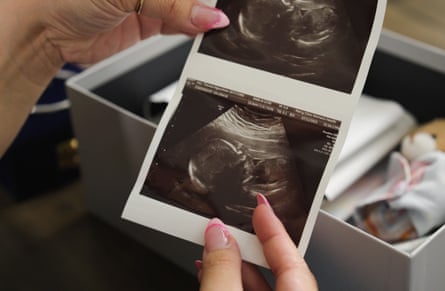
The lawsuit alleges Van feared criminal prosecution if she tried to leave the state for an abortion. “In addition, the financial strain of traveling for abortion care was too intense. She felt she had no choice but to continue her pregnancy until her daughter passed,” the lawsuit says.
The fourth woman suing Arkansas, Allison Howland got pregnant in 2024, according to the lawsuit, after being sexually assaulted at a hotel in 2024. Rather than immediately traveling out of state for an abortion, she continued the pregnancy for weeks in the hopes that police might be able to use DNA from the pregnancy to prove her allegations against the assaulter, the lawsuit says.
However, police concluded that there was little they could do, since the alleged assailant maintained that the encounter was consensual. One detective allegedly told Howland that the assailant “seemed like a really nice guy”. When Howland informed the police that she planned to get an abortion in Illinois and asked if she needed to preserve the remains of the pregnancy, a detective told her “not to bother”, as the lawsuit put it, as the police were unable to take proper care of the potential evidence.
“I do not want to keep the product of this assault,” the lawsuit quoted Howland as saying. “Call that selfish but I stand by it. I was violated and put into extreme danger and living in a state like Arkansas – I was royally fucked.”