3 months ago
70
3 months ago
70
As a writer of political fiction for many years, including four seasons of my TV series Borgen, I find myself in the strangest of landscapes watching Donald Trump desperately wanting Greenland like a spoilt child who has never heard the word “no”.
We dedicated an episode to Greenland in the first season in 2010 and then it became the main setting for the fourth season in 2022. Our focus on this former colony of Denmark, and its amazing Indigenous people, was motivated by one big factor. For political drama I always look for stories with emotion, and the old colonial tale of Denmark and Greenland is full of it.
The modern history of that complex relationship began in 1721, when the priest Hans Egede, with permission from the Danish King Frederik IV, founded a mission and trading station in southern Greenland. The indigenous Inuit people were welcomed into the realm of Christ either voluntarily or by force. Egede remains a controversial figure in Greenland even still, and with good reason. A huge statue of him that sits on a hill just outside the island’s capital, Nuuk, was vandalised in 2020 with the slogan “Decolonize”.
Greenland was formally made an equal part of the Kingdom of Denmark in our constitution of 1953. But more than a decade earlier, during the second world war, Greenland had become a strategic hotspot for the United States, which needed a place to refuel its heavy bombers en route to Europe. Denmark was occupied by Nazi Germany and the daring Danish ambassador to the US, Henrik Kauffmann, acting on his own, signed an agreement on behalf of the Danish king giving the Americans military access to Greenland. In 1951, during the cold war, the American need for even bigger bases was secured in a treaty that is still in existence. Basically, it means the Americans can build as many bases in Greenland as they want.
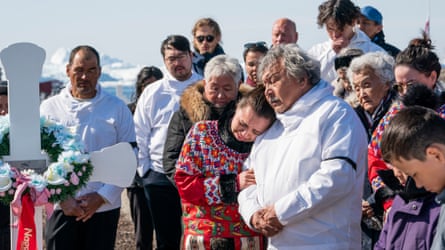
In 1953 the Americans decided to build their biggest base yet, Thule airbase (later renamed Pituffik space base) in a harsh northern area of Greenland that was home to the old Inuit settlement of Uummannaq. Again, the Inuit people were given an ultimatum: move immediately or we will move you by force.
In the 1950s and 60s Thule airbase had more than 10,000 personnel and B-52 bombers were landing and taking off constantly. This posed a new challenge for the American-Danish-Greenlandic relationship. Denmark would not allow nuclear weapons on Danish soil but pragmatically decided that, if we refrained from asking the Americans whether the B-52s were carrying nuclear bombs they wouldn’t have to disappoint us with the truth.
This wilful ignorance ended in 1968 when a B-52 crashed near Thule airbase and four nuclear bombs rolled out on the ice. This became yet another scandal in the difficult relationship between the superpower that is the US, its loyal ally the kingdom of Denmark, and Greenland, the world’s biggest island with a tiny population – currently about 57, 000 people.
Greenland gained home rule in 1979 and finally in 2009 the Act on Greenland Self-Government was passed by the Danish parliament, acknowledging that Greenland ultimately belongs to the Greenlandic people and that they should decide their own fate as an autonomous part of the kingdom.
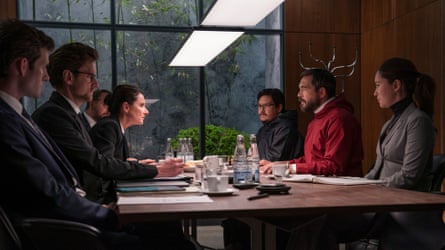
This law was the primary source of inspiration for Power & Glory, the final season of Borgen, as the legislation deals with dividing the income from Greenland’s natural resources between the Danish and Greenlandic peoples. In my story, a huge oil find close to the pristine ice-fjord of Ilulissat on the west coast of Greenland (one of the most popular tourist sites on the island) ends up as a geopolitical nightmare for Borgen’s main character, Birgitte Nyborg, Denmark’s fictional foreign minister. The oil company behind the discovery is first believed to be Canadian but turns out to be Russian; later on we learn it is actually Chinese. Of course, we know that such an oil find would be considered critical infrastructure by the US, which would be highly critical of it falling into Chinese ownership. This puts Denmark in the difficult position of a little brother who must follow orders, and in the process demand that Greenland does what it is told – thus reopening the old colonial wounds yet again.
We really tried to create a dramatic plot that would seem credible yet take the Arctic tension further than had been done before. And we find ourselves completely overtaken by the theatre of the absurd played out by the Trump administration.
Had I ever suggested a storyline involving an American president who becomes obsessed by the thought of owning Greenland, to the extent that he is willing to sacrifice Nato and use mob methods to bully allies into compliance, I would have been laughed out of any pitching session.
Now we are living this nightmare. Listening to Trump’s rant in Davos did not make us feel much safer.
It is bizarre how accustomed we have become to a US president who openly lies, distorts facts and is utterly ignorant about history. (Leaving aside that he confused Iceland with Greenland in his speech.) Trump claimed that Europeans alone benefit from Nato and said he doubted anyone would come to the aid of the US. Yet the only country that has ever called for help invoking Nato’s Article 5 is the US after 9/11. Europe immediately responded. Denmark, along with the UK and other Nato allies, sent troops to Afghanistan. Denmark lost more soldiers per head than any other country in the coalition apart from the US. How utterly insulting for the families, still mourning their dead, to hear the ingratitude of a US president so ignorant of their loss.
In Greenland, people are genuinely afraid of the madness coming out of the White House. So are the Danes. But if anything good has come out of this, it is that Danish and the Greenlandic people stand more united than ever. Danes fully support Greenlanders’ right to Greenland and to decide their own destiny.
In Davos, Trump ruled out military action in Greenland, sure, and called off his outrageous tariff threats as part of some vague “deal”, with Mark Rutte, the secretary general of Nato, reportedly involving a renegotiation of the 1951 treaty between the US and Denmark. The devil’s advocate might ask: how can “Daddy” Trump and the ever pleasing Rutte even negotiate the framework of a “deal” involving the US military presence in Greenland without the participation of Greenland and Denmark? It almost reminds me of Trump meeting Putin to discuss peace in Ukraine without inviting Zelenskyy.
But maybe these theatrics are just part of the new Trumpian “art of the deal”, where a more sinister scheme is really at play. Could Europe’s defence of Ukraine become the hostage in a mad game of power Monopoly, where the unity of Nato is at stake and ownership of Greenland is the ultimate reward? I certainly hope not. But this could be my dystopian pitch for how the nightmarish story develops. Please let me be laughed out of the pitching session one more time.
-
Adam Price is a Danish screenwriter, executive producer and the creator of the TV series Borgen