3 months ago
90
3 months ago
90
Hungary’s prime minister, Viktor Orbán, will face pressure from other EU leaders to stop blocking a vital €90bn loan for Ukraine over a political dispute about an oil pipeline.
Ahead of an EU summit on Thursday, Orbán, who faces elections next month, showed no sign of backing down in his veto of the loan. He said he would not allow it until the damaged Soviet-era Druzhba pipeline supplying Hungary with Russian oil via Ukraine was repaired.
“If there is no oil, there is no money,” Orbán said in a video message on Tuesday posted after the publication of a letter from Ukraine’s president, Volodymyr Zelenskyy, saying “all possible efforts” to repair the Druzbha pipeline were under way.
Orbán said he had made it clear to the European Council president, António Costa, that Hungary’s position was unchanged. “If President Zelenskyy wants to receive his money from Brussels then he must reopen the Friendship [Druzhba] oil pipeline,” he said.
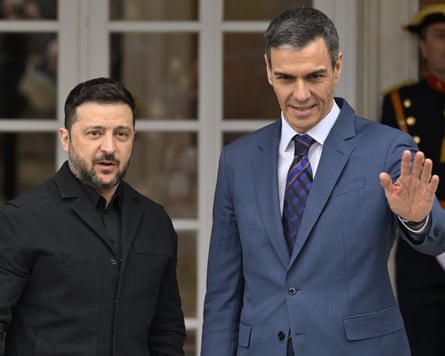
Zelenskyy said on Wednesday he hoped EU leaders would stand by their promise to lend Ukraine €90bn for urgently needed military supplies and general budget support. “We are really counting on the countries and the EU to find ways to resolve this issue,” he said on a visit to Madrid.
Zelenskyy told EU leaders earlier this week that Ukraine was “undertaking all possible efforts to repair the damage and restore operations” to the pipeline, which Kyiv says was damaged by a Russian airstrike.
Hungary and Slovakia are the only two EU countries that benefit from Druzbha, having secured a temporary exemption from the EU’s import ban on Russian oil, which was introduced after the full-scale invasion of Ukraine.
Hungary’s last-minute blockade of the €90bn loan has infuriated other EU leaders as Orbán agreed to the funding deal last December as long as Budapest did not have to take part.
Hungary, Slovakia and the Czech Republic pledged they would not block a decision by 24 EU member states to take out the loan. The loan offer was a hard-fought plan B agreement after an initial proposal to tap Russian assets as the basis of a loan was rejected by Belgium and a handful of other countries.
EU diplomats insisted there was no alternative to what Hungary had already agreed to. “A deal is a deal,” a senior EU diplomat said. “So no plan B, no plan C, no plan D. This [€90bn loan] is what needs to happen.”
A second senior diplomat said: “We cannot talk about plan B, because if we talk about plan B we give in to blackmail.”
Criticism of the Hungarian government was becoming more and more open, the person said. “The fact that the €90bn loan is blocked after Prime Minister Orbán had explicitly approved it with his colleagues is a turning point and that [criticism] it is clearly expressed now in a way I had not heard or seen before.”
An EU official said Costa, who will chair the EU summit, held a long phone call with Orbán on Tuesday morning. “The message was very clear: ‘I expect from you that you respect the commitments you have taken at the European Council and that this decision on the €90bn loan is respected,’” the official said, reporting Costa’s words.
While some diplomats voiced scepticism that Orbán would back down before elections, a leaked draft of the post-summit communique states that EU leaders look forward “to the first disbursement [of the €90bn loan] by the beginning of April”.
Hungary, along with Slovakia, is also blocking the EU’s 20th round of sanctions against Russia, which were meant to be passed last month to mark the fourth anniversary of the full-scale invasion.
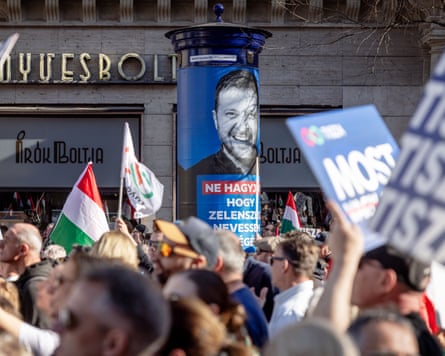
In Hungary’s elections on 12 April, Orbán faces the most serious political challenge of his 16 years in power. Polls show his main rival, Péter Magyar, up to 20 points ahead, while Orbán is seeking to capitalise on the dispute with Ukraine.
The European Commission announced on Tuesday that EU funds and technical support would be available to restore the flow of Russian oil to Hungary and Slovakia. While the move is aimed at overturning the Hungarian veto, the offer has raised eyebrows at a time when the bloc is committed to phasing out Russian oil imports by the end of 2027.
“We are preparing to repair a pipeline Russia itself bombed – to restart the flow of Russian oil we claim to be phasing out – for Hungary which is blocking €90bn for Ukraine that we’re funding – sans Hungary,” wrote Rihards Kols, a Latvian nationalist conservative MEP, who described the policy as “delusional”.
The summit in Brussels on Thursday is meant to be dedicated to revitalising Europe’s waning competitiveness against the US and China. That agenda is likely to be overshadowed by the dispute with Hungary and the war in the Middle East.
On the Middle East, EU leaders are expected to call for “de-escalation and maximum restraint” and to condemn “Iran’s indiscriminate military strikes in the region”. The European Council will say it is “deeply concerned about the increase in hostilities in Lebanon”. While the statement also condemns Hezbollah, there is not direct reference to the US or Israel in terms of their role in starting the Iran war.
Speaking alongside Zelenskyy on Wednesday, Spain’s prime minister, Pedro Sánchez, said the Middle East war would not dim his government’s support for Ukraine.
“We cannot deny that the crisis in the Middle East is monopolising conversation, and precisely for that reason I want to say to the government of Ukraine that nothing and no one will make us forget what is happening in Ukraine,” Sanchez said.