3 months ago
62
3 months ago
62
I met Carole Guscott, a retired former carer, on a clear winter’s morning in the Somerset town of Minehead. She was walking her whippet, Gracie, on the way back to her new flat, past the local Premier Inn and on to a cul de sac called Rainbow Way. “I knew as soon as I saw it,” she told me. “I just thought: ‘I can make this place my home.’”
Up until recently, she was living in a private rented place near the centre of town and paying £780 a month in rent. For four years she had known that Rainbow Way was being built. She also knew that its houses and flats were an example of something that is vanishingly rare in post-Thatcher Britain: new council housing, which meant security for the people chosen to be the tenants but also intense competition for places.
But she then got a call, and an invitation to come and have a look. “I was stunned,” she said. She instantly decided to move in, paying just over £500 in monthly rent, and delighting in the views of the surrounding hills and townscape. “The flat is just so open and bright,” she told me. “I feel blessed that I’m here.” She also said: “Without a council house, there just isn’t the security.”
There are 54 new council homes on Rainbow Way: 33 flats and 21 houses – the first such dwellings to be built in this part of Somerset in 30 years. Around half the people now living here were recently “homeless, facing harassment, being moved on from supported accommodation or urgently needing two or more bedrooms due to family circumstances”. Of the new tenants, 89% were already resident in Minehead and 11% had “strong local connections”: an important point, because the town is a byword for deprivation and low social mobility, with an economy centred on seasonal employment – symbolised by its renowned and vast Butlin’s – and a dire level of local housing need.
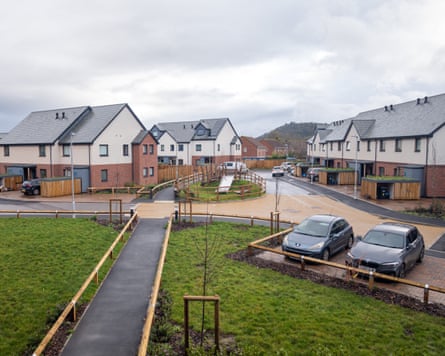
And so here it all is: gently contemporary architecture, a compact children’s playground and homes designed to be zero carbon. On the morning I visited, a party of councillors and their officers were having their photo taken in front of one of the four-storey apartment blocks as they cut a length of ceremonial ribbon. As gulls cawed, a van pulled in, dropping furniture off at one of the new flats. Ushered into the sole flat still awaiting tenants, I flicked through a dossier of instructions and suggestions about how to get the best out of the garden, and local walking routes. There was a tangible sense of calm, wellbeing and lives that have taken a welcome new turn.
How did this happen? Somerset has a new unitary council, which has absorbed four district councils that were once responsible for housing. Two of those councils had long since sold their stock to housing associations, but the others had stuck with providing and maintaining homes. Here, then, was an opportunity for the ruling Lib Dem administration to both sustain 10,500 existing council homes and build as many new ones as possible. At the last count, there were 11,644 households on the Somerset waiting list – what can currently be done may only scratch the surface, but that does not make the drive to build any less urgent.
As far as national politics is concerned, the warm glow emanating from Minehead triggers a couple of obvious questions. Amid the bitter, resentful public mood and a housing crisis that grips so many parts of the country, why are there not far more Rainbow Ways? And given that the government has talked repeatedly of “the biggest increase in social and affordable housebuilding in a generation”, how long will we have to wait for some kind of breakthrough moment?
Which brings us to Labour’s record so far, and aspects of policy that ministers do not talk about nearly enough. Thanks chiefly to Angela Rayner’s time at the Ministry of Housing, Communities and Local Government, the government has drastically restricted the right-to-buy scheme that made the economics of council housing almost impossible, limiting discounts, allowing councils to keep all the receipts from any sales and announcing plans to exclude new properties from the scheme for the next 35 years. In stark contrast to past periods when budgets were squeezed by rents being capped and reduced, they can now increase annually by up to the rate of inflation plus 1%. And then there is the biggest move of all: £39bn set aside for affordable housing over 10 years, which will apparently pay for 180,000 homes for social rent by 2035, although no one expects the results to even begin to become apparent until the end of the current parliament.
The housing charity Shelter gladly acknowledges how significant this is, but also points out that 18,000 new council homes a year is way short of the 90,000 annual completions it says are needed to get a grip on the housing crisis. And there is one other glaring problem: the legacy of a labyrinthine agreement struck between central government and local authorities back in 2012, which transferred £13bn of historic housing debt from Whitehall to councils on the basis of guarantees and assumptions – that rents would steadily rise and right-to-buy sales would continue at pre-2012 levels – that did not hold. Somerset now carries £190m of that debt, which it says it can service, though if it were free of that burden it would be able to build much more.

Other local authorities are in much more difficult circumstances. When I got back from Minehead, I had a conversation with Sarah King, the leader of Southwark council, which according to them built 600 new homes in its chunk of London last year but is held back from doing more by its £408m share of the same burden, as well as fire and safety demands that – entirely correctly – arrived in the wake of the Grenfell Tower disaster (“The commitments put new demands on us without any new money,” she said). Unlike with some other councils, the cost of servicing its housing debt means Southwark can no longer borrow to build. “And this is the depressing bit,” she said. “We have sites with planning permission, but we can’t build on them because of the state of our finances.”
Ministers, she said, understand her predicament, but she and her colleagues – along with the people who run scores of other councils – are still demanding the kind of meaningful action that would begin with central government writing off at least some of that debt on the basis that doing so would open the way to much more housing investment. And as they campaign, they feel the need to restate some obvious truths. “If you invest in council homes, you save massive amounts on the housing benefit bill,” King told me. “You make savings on people’s health because people are living in homes that are warm, safe and dry. You provide space for children to do their homework.”
This, of course, was the source of the lovely, life-affirming feeling I got that morning in Minehead – accompanied by a nagging sense of unfinished policy, time fast running out, and yet another example of one of this country’s most tragic habits: patiently and anxiously waiting, even though we all know what urgently needs to be done.
-
John Harris is a Guardian columnist