2 months ago
49
2 months ago
49
It’s a crisp Sunday morning in south-west London. Tucked within rows of terrace houses, the playground of a primary school has been transformed into an outdoor treasure trove. Tables are filled with stacks of books and board games; clothes hang from metal racks or are piled into boxes which are strewn over a hopscotch. It’s the 10am opening of Balham car boot sale. A modest queue filters through the entrance: families, pensioners, fashion influencers, TikTokers.
Three friends – Dominique Gowie, Abbie Mitchell (both 25 years old) and Affy Chowdhury (26) – arrived an hour earlier, to set up. They are selling at a car boot for the first time, enticed by the growing hype circulating on social media. “If you go out and say: ‘Oh I bought this at the car boot,’ I think it’s actually cooler than saying I bought this on Asos,” says Dominique.
“If you go into Zara and H&M, it’ll be the same stuff. But here I think you’ll find something really unique, especially on this stall,” says Affy, gesturing towards three bedroom floors’ worth of hardlyworn clothing flung over a picnic table.

Like a pub roast or a needless apology, a car boot sale is a quintessential British pastime; a staple weekend activity for those willing to venture into a field at 6am to flog old DVDs from the boot of their car at 50p a pop. But the Balham organisers, like others across the country, have rebranded the British car boot to represent something slightly more en vogue.
“It’s not like a traditional market in a field filled with tools and stuff,” says owner Steven Lopes, 36, who first founded Balham and its sister car boot in Peckham in 2019 with his partner, Erin Murphy, 34, who also runs a vintage store in east London.
“I have been going since I was young, always buying bits to wear and then selling them. There was a bit of a gap in south-east London,” says Murphy. The pair envisioned a car boot that would represent the style of the city while maintaining a family-friendly, nostalgic atmosphere.
The fashionably later start (car boots typically kick off at the crack of dawn) feels typical of this new breed of sale. “It’s a chill Sunday,” says Lopes. “Go and meet your mates, have a little mooch around. You can be hungover, there’s no real pressure.”

Murphy estimates that about 20 people showed up in the first few months of the car boot opening six years ago. Now, she guesses that 1,000 to 2,000 people attend every other weekend.
A similar surge has been observed at Rummage in the Range, a car boot sale in Manchester, which sees “a queue down the street with probably 300 people at 10am”, says organiser Andrew Newens, 43. The upmarket rebrand of the “car boot style meets flea market” is something Rummage has also embraced. “Although we consider ourselves a car boot, it’s not got that old-school thing that people might be used to. You can get something for 50p or £50. I think that brings different demographics together,” he says.
A card machine is rarely in sight. Part of the joy of a car boot is that it offers a quaint, charming alternative in an increasingly cashless society – something that Lopes believes helps a more considered habit of spending. “It’s a nice feeling when you’ve got cash in your hand: it sets a limit and it’s more fun,” he says, although he admits he puts through the occasional PayPal transaction.
“It has an inner-city feel,” says Lopes of his London iterations. “There’s cool stuff.” It’s this element of “coolness” that has attracted the Salomon-wearing crowd who may ordinarily be found at a pop-up for a designer sample sale – seemingly ushering in the gentrification of the British car boot into a revolving door for fashion-focused resellers and influencers.
As many shoppers and sellers attest, the growing interest in car boot sales is directly in alignment to the younger generation’s affinity with secondhand shopping in general, for a list of reasons: the cost of living crisis, the higher quality of vintage fabrics, the thrill of “the hunt” and the desire to find something unique.
With the popularity of reselling apps such as Depop and Vinted, secondhand shopping has shot up in recent years. Research shows that the market for secondhand goods has increased to £4.3bn this year (including “open-box” items, where an item has been returned unused, and refurbished goods). The average person in the UK spends £124.80 a month on secondhand items, compared with £58.40 five years ago.
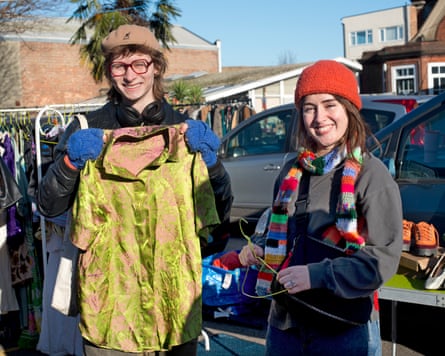
But like other social media platforms, reselling apps dictated by algorithmically fed content often promote overconsumption rather than a discipline of mindful, sustainable shopping. Emily Jenkins first opened her shop on Depop 10 years ago when she was a teenager. But now, she has retired the apps and exclusively sells at markets and car boots. “I can get a bit triggerhappy on Vinted – I think it’s quite addictive,” she says. “People want to get clothes that they know they’re actually going to wear. I think people are quite conscious about what they’re buying.”
Much of the increased interest is also due to the work of secondhand fashion influencers putting the British car boot on the digital map. Becky Chorlton, 27, a fashion reseller and car boot content creator from Cheshire, trails the country looking for the best bargains, and documents her journey online. “I’ve definitely noticed the popularity grow,” says Chorlton, who has made her hobby a full-time job, amassing more than 30m likes on TikTok.
Freddie Stoten, 25, a vintage clothing reseller who has been selling at car boots in and around London for seven years, has witnessed the shifting demographic and increased popularity, much to the benefit of his business pursuits. “There’s definitely been a spike,” he says. But there’s also a downside: “Seven years ago it was easier to buy better stuff. Now it’s a lot more competitive,” he says, while dealing with a haggling customer trying to get a vintage Nike jumper down to a fiver.
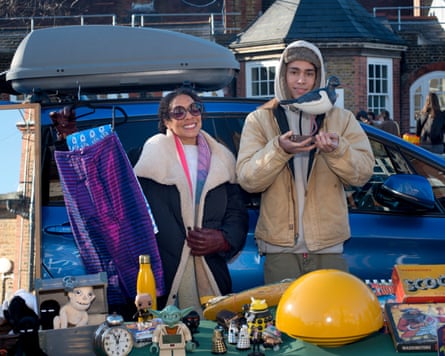
“From a selling perspective, it’s 10 times better because people are aware of it,” says Stoten. “There’s more footfall.”
Another factor, he says, is that “it’s basically the cheapest rent you’re going to get in comparison with storefronts and other markets”. Drive-in pitches at Balham car boot cost up to £35, with walk-ins £10 – a small price to pay compared with the elite ranks of Portobello Road, where securing a pitch apparently requires insider political power play, as well as the money – up to £50 on a Saturday.
Jenkins, 26, a frequent car boot seller, is shifting her stock of Y2K fur coats and vintage Vivienne Westwood crop tops. “It goes to Portobello first and then if it’s not gone there, it comes down here,” she says. “It starts at a fiver, up to about £25 – it’s nice getting rid of things cheaply. It means everything’s a lot less wasteful.”The communal aspect of meeting up in a car park on a Saturday morning will always be something reselling apps can’t replicate. “It’s a little bit like a community and it’s so much fun,” says Chorlton about her favourite car boot, Skirlington Market in East Yorkshire.
In Balham, Andrea, 51, and Dash Bradley, 15, a mother and son who have been going to car boots for years, echo this sentiment. “A lot of people are into getting secondhand clothes and using apps like Vinted, but you don’t get the full story behind what you’re buying and the physical person-to-person interactions,” says Dash.
“We love a car boot,” says Andrea. “But we were going to them before they were cool.”