3 months ago
68
3 months ago
68
Not long after being made Time magazine’s Person of the Year in 1999, Jeff Bezos told me: “They were not choosing me as much as they were choosing the internet, and me as a symbol.” A quarter of an increasingly dark century later, the Amazon founder is now a symbol of something else: how the ultra-rich can kill the news.
Job cuts in an industry that has struggled financially since the internet came into existence and killed its business model is hardly new, but last week’s brutal cull of hundreds of journalists at the Bezos-owned Washington Post marks a new low. The redundancies that were announced to staff on a video call, the axing of half its foreign bureau (including the war reporter in Ukraine) – not since P&O Ferries have layoffs been handled so badly. Former Post stalwart Paul Farhi described a decision that affected nearly half of the 790-strong workforce as “the biggest one-day wipeout of journalists in a generation”.
Why it happened is still baffling, at least for anyone not inside the head of one of the world’s richest men. Marty Baron, the Post’s former editor, highlighted the owner’s “sickening” efforts to curry favour with Donald Trump in a “case study in near-instant, self-inflicted brand destruction”. Slate magazine, owned by the Graham family (previous owners of the Post), accused Bezos of “accelerating the [Post’s] decline on purpose” because of “external economic interests” such as Amazon and Blue Origin, his space business. Perhaps he agreed to savage cuts because it showed he really was the boss, or just because he could. In any case, his ownership of the Washington Post is yet more proof, if needed, that owning a newspaper is not about money; it’s about power and influence. In other words, it’s about politics.
Bezos, with his $266bn fortune, doesn’t need the money that a newspaper might bring in; his interest payouts make the Washington Post’s $100m annual losses look like a rounding error. When he bought the paper in 2013, the age of Obama, Bezos splashed the cash on bonuses for reporters, used one of his private jets to collect reporter Jason Rezaian from an Iranian jail and travelled to Istanbul to make a speech about murdered columnist Jamal Khashoggi. Then, in the first age of Trump, who made no secret of his dislike for a paper known for bringing down corrupt presidents, Amazon lost a $10bn government computing contract. The resulting lawsuit blamed “improper pressure from President Donald J Trump … to harm his perceived political enemy – Jeffrey P Bezos”. (The US Department of Defense defended its selection process, saying there were no external influences.) The ability of Trump to use other means to flood the zone – social media run by himself or his big-tech pals – has made him even more dangerous in his second coming.
Last week’s news was the climax of a turbulent few years at the paper, notably since Bezos pulled the Post’s planned endorsement of Kamala Harris, Trump’s Democratic presidential rival, on the grounds that endorsements create distrust; and insisted on a more free market-friendly orientation in its opinion pages. The decision led, within days, to almost 250,000 subscribers deserting the paper.
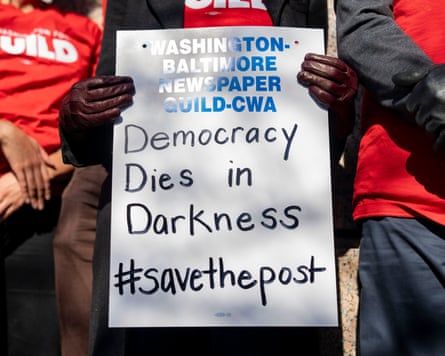
Anyway, all this seems to go to show that uber-wealthy owners in the news industry can’t be trusted to put private interests over the public good. Or, as the award-winning editor Tina Brown says of the Post debacle: “The purpose of having fuck-you money is to say fuck you, but it seems the purpose of fuck-you money is to have more fuck-you money.” And if the pesky newspaper that burnishes your reputation hurts your ability to make fuck-you money? Kill it – or at least let it fade into managed irrelevance.
So what are the alternatives? There has been no shortage of ideas among those who care about the future of journalism. One of my favourites is the suggestion that Bezos’s ex-wife, MacKenzie Scott, could pair up with other first wives of big-tech billionaires, such as Melinda French Gates, and use their divorce payouts to support the Post instead of their other philanthropic causes.
A better, though possibly just as unlikely, idea is for Bezos to erect some legal frameworks to protect editorial safeguards. The best guarantees are embedded into a trust-based ownership such as that enjoyed by the Guardian. He could just stick a tiny fraction of his planet-sized fortune into a trust and have nothing to do with it.
The most likely scenario is the most depressing for anyone who cares about freedom of the press. The Post will simply do less and less of the great journalism that has seen it lauded with Pulitzer prizes, until eventually no one thinks of it as the paper of Watergate any more.
The crisis at the Washington Post marks a turning point in this new age of disillusionment, an era in which the excitement of the early web has made way for shame and bewilderment at how much we lose by allowing the rich and powerful to kill the parts of society that make it function better.
-
Jane Martinson is an academic and Guardian columnist. She is a board member of the Scott Trust, which owns the Guardian Media Group, and writes in a personal capacity