4 hours ago
14
4 hours ago
14
I have no shame confessing that I’d be a crap companion during the apocalypse. My practical skills are limited, I’d be a right Debbie Downer and I don’t respond well to sharing food. Still, last November, two survival experts spent a morning making a valiant effort to prepare me for Armageddon deep in the rural Indiana countryside.
I had ventured to the US midwest to see the making of Apocalypse, an ambitious new Channel 4 reality series: an eight-parter following 16 people attempting to sustain themselves after an unexplained catastrophe from which only they appear to have survived.
I was to experience the abridged version: my training only lasted a couple of hours, whereas the real participants will get three days of prep. They’ll then have to endure a month in the doomsday simulation. I only had to muddle on until dinnertime.
After an hour spent in a gravel-pit junkyard, I could (theoretically) build a shower and make a torch with scavenged items. I’d learned how to open a tin of pilchards sans can opener (thwack it on concrete) and to start a fire without a lighter or matches (twigs, maybe?). Induction over, I was blindfolded and bundled into a minivan. We stopped, and I was shoved out, just as the show’s participants would be. As I peeled off my mask, I saw for the first time the extraordinary location in which Apocalypse is set: a thousand-acre abandoned town comprising hundreds of individual buildings.
The fictional town of Riverside wasn’t built from scratch for the show. The production took over Muscatatuck Urban Training Center, about 70 miles west of Cincinnati, a site usually used by police and military groups to train in urban warfare.
There were no Big Brother-style CCTV cameras on set; kitting out the vast site would be impossible. Instead, a small team of producer-directors would live among Riverside’s residents, documenting every moment.
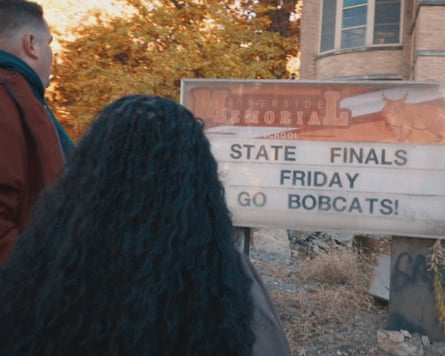
Out there in Riverside on my own, in a state of mild peril, I started to explore. I walked past burnt-out vehicles and the remnants of a tanning salon; a multistorey car park and a smashed-up cop car. The Riverside Memorial High School building looked as if it had been ransacked. In every corner of every room in the hospital, I found meticulous attention to detail: IV drips, dusty bedpans, even a game of Twister left on its otherwise looted gift-shop shelves.
Series producer Jake Smith was tasked with turning the training centre into a live-in stage. “I had to imagine what people might actually do in there,” he said, “start plotting out imaginary storylines: if they found this, what could they do?” He watched “grim” survival shows on YouTube and took inspiration from prepper content. Yes, scarcity of life’s essentials would see contestants struggle for our titillation, “but I also want there to be comedy and joy with the dark”.
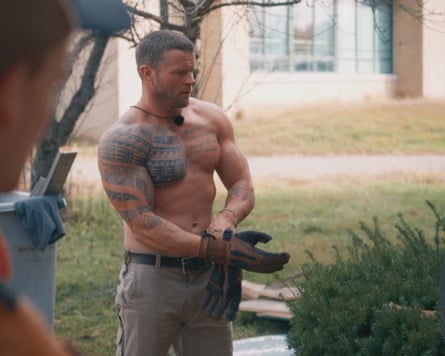
Alongside functional necessities, Smith’s team included some surprises. A battery-powered candy floss machine was squirrelled away. “It’s so unexpected in an apocalypse context,” he said, “that I can envisage a funny scene if they find it.” There was also a disco ball, a dozen Christmas crackers, a record player and one record (Dancing Queen by Abba). Inside the bus station was a broken ATM, next to which Smith sprinkled $200 in cash. “They may talk about what it’s like to be in a world where money means nothing,” he said, “or how society could function differently.” They might just use the bills as toilet paper.
Whether or not these potential plot points are discovered – and what happens if they are – is beyond Smith’s control. “That’s what I love about this,” he said. “It’s not formatted, like so much TV now. No elimination votes or must-win, set-up challenge.” There’s no prize money either. So much TV today feels “rinse and repeat”, he explained. “The Traitors comes out, then suddenly every network’s trying to do their version.” Granted, survival shows have been on our screens for more than a quarter of a century, “but a derelict city is a new environment. We’ve built it; now it’s over to them. We will see what they come up with in this ‘choose your own adventure’ world.”
As for my own adventure? Let loose around the town, I walked for miles past a railway station (train included), a church, a prison, a motel and a lake with cars semi-submerged in water. It was like I’d been dropped inside a video game, only without instructions. Even the edges of its seemingly limitless playable area only became visible when I rubbed up against them: doors that didn’t open, walls that curved away from me, a row of stacked shipping containers blocking off the horizon.
Darkness was approaching when the producers rescued me. I’d found no water, no source of heat, no tin of pilchards. There’d been talk of me spending the night on site – I’m not convinced I would have made it through. If I’d been caught on camera, my ineptitude might well have made for compelling watching, but it would have felt somewhat sadistic, too.
Later I watched in production HQ as the participants entered. A wall of screens beamed back a series of live feeds, which a team monitored day and night. On one wall was a large white sheet split into 28 daily sections and titled “Architects of the apocalypse”. It’s here that storylines and character arcs would be produced in real time.
Executive producers Jo Harcourt-Smith and Tim Whitwell spent years trying to get access to the site. With about 85% of the UK’s population living in urban areas, Harcourt-Smith felt that “if shit does hit the fan, it’s going to be in towns and cities that we all end up having to survive. We wanted to find out what that would be like.”
“We’re interested in some of the practicalities and processes,” says Whitwell, “but it’s all about how you feel when you’re in this situation. We’ve created a playground in which ordinary people will experience something extraordinary.”
Months later I found myself mulling over this noble cause as I watched early episodes in which TV archetypes – blokey chef, heroic Paralympian, Welsh farmer, clueless posh man – muddle through with the content creators. The participants fail and succeed, fight and bond, cry and laugh. They go to the loo in buckets.
The series is firmly in the “factual-entertainment” reality television genre, in which human stories and emotions are evoked for the viewer’s enjoyment. It’s in the canon alongside The Island with Bear Grylls (Whitwell was an executive producer), ITV’s Survivor from 2001-2 and early iterations of Shipwrecked.
But in an era when the ethics of reality television are being increasingly scrutinised, how can viewer pleasure be squared with participant discomfort? What differentiates a worthwhile endeavour from a circus of manipulation?
Su Holmes, a University of East Anglia professor and TV historian, tells me this tension has always been present, even in the earliest days of “fact-ent”. She points to prank show Candid Camera, which aired in the US in 1948, and the American quiz show scandals of the 1950s in which rigged outcomes and scripted performances caused national outrage. “Questions always arise when ‘ordinary’ people are put in a constructed reality,” she says. “How much is manufactured – real emotion versus performance? Where is the tipping point into exploitation?”
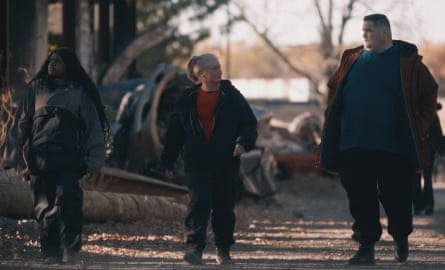
In the early days of reality TV, cast members had little concept of what it meant to be televised. Now contributors enter these environments eyes open. Few believe they’ll become overnight celebrities, and most understand the basic concept of an edit. A genuine interest in a money-can’t-buy experience remains a pull, as does the prospect of leveraging the exposure. Every Apocalypse participant I speak to after filming gushes about their time in Riverside.
“It totally changed my perspective,” TikToker Steven Mckell tells me. “There, finding a bag of rice was the greatest feeling – it makes you appreciate the small things. I learned to be more in the moment, to let my guard down.” Cabbie Brooke McCreaner shares a similar sentiment. “I’ve been through the trenches. I’ve had some struggles. To be stripped of everything? It was the opportunity of a lifetime. I would go back in a heartbeat,” she says.
Promotional material for Apocalypse bills it as “a bold and ambitious social experiment”. Broadcasters such as Channel 4 and the BBC have always framed fact-ent in lofty terms, Holmes believes, to justify the shows in their public service remit. “Look at the early 2000s adverts for Big Brother,” she says. “It’s not ‘Come gawp at these people’ – it was framed as a social experiment.”
That’s not a criticism, she is quick to add. Holmes is a reality TV super-fan. She argues that “these shows can be exploitative and commercialised and raise important questions, explore complex themes and expose ideas about society like nothing else can”.
Back in Muscatatuck, as soon as the show’s participants-slash-human guinea pigs were let loose, I couldn’t tear my eyes away from the action. I wanted to see them succeed but also to witness their strains and blunders, how they coped with exhaustion and hunger; that first moment when they clocked that across the endless acres there wasn’t a single flushing loo.
Prying on pressured human emotions may for ever be ethically dubious. That doesn’t make it any less engrossing. Fact-ent shows get greenlit because we keep watching them. And while that’s the case, I’d prefer to tune into shows that at least attempt to make my voyeurism feel vaguely worthwhile.
Apocalypse starts on Channel 4, 13 September, 9pm.