2 months ago
50
2 months ago
50
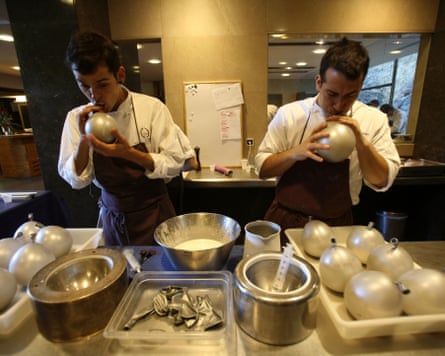
Catalonia’s avant garde chefs have made a name for themselves with their revolutionary techniques and molecular gastronomy, yet they are fond of saying they are merely paying homage to the simple dishes served at their grandmother’s table.
Maybe so, but now the grannies have been given a chance to show off the real thing under a Catalan government initiative called Gastrosàvies.
A double play on the Catalan words for wise and grandmother, Gastrosàvies provides a platform for more than 100 women of a certain age to share videos cooking traditional dishes “with a view to preserving and communicating traditional Catalan cuisine for future generations”.
No spherification and liquid nitrogen for these chefs – just some basic ingredients, a sharp knife and a couple of pots and pans.
The project has collected more than 300 recipes from all over Catalonia, and videos of home cooks preparing 12 of them have been posted on the Gastrosàvies website, with more to follow.
These simple creations such as rice with cabbage and peas, thyme soup, chicken with apple, duck with turnips or pork chops with chestnuts hark back to an era where people cooked with what was at hand and in season, using basic equipment and techniques handed down over generations.
While these rustic dishes can still be found in bars and restaurants in rural Catalonia, they are increasingly hard to come by in Barcelona where they have been usurped by pizza, kebabs, ramen, sushi and the ubiquitous Argentinian empanadas.
Working in her farm house kitchen in the village of Santa Margarida i els Monjos in Penedès, a region 45 minutes south of Barcelona, Maria Antònia Udina, 76, prepares a Penedès cockerel with dried fruit and nuts and a dash of cognac, a dish characteristic of Catalan cuisine.
“Catalonia is small but we have mountains and sea and we like mixing the two,” she says. “That’s why we cook meat with fruit or meat with fish in dishes such as meatballs with cuttlefish, chicken with prawns or xató, a salad made with frisee, salt cod, tuna and romesco sauce.”
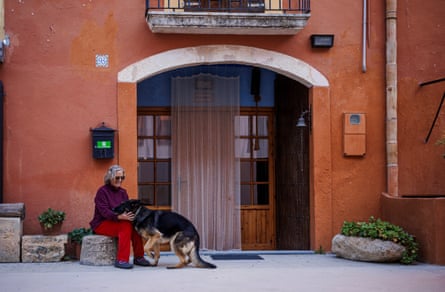
Udina’s mother cooked for her and her five siblings, “simple dishes with local products, a lot of potatoes, a lot of rice. We did the dishes and laid the table but my mother did the cooking. I didn’t really know how to cook. I wasn’t a good eater as a child but I loved mashed potatoes with a bit of oil poured over them.”
She is also a champion of local produce such as the Penedès cockerel that she and her husband farmed until a few years ago. She says the Penedès variety has more flavour and a better texture than supermarket chicken because it’s reared for twice as long and is fed on grape seeds from local vineyards.
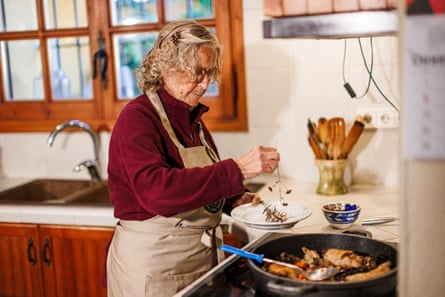
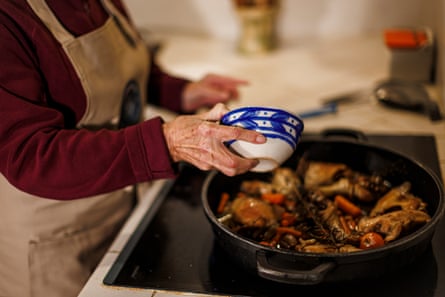
She lists what in her view are Catalan cuisine’s three essential characteristics: the sofregit made with olive oil, onions, tomatoes and sometimes peppers or carrots, which is the ground zero of dozens of dishes; the use of herbs such as rosemary, bay and thyme, and finally the picada, a paste made from olive oil, ground almonds or hazelnuts, garlic, parsley and fried bread, served as an accompaniment to many dishes and a key ingredient in suquet de peix, the Catalan version of bouillabaisse.
Although Udina has a reputation as an excellent cook, she has never worked as a professional chef. However, she has dined in some of the region’s most famous restaurants, among them Can Fabes, the first in Catalonia to be awarded three Michelin stars, and El Celler de Can Roca, twice voted the best restaurant in the world.
She admires these avant garde chefs and accepts that their cuisine is rooted in tradition. However, she is sceptical about the claim that it’s simply a homage to their mother’s and grandmother’s tables.
For example, Udina says, wild mushrooms are a staple of Catalan cooking but at Can Fabes, “we had six or seven dishes that were all made with wild mushrooms, including an ice-cream”.
“That’s nothing like what their mothers would have cooked,” she says, adding that she believes there’s a move back towards simpler, less innovative cuisine and hopes that Gastrosàvies will encourage “our children and grandchildren to cook traditional food instead of pizza, hamburgers and Pot Noodles”.