3 months ago
96
3 months ago
96
Some of my earliest memories feature my mother’s leotard-encased body bouncing to Jane Fonda with abandon. A similar carefree fluidity prevailed a decade later, as her feet struck hard-packed sand on a shorebreak jog. Twelve-year-old me panted alongside, so desperate to be made in her image that I tolerated heated cheeks and shaking quads. Their trembling barely subsided during the one stop we made, for her to wade into the waves and pee.
But it got easier to keep up after she gave birth to my youngest brother, with her squatting in the bushes every 10 minutes or so. Soon, even that wasn’t enough to staunch the flow. She gave up and switched to hiking. “I should have done more Kegels,” she quipped.
And that’s how I learned – before I’d even taken the SAT – about the repetitive undercarriage squeezing recommended for millions of Americans.
I recently learned something else: women don’t have to live like this.
Arnold Kegel was born in Iowa in 1894 and by the mid-20th century, he was a professor of gynecology in southern California. For context, in 1948 the New York Obstetrical Society refused to admit women, and as late as 1970 only 7% of gynecologists were female. So it makes sense that a man created “the vaginal manometer” to record the strength of contractions of the pelvic floor muscles.
They weaken over time as a result of things like surgery, pregnancy, vaginal delivery, smoking, and just plain ageing while female. Kegel is credited with first describing how exercising these muscles can reduce the type of urinary incontinence that comes with a stressor, like aerobics or jogging on the beach.
If only it were as simple as that sounds.
Eventually it was my turn for stress urinary incontinence (SUI). After five pregnancies and three deliveries, coughing while walking would leave me in want of fresh panties. I told my friends I could walk without peeing and I could cough without peeing, but stood no chance against two abdominal stressors at once. “Have you done your Kegels?” they’d ask.
A few more years ticked by, and after a lap at the track I’d be so wet that it looked like I’d put my pants on over a damp bathing suit. “You’ve been doing Kegels though, right?” a friend texted in response to one of my pandemic-era rants.
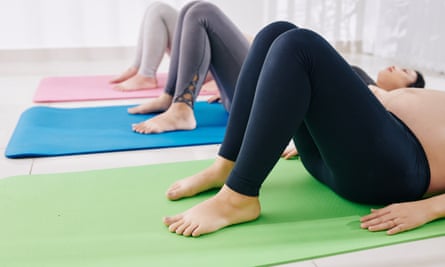
Eventually, I started paying about $90 a month to access online videos involving hip lifting and squeezing. I only did it once. By the time I turned 43, I had to wear black leggings on my Sunday morning runs so the dark outline that extended all the way to my knees wouldn’t be so stark.
I never mentioned my incontinence at a doctor’s appointment, and no one asked. I assumed this was just the price I had to pay for procreating – and for failing to do my Kegels. I was the one who’d signed up for the course and not done my homework so I didn’t question the narrative of midlife incontinence being a mixture of my fault and my destiny. But what if I should have? What if a catastrophic failure of women’s health and wellness has occurred?
Spoiler alert: I should have, it has, and once I figured that out, a few quick office visits changed my life.
No more suffering in silence
The first part of my story, the silent suffering, is hardly unique. About 45% to 50% of women experience SUI at least once a week. Think of it this way: If you make 10 of us skip rope, at least four will later slink off to a bathroom to wrap toilet paper around the crotch of our undies. But not to a doctor’s office, research suggests. One report estimates that for every case of incontinence reported to primary care doctors, 20 go unreported. Transgender men on hormone therapy also often experience SUI, according to preliminary research. Some cis men struggle with SUI too, usually after treatment for prostate cancer, but many, many fewer of them.
For years, I just sucked it up, idiomatically and also literally, with the tissues I carried everywhere. Then one Sunday in February of 2024, something clicked. I’d run a 10K, rather than my usual 5K, on a path way out by the water, too far to make it home to change before church. Tissues it is then. The entryway smelled like urine, but I didn’t think much of it, with all the older folks there to worship. The elevator also reeked. As I moved through more spaces, a terrible realization swept over me. I whispered in my husband’s ear: “Is that odor me?” His widened, almost guilt-ridden eyes were my answer.
Later that same evening, I sat in bed, showered and fresh. Until I sneezed. After a few moments of disbelief, staring down at my wet pajama shorts, I decided enough was enough. The next morning, I called University of California, San Francisco’s Women’s Center for Bladder and Pelvic Health.
“I can’t even do one thing without peeing any more,” I told Dr Michelle Van Kuiken, less than two weeks later. Apparently, I had four main options: (1) pelvic floor muscle training (PFMT), which is more than Kegels, but also, is Kegels, (2) the Poise Impressa, a tampon-like contraption you can insert into your vagina in order to “gently lift and support the urethra”, according to its promotional materials, (3) bulking agent, sort of like lip fillers, but injected into the tissues of the urethra to make the opening smaller, and (4) the “sling”, a gold-standard surgery that creates a hammock for the urethra.
I quickly ruled out PFMT, having written “do Kegels” on my to-do list for the previous seven years and not getting them to-done. The second option seemed silly, given the bedtime incident. Was I supposed to sprint to the bathroom cabinet for an Impressa when I felt a sneeze coming on? The surgery could last me decades (only about 2.5% of women need a new one after 10 years and less than 20% have re-upped at 15 years), but it would require general anesthesia with its attendant risks, and I wouldn’t be able to exercise for two weeks or have sex for at least four. Exercise is my antidepressant! So is sex!
That left the fillers, what doctors call a “submucosal bulking agent”. Dr Van Kuiken’s staff made a quick call to my insurance company for approval, and told me I could receive the injection the same day.
She warned me that it could end up taking me longer to pee and asked what would bug me more: that delay or leakage? She also offered a heads-up that it would hurt. I figured short-term pain sucks, but after childbirth, I can handle it. And you know what would suck more? Ending up like my grandma, whose bulky adult diapers made a crinkling sound when she sat, yet still weren’t effective enough for her to be comfortable in public. Not wanting that kind of isolation, I decided fillers were worth a try.

With my feet in stirrups and a drape spread over my knees, the ghost of pap smears past floated in the air. Starting the same way my IUD insertions had, Dr Van Kuiken first injected lidocaine to numb my urethra and its surrounding tissues. That burned some, like a vaccine, only unfortunately placed. While we waited for it to take effect, she explained that my urethra was sort of like a deflated, doughnut-shaped pool float. By spacing four injections just right, she could plump it up without leaving a low side. Now, those injections? Those hurt quite a bit: Think bee sting plus bikini wax for at least 15 seconds each. Still, when they were done, they were done. The whole thing was no worse than a facial laser treatment like broadband light therapy, and I soon walked comfortably home.
The next day, I went for a run with the aforementioned baby brother, who’s now 31. Nothing. Not a drop. At the tail end of a jog with one of my teenage daughters a few weeks later, I tried to sprint and felt a familiar dribble. So I went back to Dr Van Kuiken, and four weeks after the initial procedure she injected about 30% more Bulkamid. (It’s not uncommon for women to need a “top-off” injection to achieve results and durability.)
I hardly realized I’d come to fear leakage, until all of a sudden I didn’t. I had no idea my gait had changed to try to minimize wetness, until my stride lengthened in the months after the procedures. The way I held my abdomen shifted, as did my times, soon matching my high school best, and then faster. I started running more – and having more fun doing it. It’s been more than a year now, and I’ve completed seven half marathons on trails up and down mountains. Without. A. Drop. And straight to church I can go, with nary a worry or a tissue.
In other words, a quick, safe, minimally invasive, and cost-effective procedure eliminated my incontinence and significantly improved my quality of life. And here’s the kicker: When Dr Van Kuiken did my physical exam, after I’d already chosen fillers, she said: “Your pelvic floor is actually really strong. No amount of Kegels was going to fix this for you.”

Why don’t more women know about treatment options?
It took me years to get good care, but more than that, years to even find out a solution existed. It doesn’t have to be this way. As one group of researchers summed it up: “SUI is not part of normal ageing and can be remedied.”
But most women don’t know that. One study suggests that less than 15% of those bothered by SUI receive an injection or surgery. Anecdotally, that statistic rings true: every last one of the people I told about my procedures said they had no idea such a thing was possible.
You’d think that’s because the FDA only approved Bulkamid in 2020, but bulking agents were first used in the 1930s. Innovations in the late 80s made them a more viable option, and now, they can sometimes last 96 months or more for those who are eligible. (Doctors won’t inject bulking agent if, for example, you have an active urinary tract infection.) That can mean eight years of staying dry, or much drier, while belly laughing or lifting a squirmy baby. Most women also don’t know that using synthetic mesh in sling operations starting in 1996 eliminated the need for an abdominal incision and an overnight stay. They don’t know that hormones can affect SUI. We just don’t know.
We believe Kegels are it. As it turns out, Dr Van Kuiken is a big fan of PFMT as a risk-free option. But its efficacy for SUI depends on the cause and severity of the incontinence. What’s more, that acronym encapsulates a lot of different practices, so different that researchers don’t actually know how effective PFMT is. PFMT with biofeedback, for example, has been shown to work better than without it. In plain English, that means Kegel-like therapies can work for SUI, but doctors don’t know how often or how well they do work, especially since the exercises can be time-consuming. In one study, researchers asked women to do exercises for 45 minutes a day. I’m not the only one for whom that’s never going to happen. As one friend put it in a text: “They just told me to do kegals which I don’t.”
And shame keeps women from learning about other options. Women who do come forward are often told to lose weight or cut out alcohol or sweeteners. Sometimes they’re instructed to drink more water, sometimes less. Sometimes to avoid tea, but maybe add in decaffeinated coffee. Each of these “behavioral and lifestyle” recommendations can be read to imply that a woman is suffering because she’s been lazy or made bad decisions about what she puts in her mouth.
That feels gendered. When men have a quality-of-life issue, we try to fix it. (Hello, Viagra.) When women have a problem, we tell them they wouldn’t if they’d just been a bit better and tried a bit harder, and also, to just deal. (Combine those Kegels with “belted undergarments” and pricey med-spa treatments, ladies!) I’m exaggerating somewhat, but also, there are real disparities in funding for research on women’s health, female inclusion in clinical trials, and more.
For me, finally receiving the right care was life-altering. After yearning to be just like my mother for so long, starting to pee myself seemed like a particularly embarrassing case of “be careful what you wish for.” But not any more. Now, I’m high and dry, even on a trampoline.
When my bulking injections wear off in a few years, I’ll probably ask for more. Although, maybe I’ll be like my mom, who at age 75 hops on to the treadmill unworried. She got the sling surgery.