3 months ago
74
3 months ago
74
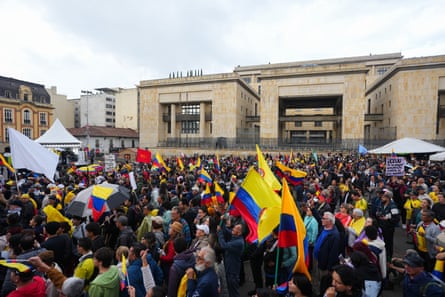
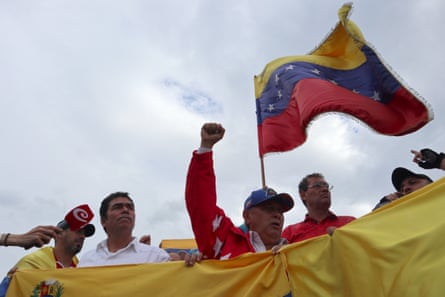
Thousands of protesters have taken to the streets of cities across Colombia to decry Donald Trump’s threats to expand his military campaign in South America into their territory, after last weekend’s deadly attack on Venezuela.
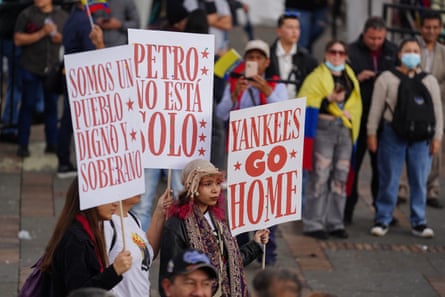
In Cúcuta, a city on Colombia’s eastern border with Venezuela, several hundred demonstrators marched towards its 19th century cathedral waving the country’s yellow, blue and red flag and shouting: “Fuera los yanquis!” (“Out with the Yanks!”)
“Trump is the devil … he’s the most abhorrent person in the world,” said one demonstrator, a 55-year-old businesswoman called Janet Chacón.
Another marcher, José Silva, 67, said the abduction of Venezuela’s president, Nicolás Maduro, during Saturday’s attack made a mockery of Trump’s claim to be “the president of peace”.
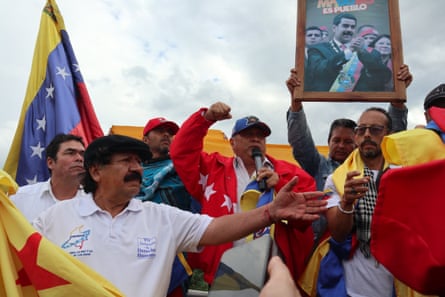
“He’s the president of war … he’s a maniac,” Silva declared. “The US congress needs to do something to get him out of the presidency … He’s a thug.”
Colombia’s leftwing president, Gustavo Petro, called Wednesday’s rallies after Trump indicated he favoured the idea of military action in Colombia, after Saturday’s audacious assault on Venezuela’s capital. Venezuela’s president, Nicolás Maduro, and first lady Cilia Flores were captured, while dozens of Cuban and Venezuelan bodyguards were killed, during the dramatic US special forces raid on a military base in Caracas.
“What happened in Venezuela was, in my opinion illegal,” Petro told thousands of supporters who had gathered at a rally in Bolívar plaza in Colombia’s capital, Bogotá.
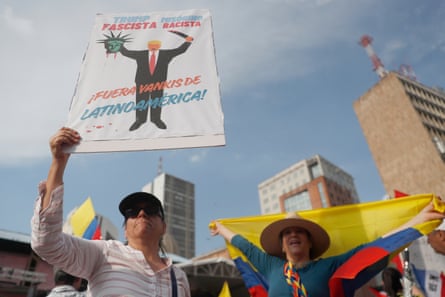
In front of the stage a protester held a placard reading: “Go to hell shitty yanks”. However, Petro took a less combative line after talking to Trump for the first time, shortly before his public statement.
“It was a great honor to speak with the president of Colombia … I appreciated his call and tone, and look forward to meeting him in the near future,” Trump wrote on his social media platform Truth Social.
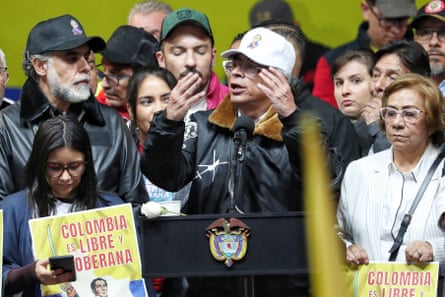
Petro indicated he was willing to meet Trump but added: “We cannot lower our guard.”
“Words need to be followed by deeds,” he added.
On Sunday Trump called Petro “a sick man who likes making cocaine and selling it to the United States” – although there is no evidence Colombia’s leader is linked to the drug trade in his country, the world’s largest producer of cocaine. Asked if he would consider a Venezuela-style military intervention in Colombia, Trump told reporters: “It sounds good to me.”
Trump’s attack on Venezuela – which he has admitted was in-part designed to secure “total access” to Venezuela’s massive oil reserves – and subsequent threats to Colombia have sent shock waves through Latin America. Demonstrators have this week hit the streets of cities including Mexico City, São Paulo and Buenos Aires to condemn the “Yankee invasion” and the possibility of further attacks.
“The message from the people of Latin America is: ‘Donald Trump, get your hands off Latin America. Latin America isn’t the US’ back yard’,” said Reimont Otoni, a leftwing Brazilian congressman who led protests outside the US consulate in Rio on Monday.
Otoni recognised Venezuela faced “a humanitarian and a democratic crisis” under Maduro. “[But] there isn’t the slightest chance that an aerial bombardment or the kidnapping of a country’s president … will fix this,” he said, condemning the failure of European leaders to denounce Trump’s intervention. “This is simply an assertion of North American imperialism … Trump wants to seize control of the biggest oil reserves in the world … and dominate Venezuela.”
There was similar anger on Colombia’s streets during Wednesday’s marches, which the US embassy urged its citizens to avoid, claiming they had “the potential to turn violent”.
“He doesn’t want to liberate Venezuela. He just wants the oil,” Marta Jiménez, a 65-year-old teacher, said of Trump as she stood in Cúcuta’s palm-dotted Santander Plaza.
Jiménez slammed the international community’s failure to confront Trump. “They are leaving him to fly, free as a bird over every single country, to do whatever he likes,” she said, warning that while Venezuela and Colombia were Trump’s current targets, any Latin American nation could be the next.
“It might be Nicaragua, Brazil, Ecuador, Peru – any of them,” she said.
Another protester called Juan Carlos Silva, 59, feared that after the US attacked Venezuela, “they are coming for Colombia”. “We’re not against North America. There are lots of good people there. But this guy [Trump] is possessed by the devil,” he said.
Silva recognised Maduro had been a dictator. But he believed Trump was more dangerous. “He’s trying to cause a third world war, just like Hitler did. He’s a fiend and he must be stopped.”
Trump’s night-time assault on Caracas was by far the most dramatic of his interventions in Latin America since he returned to power one year ago. But it was by no means the first.
In his inaugural address last January, the US president vowed to “take back” the Panama canal. He subsequently launched a pressure campaign of sanctions and tariffs against Brazil’s government in a failed bid to help his far-right ally, Jair Bolsonaro, escape jail for plotting a coup.
Trump also waded into last month’s presidential election in Honduras, in support of the eventual right-wing winner, and offered an ideologically motivated multi-billion dollar bailout to Argentina’s right-wing president, Javier Milei.
On Sunday Trump hinted at military action in Mexico to combat its drug cartels, telling reporters: “We’re going to have to do something.”
Asked this week if Trump’s next target might be Cuba, his secretary of state, Marco Rubio, replied: “They are in a lot of trouble, yes.”
Trump’s moves have horrified Latin American diplomats, who fear a further US attack on Venezuela is possible. One called the White House’s behaviour “unhinged”.
Benjamin Gedan, the South America director at the national security council under Barack Obama, said Trump had shown himself to be “astoundingly disinterested in US diplomatic relationships and the US image in the world”.
“He has demonstrated absolutely no concern for the way the United States is viewed and for its relationships with governments of the region. He has concluded that he can bully governments into submission and that public opinion is meaningless and that soft power is irrelevant … It’s a bizarre approach to a region that he himself has identified as strategically important for the United States,” added Gedan, the director of the Latin America Program at the Stimson Center. “It seems like Trump goes out of his way to maximise the diplomatic wreckage.”
Gedan said Trump could have tried to portray his capture of the “universally loathed” Maduro as a boon for democracy.
“But instead of making a case or even gesturing toward democracy and human rights, he immediately pivots to a resource grab, alienating almost any potential ally who wants to make the case that this person should be gone for the interests of the country, its people, and the region. What leader in Latin America can sign on to this operation in the interest of the US oil sector?” Gedan asked.