3 months ago
59
3 months ago
59
There are few British comedy shows that were as popular, yet now completely extinct, as Phoenix Nights. The sitcom – which ran for just two series between 2001-2002 – is set in a fictional working men’s club in Bolton, and was a huge hit of the physical media era. Its second series was once the fastest ever selling UK TV show on DVD, shifting 160,000 copies in its first week of release. However, it is now 25 years since it was first broadcast on Channel 4, and it does not feature, nor has it ever, on any streaming service. Instead, it’s confined to dodgy fan uploads on YouTube and the secondhand DVD market. It is also almost entirely absent from all of the major publications’ best TV of the 21st century listicles.
Nevertheless, it remains a programme like few others. Distinctly northern and working class, it crucially uses neither as the butt of its jokes. In the same way that The Royle Family turned the everyday routine of watching TV, bickering, having a brew and asking each other what they had for tea into a relatably funny yet poignant shared living-room experience, Phoenix Nights invites people through its sparkling tinsel curtains into the familiar yet fading glory of clubland.

The show is a spin-off from an episode of That Peter Kay Thing, the 1999 spoof documentary series, and was written by Kay, Dave Spikey and Neil Fitzmaurice. Kay plays the lead, Brian Potter, a choleric, acerbic yet bitingly funny club owner who, when not busy being a ceaseless cheapskate, can be found rolling around the club in his wheelchair topping up his whisky glass – which is a flower vase, so that he can reach the optics on the top shelf.
Loaded with eccentric characters, wonderful details and sharp-eyed observations, it is material plucked straight from smoke-filled bingo halls and dilapidated function rooms. A world of curled sandwiches at daytime wakes, as people rest pints on coffin lids and fruit machines bleep away, clashing with blaring TVs, the clack of pool balls and the idle chat of regulars. Over 12 episodes, the club encounters a drunk horse during a themed wild west night, guest spots from Catchphrase’s Roy Walker and Bullseye’s Jim Bowen. There’s even a kid’s playground concocted around a portable toilet and scaffolding in the car park, complete with a poorly disguised adult-themed bouncy castle.
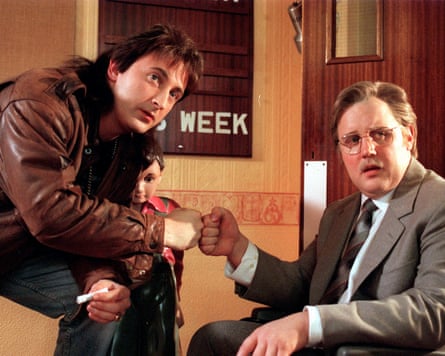
While the show has become synonymous with its most famous star – Kay also plays one half of the bumbling bouncer duo, Max and Paddy, with Paddy McGuinness – it really is an ensemble comedy that succeeds due to the eclectic figures that fill the club. There’s Ray Von (Fitzmaurice), an enthusiastic DJ, dodgy electrician and rumoured murderer; Jerry St Clair (Spikey), the long-suffering club compere who finds himself singing about bin bags in Asda; compulsive liar Kenny Senior (Archie Kelly); the hapless clairvoyant Clinton Baptiste (Alex Lowe); Holy Mary (Janice Connolly), the club’s strict catholic barmaid; and the obnoxious cigar-chomping Den Perry (Ted Robbins), who is Potter’s arch-nemesis and rival club owner. Phoenix Nights is a contained and intimate sitcom, but it’s bursting at the seams with unique characters that make up the club’s hodgepodge community.
One character, Keith Lard – an overly officious fire safety officer who is rumoured to be engaged in bestiality with dogs – landed the show in trouble. Keith Laird, a real-life fire safety officer in Bolton, complained and was paid compensation, forcing Channel 4 to issue an apology despite Kay insisting the character was fictional.
Understandably, for a show that is a quarter of a century old and based around a working men’s club – a culture which peaked decades earlier – there’s some material that wouldn’t fly today. The second series notably dips in quality and the poor choice to write in a couple of problematic Chinese immigrant characters led to deserved criticisms, even from a member of its own cast. The alternative comedian Daniel Kitson, who played barman Spencer, called the show “lazy and racist”.

Such views have unquestionably affected the reputation and legacy of the show, with Kay recently saying he wouldn’t want it on streaming sites like Netflix as it would likely need a content warning these days. However, in retrospect, the show is much softer, and dafter, at its heart than the wider TV comedy landscape of the 2000s. In an era where Black face was still happening, sexism was rife, and many shows were rooted in nasty humiliation and cruel demonisation, Phoenix Nights, for the most part, offered a comforting antidote.
Flawed, sure, but it remains something of an anomaly in British TV. It carved out a singular space in a corner of the comedy world – in terms of region, class and content – that is frequently shunned by mainstream broadcasters. Twenty-five years on, with depressingly low numbers of working-class people working in, and on, TV, a comedy show that felt like a one-off at the time, continues to be. So maybe it’s time to swing by your local charity shop to see if you can find the DVD of this increasingly forgotten gem.