3 months ago
70
3 months ago
70
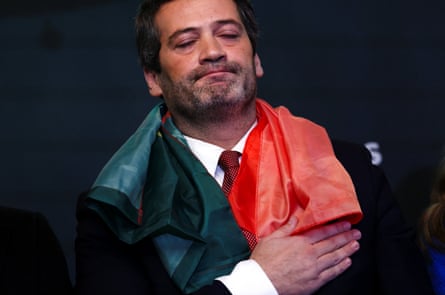
The moderate socialist António José Seguro won a resounding victory in the second round of Portugal’s presidential election on Sunday, triumphing over his far-right opponent, André Ventura, whose Chega party still managed to take a record share of the vote.
Seguro won 66.8% of votes to Ventura’s 33.2% in the election, which went ahead despite weeks of disruption caused by deadly storms. The vote to elect a successor to the outgoing president, Marcelo Rebelo de Sousa, was marked by a cross-party push to head off the prospect of a Chega victory, with some senior rightwing figures throwing their weight behind the centre-left candidate to keep Ventura from entering the presidential palace.
“The response the Portuguese people gave today, their commitment to freedom, democracy, and the future of our country, leaves me naturally moved and proud of our nation,” said Seguro.
Ventura, a former football pundit, columnist, seminarian and novelist who founded Chega seven years ago, said the result showed that “the message from the Portuguese people is clear”, adding that Chega was now the main party on the right and would “soon be governing Portugal”. Earlier on Sunday, he had accused “the entire political system” of uniting against him.
The far-right, anti-establishment party had once again sought to make immigration a key issue in the campaign, setting up billboards across the country that read “This isn’t Bangladesh” and “Immigrants shouldn’t be allowed to live on welfare”.
Chega’s result far exceeds the 22.8% it won at last May’s general election – and the 31.2% that the governing, centre-right Democratic Alliance took to win that election and propel Luís Montenegro to office as prime minister.
European leaders were quick to offer Seguro their congratulations. France’s president, Emmanuel Macron, said he looked forward to working with his new Portuguese counterpart to serve “a Europe that decides for itself, and is more competitive, more sovereign, and stronger!”.
Ursula von der Leyen, the president of the European Commission, said the fact that Portuguese citizens had exercised their right to vote “in the face of the devastation caused by the storms, demonstrated remarkable democratic resilience”. She added: “Portugal’s voice in defending our shared European values remains strong.”
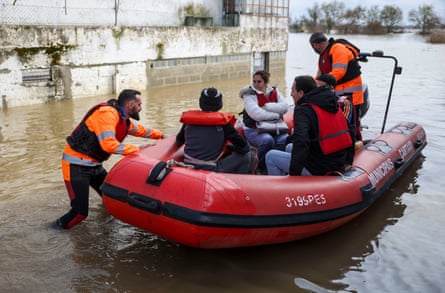
The campaign for the second round of the election was overshadowed by two major storms that prompted the declaration of a state of calamity that has been extended to 15 February. Ventura had called for the vote to be delayed by a week, calling it “a matter of equality among all Portuguese”.
But the national electoral authority said the vote would go ahead as scheduled, saying: “A state of calamity, weather alerts or overall unfavourable situations are not in themselves a sufficient reason to postpone voting in a town or region.”
Nevertheless, the aftermath of Storm Leonardo led about 20 badly hit constituencies to postpone the vote by a week. The postponement affected about 37,000 registered voters – about 0.3% of the total – and is unlikely to influence the overall result.
Portugal’s presidency is a largely ceremonial role but holds some important powers, including the ability to dissolve parliament under certain circumstances. Ventura had said he would be a more “interventionist” president, advocating increased powers for the head of state.
Seguro had positioned himself as a moderate candidate who would cooperate with Montenegro’s centre-right minority government, repudiating Ventura’s populist, anti-immigrant tirades.
The far right also put up a strong showing over the border in Spain, where Vox doubled its seat count to finish third in an election held in the north-eastern region of Aragón.
The incumbent, conservative People’s party (PP), which won the election despite losing two seats, will again need Vox’s support to govern the region. The Spanish Socialist Workers’ party of the prime minister, Pedro Sánchez, finished second and lost five seats.
Sánchez, whose inner circle and party have been battered by a succession of corruption allegations, congratulated the PP candidate, Jorge Azcón, but insisted the socialists remained “the only progressive alternative”.
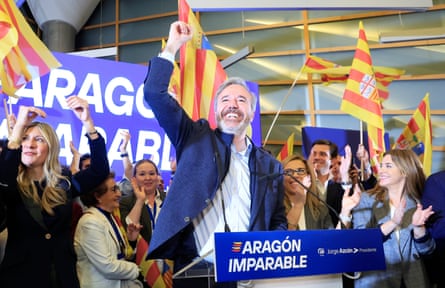
The PP’s leader, Alberto Núñez Feijóo, said the result was proof of the prime minister’s waning support. “How many more collapses does Sánchez need before he understands that enough’s enough?” he said.
Santiago Abascal, the leader of Vox, said his party was prepared to work with the PP but only if it adopted a tougher line on immigration. Disagreements over the issue led Vox to abandon its coalitions with the PP in five regions in 2024.
“If the PP wants to change its policies, it can count on us,” said Abascal. “But if the PP wants to continue with the policies that led us to quit the regional governments, then it best look towards the socialist party.”
Associated Press contributed to this report