3 months ago
78
3 months ago
78
Just off the B3134 in Somerset is a portal to the underworld. The smaller of two openings to Goatchurch Cavern, it’s called the Tradesman’s Entrance – and through it I am squeezing. After tumbling on my bum over damp smooth rock, lacerating a jumpsuit in the process, I venture down and down, sometimes crawling, sometimes standing upright, trying to find footholds in the dark.
I’m here with film-maker Robert Petit, so he can show me something of what he’s been experiencing for the past five years, on his way to making an endearingly poetic documentary film called Underland, which riffs on nature-writer Robert Macfarlane’s bestselling 2019 subterranean travelogue of the same name. We’re heading 100ft underground to the Boulder Chamber where, over sugary snacks, I will quiz him about his obsession.
“Some fear is good,” says Petit as we travel downwards. But not too much. “Hyperventilating takes away the oxygen.” What if I freak out? Or twist my ankle? Or join Pleistocene mammoths and lions in the fossil record? I’m not yet terrified but I yearn to be on the cliffs above this perforated landscape with a mountain goat nibbling grass and looking with disdain on foolish humans below.
And yet many, including the three protagonists of Petit’s film, feel otherwise. The upside-down is where they feel, existentially, the right way up, free from the constraints of the surface world. One of them, urban explorer and geographer Bradley Garrett, who we see in the film savouring the faecal tang and abandoned car wrecks of Las Vegas’s storm drains, says that down there he experiences the smell he “most associates with freedom”.
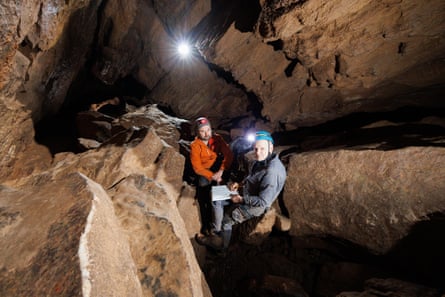
Petit, too, feels free underground. “And not just because there’s no wifi,” he laughs. “Time changes down here – it thickens and slows.” True enough, but he has alerted Mendip Cave Rescue to send down a team if we don’t surface by 3.30pm so we’re not completely disconnected from normal clock time.
While I stumble and plummet, 41-year-old Petit bobs and weaves around me like a genial buttered otter, attaching ropes and hefting the Guardian photographer’s kit, shouting instructions that may save our lives. “Don’t go down the Coal Chute!” he says, nodding with his headtorch at some yawning abyss. “Stay away from Jacob’s Ladder!” Every feature down here has been morbidly named by sarcastic explorers, from Desolation Row to (my least favourite) Abandon Hope. “It’s like Alice in Wonderland,” says Petit. But I feel more like Winnie the Pooh, worried that I’ll get stuck between narrow rocks until rescuers pull me out.
The conceit of Petit’s film is that, at the beginning, his camera heads below ground through a cleft in an old ash tree, and doesn’t resurface until the end. As a result, there are no talking heads in hotel rooms, no birds singing and no traces of daylight. As artistic self-denial goes, Petit’s approach reminds me of Lars von Trier’s Dogme manifesto. But for Macfarlane – who I speak to over Zoom a day after surviving my descent – it recalls the strict formal constraints of French novelist Georges Perec and the rest of the Oulipo literary group (who can forget Perec’s 1969 novel La Disparition, composed without the letter e?).
Macfarlane admired Petit’s approach to the original text. While the book consists of 13 chapters in which the Cambridge don descended into underlands beneath Slovenia, Yorkshire, London (Epping Forest), Paris and more, Petit’s film chooses three subterranean denizens whose descents braid into one another as the film progresses. As we sit in Boulder Chamber, the film-maker draws me a diagram of the storylines intertwining. It looks like Dante’s descent into hell.
There was a bidding war for the book’s film rights, but Macfarlane was delighted Petit won them. “I would have given him the rights for a farthing and a pint of beer frankly. I’m incalculably more interested in people who will take creative risks and try to find new forms. I sometimes think about the difference between Newtonian collaboration and quantum collaboration. Newtonian collaboration is the methodical and causal kind. I bring my skill and you bring yours and we build those upon each other and create something hybrid and interesting. Quantum collaboration is where you trust somebody else with the work you’ve made and they alchemise it into something utterly different. For me, that is where the thrill is – in watching that metamorphosis.”
Although Macfarlane gave Petit free rein and isn’t on camera, he did collaborate on the script. Their words are narrated by Sandra Hüller, the Oscar-nominated star of Anatomy of a Fall and The Zone of Interest, often juxtaposed with a superbly eerie score by Hannah Peel who wrote music for Game of Thrones.
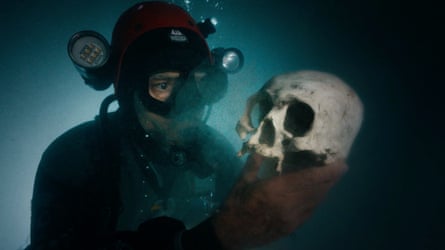
One thread follows Garrett exploring a storm drain in Las Vegas, a place inhabited by the most precarious of humans as well as the detritus from Sin City above. Another follows Fátima Tec Pool, descending into the caves of Yucatán in Mexico, to find fossil traces of her Maya ancestors. The third tracks Mariangela Lisanti, a leading dark matter physicist whose work seeks to unravel some of the universe’s biggest mysteries using scanners miles beneath the surface of Canada.
Petit – son of avant-garde film-maker Chris “Radio On” Petit – cites Werner Herzog’s Fitzcarraldo and Joseph Conrad’s Heart of Darkness as influences. But instead of documenting one human being’s extraordinary journey, Petit’s camera is actually more like his protagonist.
This isn’t the first time the two Roberts have collaborated. Near-contemporaries at Cambridge, they met when Petit made a video profile of the young nature writer for Granta magazine. A few years later, a kindly uncle gave Petit a drone that he promptly used to make footage following the River Dee, starting at its source deep in the Cairngorms. He sent it to Macfarlane, who was so impressed that he wrote back saying they must make a film. The result was a 27-minute short called Upstream.
“The camera would always be moving upstream and the river would always be moving downstream and that set up this strange sort of dialectical frictional process,” says Macfarlane. “The constraint here is similar, which is to have this storytelling voice which is not anchored to anybody in particular.”
Macfarlane insists that Underland is not one of those travelogues in which some bloke wanders lonely as a cloud in the wilderness and mansplains what he sees. In the book, Macfarlane writes of the threefold features of what the underland means for us humans:
Shelter (memories, precious matter, messages, fragile lives)
Yield (information, wealth, metaphors, minerals, visions)
Dispose (waste, trauma, poison, secrets).
Into the underland we have long placed that which we fear and wish to lose, and that which we love and wish to save.
All that resonated for Petit when he read Underland, but there was something more personal. “There’s a passage about fossil traces which is to do with loss.” This chimed with Petit as he mourned the recent deaths of a beloved aunt and uncle. The companion book to the film, Beneath the Old Ash Tree: The Making of Underland, includes a message from one Robert to the other while Petit was staying in the Poconos with his family. “Your passage on ‘trace fossils’ helped me today while I was feeling their absence,” wrote Petit. “This house is full of them: the missing varnish on the floorboards in the study, the grooves in the cushions of their favourite chairs, the orderliness of the woodshed.”
The inspirational passage he’s referring to in Macfarlane’s book reads: “We all carry trace fossils with us – the marks that the dead and missed leave behind. Handwriting on an envelope; the wear on a wooden step left by footfall; the memory of a familiar gesture by someone gone …”
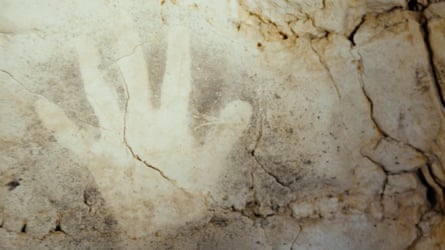
Reading this, I think of Fátima Tec Pool in Petit’s film. His camera follows her through impossibly narrow caves and as she dives into subterranean waters, until she encounters handprints left on cave walls. Across the millennia, in the film’s money shot, she presses her open hand against handprints left by ancestors. We’re in deep time, not in a geological sense but in an ancestral, human one.
Macfarlane believes we’ve always been drawn to the underland. He cites the Epic of Gilgamesh. “It’s the first great story of mortality. And it’s also an underworld story. The matter of the world beneath our feet is being used to figure out a metaphysics to us. It always has and it always will.”
We have always looked into the abyss but, as Nietzsche reminded us (in words that Petit first thought of as a motif for his film), if you do so for long enough, it will start looking back at you. Which is to say, we might think in our hubris that our gaze is all-consuming, but in truth we can become consumed by what we’re looking at. Especially if the abyss is as dark and unfathomable as what lies beneath Somerset.
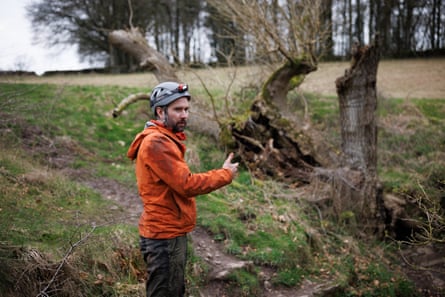
Petit, the photographer and I make our way back to the surface, muddied, damp and chastened. Never has birdsong seemed so lovely, the daffodils so yellow, the early spring scents of Somerset so sweet.
But that’s not the end of our journey. We drive on a few miles, park at the village of Priddy and head across fields to the tree where both book and film begin. “Old Mother Ash tree is dying,” says a worried Petit. I’ve seen the cleft in the tree from photos in Macfarlane’s book and from footage in Petit’s film, but when we arrive the scene is very different. The ash has recently collapsed, its cleft broken, its vigour seemingly sapped. “It’s as if it was holding on until we completed the film,” says Petit mournfully. Perhaps. But, although the trunk is broken, there are buds growing from a broken branch. Death and life are not so very far apart.
I lie down to look through what remains of the tree hole that spurred the two Roberts’ imaginations: down there surges an underground stream that may well push on towards the village of Wookey Hole.
Next to the tree is a human-fashioned hole leading to the roaring torrent below. Petit jumps into this, to explore the entrance to the underland from below. Seconds later, the photographer and I gaze down through the ash tree’s cleft to see Petit’s cheery face looking up from below. A moment later, he’s back on dry land, emptying his wellies of chilly spring water, radiant with enthusiasm for the world below.