3 months ago
79
3 months ago
79
Toyota, the world’s biggest carmaker, is using retro-style video games to rally its US workforce behind its corporate goals, including lobbying to relax environmental rules, the Guardian can reveal.
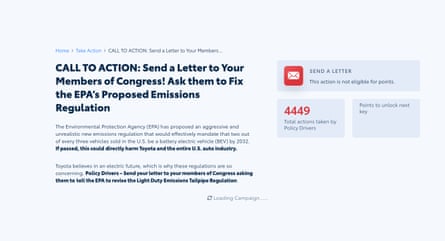
Through an internal platform called Toyota Policy Drivers, employees can play games with names such as Star Quest, Adventure Quest, and Dragon Quest, earning prizes by engaging with company messaging about policy and by contacting federal lawmakers using company-provided talking points.
“By joining forces, we can do a better job of telling Toyota’s story and demonstrating the tremendous contribution that our company makes to the US economy,” the company says on the platform. “Toyota Policy Drivers do so by contacting and interacting with members of Congress, state lawmakers, and other policymakers.”
Workers across the Toyota Motor North America subsidiary – which employs tens of thousands – may be eligible to join the program, the company says on its Policy Drivers website, as may those at its 11 US manufacturing facilities and the 4,000 working for its finance and leasing arm.

Via Policy Drivers, the company has urged workers to lobby federal representatives, including to demand changes to a Biden-era strengthening of auto emissions targets. The company has argued the rules are unrealistic and unfair to hybrid vehicles, of which it is the world’s largest producer. Critics say hybrids do not deliver the same environmental benefits as fully-electric cars.
“Policy Drivers – Send your letter to your members of Congress asking them to tell the EPA to revise the Light Duty Emissions Tailpipe Regulation,” the company wrote on the platform.
In April, Politico reported that Toyota used the platform to encourage employees to push against a California policy banning the sale of gas-powered vehicles by 2035, claiming the regulatory program would raise car prices by limiting the availability of combustion-engine and hybrid models. A company spokesperson told Politico that the best path to reduce emissions is consumer choice, and that the ban was “unachievable, unrealistic, and unworkable”.
Toyota’s use of games to reward such lobbying has not previously been reported.
“It is surprising and sickening and dystopian to see an automaker operating like this, literally making a game out of poisoning communities and accelerating climate change,” said Adam Zuckerman, senior clean vehicles campaigner for the climate program at non-profit consumer advocacy group Public Citizen.
When approached by the Guardian with questions about its Policy Drivers program, Toyota declined to comment.
The company has long branded itself as green, pledging to zero out its emissions by 2050, touting its investments in alternative fuels, and championing its “sustainable” hybrid vehicles. Its viewpoints are underlined for workers on the Policy Drivers site.
On Monster Mansion, a game featuring cozy haunted house motifs, users can earn 100 points for listening to corporate recordings. In one, company lobbyists discuss how the company is affected by trade policy; in another, women Toyota dealers praise a Washington DC company event with lawmakers. A third features Stephen Ciccone – the longtime vice-president of public affairs for Toyota in North America – criticizing environmental measures.
“The government has more ability to disrupt our business than our competitors,” he said at the speech from a recent company conference for dealers in Las Vegas, calling himself a “wartime consigliere” for Toyota.
Points earned on the gamified platform can be exchanged for rewards, which have included stickers, T-shirts, and even trips.
“On a personal level, I was actually able to win the grand prize – go and see Washington DC,” one worker said in a 2022 video about the program. He also won cupcakes, he said.
The gamified platform seems “Orwellian”, said Zuckerman.
“Toyota is treating its employees like children, using video games and cupcakes to cajole them into lobbying for dirtier air,” he said.
Toyota’s political influence
Though less scrutinized than oil and gas companies, Toyota is a major contributor to the climate crisis. Its 2023 emissions exceeded those of the entire country of Australia, Greenpeace found this year. Approached about the finding by Greenpeace, Toyota’s East Asia branch said it prioritizes “sustainable development” and “the happiness of our customers and stakeholders”, and that it aims to cut emissions.
The company has also played an active role in shaping environmental policy. Public Citizen identified it as the top auto industry financier of climate deniers in the 2024 election cycle, while corporate watchdog InfluenceMap in 2021 ranked it the third-most obstructive company globally on climate policy, behind only Chevron and Exxon.
Late last year, the automaker donated $1m to the inauguration fund of Donald Trump, who calls climate policy a “scam”. And though it has critiqued the US president’s tariffs and trade policy, it has publicly embraced Trump in recent weeks. Last month, its chairperson and scion Akio Toyoda appeared at a Japan Nascar race wearing a “make America great again” hat and Trump-Vance shirt.
Toyota says it is “passionate about the environment” and that it backs the Paris Agreement, promoting a mix of hybrids, plug-in hybrids, battery electric, and fuel cell vehicles as a “practical and sustainable” way to cut emissions. It has pledged to slash average carbon from new vehicles by nearly a third by 2030 and achieve net-zero emissions at global factories by 2035.
But the automaker has long lobbied to weaken certain pollution-cutting measures, and says its employees have played a role in its efforts. Last year, workers contributed to securing federal auto emissions regulations favorable to hybrids like the ones it produces, it says.
“Thanks to the efforts of Toyota, our team members, and our dealer partners, the rules were softened in the early years of 2027-2030 and restored the compliance value of plug-in hybrids,” reads a post on Toyota Policy Makers.

The company has long expressed skepticism about fully-electric cars, with its chairperson Toyoda last year predicting they will reach a 30% market share at most. It has also suggested that because the same raw materials used to build one fully-electric vehicle could instead produce many more hybrids, the latter is a more environmentally-friendly choice. Studies show electric vehicles have the smallest carbon imprints.
Workers and dealers also helped Toyota in its fight against California’s groundbreaking plan to ban the sale of on new gas-powered cars by 2035, according to Toyota vice-president Ciccone. Though the state has not officially pulled the policy, it is currently in legal limbo.
In the speech publicized via the Policy Drivers platform, Ciccone called the zero-emission vehicle mandate “totally absurd” and saying he worked “every damn day” to fight it.
“I’m telling you, I’ve never fought like that in my life,” he said.
Toyota fought against the policy “alone”, without other automakers, as “the media, the government and the other [auto manufacturers] were spinning this fiction that there’s a line of people just waiting to buy electric vehicles,” Ciccone said.
A letter to Trump, signed by 5,000 Toyota dealers around the country, helped the company to “call bullshit” on the regulations, he said. Dealers also attended a call he organized about the policy, critiqued the measure in the press, attended rallies in the nation’s capital, and made calls to lawmakers.
“You absolutely hammered the people in the Senate,” said Ciccone. When the White House signed a joint resolution aiming to end the rule in June, he said, he popped a bottle of champagne.
He added that “person-to-person contact” is a “superpower” that dealers can use to lobby lawmakers.
“This is exactly what you’re built to do, I’m just asking you to not just do it with your guests, but do it with politicians,” Ciccone said. “You have such great stories to tell.”
Toyota has said it supports “regulations that are predictable, technology neutral, and that allow us to provide safe and affordable vehicles to our customers”. But its lobbying contradicts its environmentally-friendly image, said Katherine Garcia, director of the clean transportation for all campaign at the non-profit Sierra Club.
“So many folks see Toyota as the green and sustainable automaker that invented the hybrid, it has this veneer of sustainability,” she said. “But we see that as greenwashing.”
Employee mobilization
Over the past several decades, US corporations have increasingly mobilized their employees for political advocacy, holding town halls with senators, circulating calls to contact regulators, and even whipping votes for preferred candidates. The trend began in the 1970s and 1980s amid mass labor strikes and a boom federal regulation, said Alexander Hertel-Fernandez, author of Politics at Work: How Companies Turn Their Workers into Lobbyists, who calls it “employee mobilization”.
“Business felt like they were on the outs in DC, and thought they needed to step up their game to rebalance the policy landscape at the federal level,” he said, noting that few rules restrict the practice.
With the rise of the internet, many companies built online platforms to coordinate advocacy nationwide, sometimes offering employees incentives to participate. It is part of a wider move to mimic bottom-up advocacy, said Edward Walker, author of Grassroots for Hire: Public Affairs Consultants in American Democracy. Firms including Uber, Lyft, Airbnb and some health insurance providers have also engaged users in lobbying, he said.
Current political dynamics in the US suggest this trend may continue, said Walker. In today’s “populist moment”, lobbying that appears to come from ordinary constituents carries extra weight. “Companies think, if legislators want to hear from their constituents, let’s help those constituents say things that help us,” he said.
There is evidence that employee advocacy works, said Hertel-Fernandez. In a poll he conducted for his book, corporate managers said it is more effective for influencing policy than all tactics except direct lobbying – even outranking candidate donations and political advertising. A 2016 survey of senior congressional aides he helped run also found that employee letters were among the most persuasive forms of advocacy.
Neither Hertel-Fernandez nor Walker have previously seen corporations create games to incentivize lobbying.
“Climate policy is not a game to the communities and to the planet who are impacted by aggressive anti-climate lobbying,” said Zuckerman of Public Citizen.
Driving policy
Toyota Policy Drivers is the brainchild of vice-president Ciccone and the company’s government affairs team, according to a 2020 post from Quorum, a public affairs-focused software company which worked on the project. In 2022, web developer LGND gave the platform a new look and created the new game Dragon Quest, according to a blog by a former LGND developer.
Neither Quorum nor LGND responded to requests for comment.
The Policy Drivers platform appears to feature a new game every year. Before 2025’s Monster Mansion, users were asked to unlock a series of majestic-looking doors on the 2024 game Adventure Quest; the previous year, users could play astronauts on Star Quest. And in 2022, employees and dealers could play Dragon Quest, which resembles popular 1990s graphic adventure video games and which has users play armored knights undertaking epic journeys. On each game, Toyota offered points for completing a variety of tasks, including not only listening to higher-ups and employees speak, but also taking quizzes about the policy landscape.
In 2020, every call to action averaged a 50% response from Toyota Policy Drivers, says the Quorum post, adding that points earned on the platform can be exchanged for stickers and T-shirts. Users are encouraged to post photos with their “swag” and share them with the Policy Drivers “community”. A photo posted on the platform shows one dealer showing a trophy he won.
Policy Drivers urges workers to listen to company higher ups’ policy perspectives. But in a video on the platform, employees say the information they are given is “unbiased and fact-based”.
“It’s really easy to join. It only takes a few minutes, and it’s a great way to make your voice heard,” one worker claims.
Toyota says that Policy Drivers “is a completely voluntary program”.
“Participation or non-participation will not impact your job or performance review,” it says.
Employees are free to ignore the platform’s political calls to action, Toyota says, or “can opt out at any time”.
“Toyota values the individual beliefs of our team members, and you are free to exercise your constitutional rights outside of Toyota Policy Drivers,” it says.
But because workers are structurally dependent on their employers, some may feel obligated to participate in lobbying, said Hertel-Fernandez.
“In the absence of public policy, I worry that workers may feel pressure to participate,” he said.
The gamification aspect of the platform may make the lobbying seem innocuous, said Garcia.
“Folks that are enrolled in this program and taking actions, I’m sure they genuinely feel like this is they’re doing the right thing,” she said. “They have actually been led to undermine some of the most important regulations of our day.”