3 months ago
65
3 months ago
65
France's Macron warns US under Trump is 'turning away' from allies
French president Emmanuel Macron warned the US under Donald Trump was “breaking free from international rules” and “gradually turning away” from some of its allies.
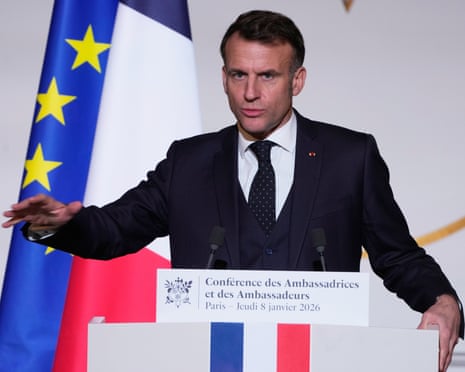
Echoing the criticism from his German counterpart (11:30), he warned about the increasingly assertive US policy.
“Multilateral institutions are functioning less and less effectively,” Macron said in his annual speech to French ambassadors, as reported by AFP.
We are living in a world of great powers with a real temptation to divide up the world.
Key events Show key events only Please turn on JavaScript to use this feature
US-Ukraine security guarantees ready to be finalised by leaders, Zelenskyy says
Ukrainian president Volodymyr Zelenskyy has just said that the document outlining US security guarantees for Ukraine “is now essentially ready for finalisation at the highest leve wiht the president of the United States.”
Could there be another big meeting with Trump on cards?
The president contijnued:
“It is important that Ukraine is successfully uniting the efforts of the European and American teams, and together, we discussed, in particular, documents on recovery and economic development.
Complex issues from the basic framework for ending the war were also addressed, and the Ukrainian side presented possible options for finalising this document.”
Zelenskyy added:
“We understand that the American side will engage with Russia, and we expect feedback on whether the aggressor is genuinely willing to end the war. Upon returning to Kyiv, our negotiating team will report on all the details of the meetings.”
He also added that Ukraine will be “informing our partners about the consequences of Russia’s [overnight] strikes, which clearly don’t indicate that Moscow is reconsidering its priorities.”
“In this context, it is necessary that pressure on Russia continues to increase at the same intensity as the work of our negotiating teams. The feasibility of future security guarantees must be proven by our partners’ ability to exert effective pressure on the aggressor at this very stage. We are preparing new relevant contacts with partners.”
Marco Rubio says he will meet Danish officials to discuss Greenland next week
Another news line dominating this week’s coverage of European politics is to do with Greenland, and the US president Donald Trump’s ambitions to somehow take control of the Danish semiautonomous territory.
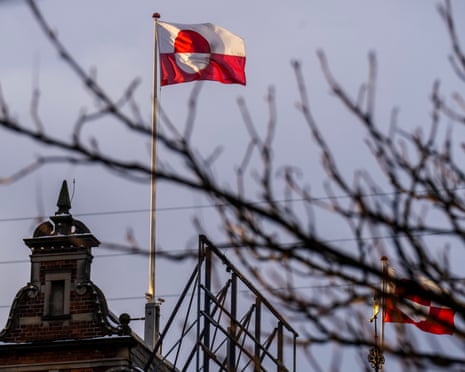
The US secretary of state, Marco Rubio, said last night that he had plans to meet Danish officials next week to discuss Greenland as a crisis escalates within Nato over US threats to take over the Arctic territory.
An urgent meeting had been requested by the foreign ministers of Greenland and Denmark, which has said that any invasion or seizure of the territory by its Nato ally would mark the end of the western military alliance and “post-second world war security”.
Speaking to reporters in Washington, Rubio did not directly answer a question about whether the Trump administration was willing to risk the alliance by potentially moving ahead with a military option to gain control of Greenland.
“I’m not here to talk about Denmark or military intervention, I’ll be meeting with them next week,” he said. “We’ll have those conversations with them then, but I don’t have anything further to add to that.” Every US president retains the option of addressing national security threats through military means, he said.
EU accused of fuelling Putin’s war by importing Russian liquefied natural gas

Daniel Boffey
European governments have been accused of fuelling Vladimir Putin’s war in Ukraine as new data shows the Kremlin earned an estimated €7.2bn (£6.2bn) last year from exporting its liquefied natural gas (LNG) to the EU.
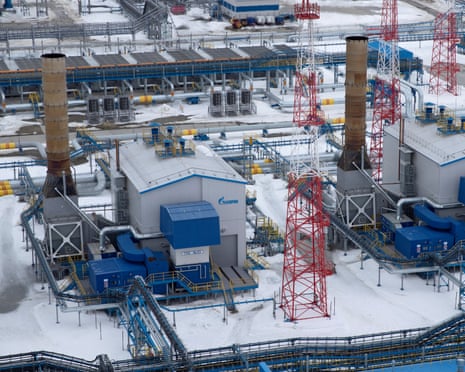
Brussels has pledged to ban imports of Russian LNG – natural gas that is supercooled to make it easier to transport – by 2027 but an analysis suggests there is yet to be any letup in the vast quantities being received at European ports from Russia’s LNG complex on the Yamal peninsula in Siberia.
More than 15m tonnes of Yamal LNG was transported through the Arctic ice to reach EU terminals in 2025, according to the human rights NGO Urgewald, earning the Kremlin an estimated €7.2bn.
While Europe has cut supplies of pipeline gas from Russia since the full-scale invasion of Ukraine, the EU’s share of global shipments from Yamal increased in the last year, the fourth of the war in Ukraine, rising to 76.1%, up from 75.4% in 2024, the report said.
The imports remain legal and the EU has been reluctant to ban Russian shipments of LNG, particularly due to the dependency of central and eastern Europe on the energy source.
Russia says any western troops in Ukraine would be deemed 'legitimate combat targets'
Meanwhile, Russia said that any western troops sent to Ukraine as part of the Coalition of the Willing would be deemed “legitimate combat targets,” after plans announced at the grouping’s summit earlier this week.
Reuters reported that a Russian foreign ministry statement said “militaristic declarations” by a coalition of pro-Ukraine European governments were becoming increasingly dangerous.
AFP added that Moscow labelled Ukraine and its European backers an “axis of war,” and stressing it was “dangerous.”
German president criticises US foreign policy for leading to 'breakdown of values' underpinning world order
German president Frank-Walter Steinmeier has strongly criticised the US foreign policy under Donald Trump, warning that “there is the breakdown of values by our most important partner, the USA, which helped build this world order” in the first place.
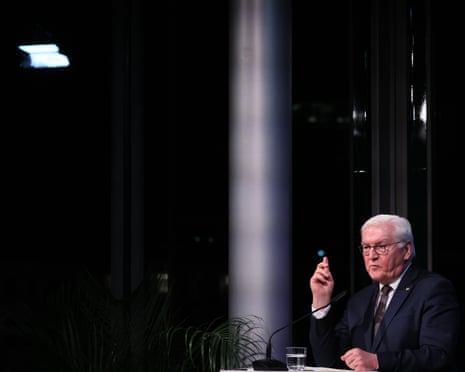
In last night’s speech at a Körber Foundation event marking his 70th birthday, Steinmeier said the US behaviour represented a second historic rupture of the world order after Russia’s annexation of Crimea and the full-scale invasion of Ukraine, Reuters reported.
He also called for more to be done to “prevent the world into turning into a den of robbers, where the most unscrupulous take whatever they want.”
The president also spoke about the pressure facing democracies “from both outside and within,” particularly from authoritarian and nationalist narratives and “aggressive” public discourse.
'This is Russia's war against our people,' Zelenskyy says after Russian strikes on energy infrastructure
Ukraine’s Volodymyr Zelenskyy has just responded to the overnight attacks and disruption on Ukraine’s energy infrastructure.
In a post on X, he said “there is absolutely no military rationale in such strikes on the energy sector and infrastructure that leave people without electricity and heating in wintertime.”
“This is Russia’s war specifically against our people, against life in Ukraine – an attempt to break Ukraine. That is why support for our resilience and all forms of assistance to our state must function at full capacity,” he said.
Zelenskyy added that “diplomatic discussions cannot be a pretext for slowing down the supply of air defense systems and equipment that helps protect lives.”
“We are working with our partners to ensure an adequate response.”
He also stressed that the repair crews are working on restoring services across the affected regions, with “all necessary resources, equipment and services … deployed to address the situation.”
We now also have a line from Russia, with the country’s defence minister saying, via Russian news agencies, that the overnight strikes targeted energy facilities and port infrastructure used by the Ukrainian military.
Coalition of the willing must be ‘robust’ to deal with Russia, warns ex-US general

Dan Sabbagh
Defence and security editor
An Anglo-French led stabilisation force for Ukraine would have to deploy thousands of combat troops if it is to successfully dissuade Russia from breaking a postwar ceasefire, according to a former commanding general of the US army in Europe.
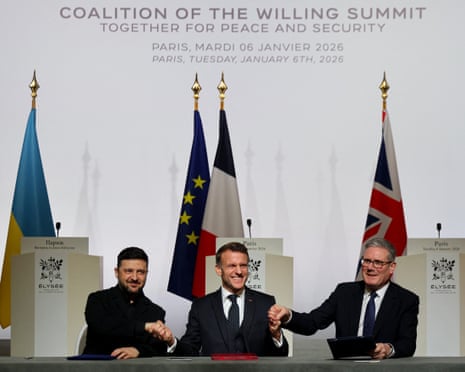
Ben Hodges said the proposed multinational force, discussed this week by the British and French leaders with Ukraine’s president Volodymyr Zelenskyy in Paris, had to be robust enough to deal with likely Kremlin-orchestrated provocations.
“The coalition of the willing has to have real force and rules of engagement that allow it to immediately react and respond to any violations,” he said.
Captains can’t be having to call back to Paris or London to find out how to deal with a Russian drone.
The retired general said: “Anybody who believes that Russia will live up to any agreement is not being realistic” – a reference in part to the period between 2014 and 2022 when there were repeated violations of the old ceasefire lines in Ukraine.
At least, British and French troops would need to be able to defend themselves from drones and other forms of attack, Hodges said, as it would be very likely that “Russia will immediately test their responsiveness”.
Russian forces, the former general added, “have to look over there and say these guys are serious, not parked in a barracks somewhere near Lviv. So far there is not enough detail to judge.”
The Ukrainian air force said Russia attacked with 97 drones overnight, with 70 downed by air defence system but 27 striking various locations, without elaborating, AFP reported.
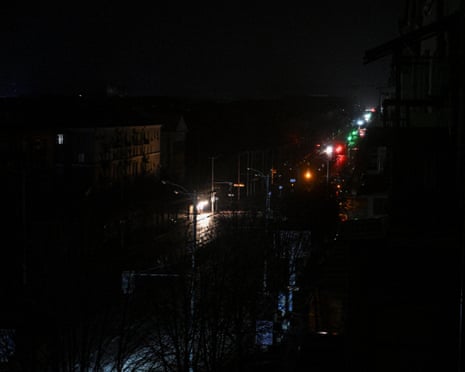
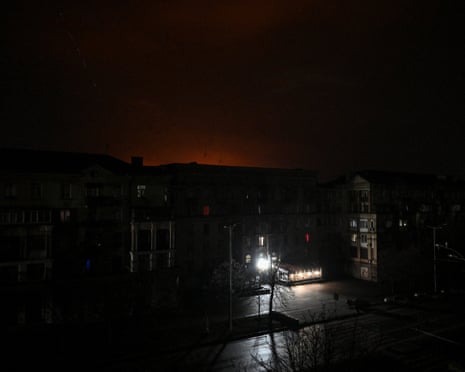
Here are some pictures showing the impact of the ongoing power blackout in parts of Ukraine – here, from Zaporizhzhia last night.
Morning opening: Russian attacks leave Ukrainian region without water and heat

Jakub Krupa
More than one million people are left without water and heat in the Dnipropetrovsk region of Ukraine after another round of Russian strikes on energy infrastructure overnight, the authorities said.
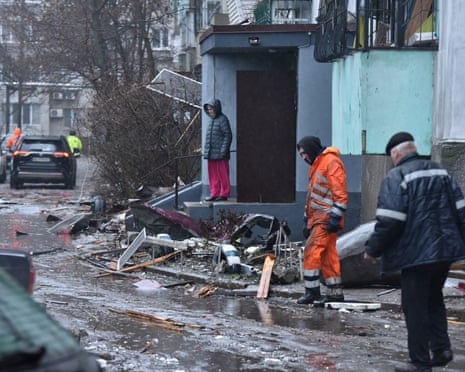
Another figure, given by the country’s energy ministry, put the number of affected at nearly 800,000 people.
“Ukraine’s energy system is under enemy attacks every day, and energy workers are operating in extremely difficult conditions to provide people with light and heat,” the country’s prime minister Yulia Svyrydenko wrote on Telegram.
She added that expected snowfalls and low temperatures were likely going to compound disruptions in the coming weeks.
“Repair work continues in Dnipropetrovsk region to restore heat and water supply for over a million subscribers,” restoration minister Oleksiy Kuleba wrote on social media.
The neighbouring Zaporizhzhia region is also affected.
The attacks took place just days after the latest summit of the Coalition of the Willing, discussing the thorny issue of security guarantees for Ukraine in case of some sort of peace settlement with Russia.
But they also serve as a striking reminder of the continued impact of the Russian aggression on civilian populations across Ukraine.
I will bring you all the key developments here.
It’s Thursday, 8 January 2026, it’s Jakub Krupa here, and this is Europe Live.
Good morning.