3 months ago
57
3 months ago
57
It seemed fitting, as the final moments ticked down at the Sydney Cricket Ground, as the day, the match, the tour seemed to ooze and melt a little at the edges under a hard white January sun, that Ben Stokes should finish this Ashes series still standing, but only just.
It was at least a suitably slapstick final session in front of a scattered, holiday-ish crowd. Australia custard-pied their way to a victory total of 160, narrowly avoiding falling pianos, dangling off giant clocktowers along the way.
It felt fitting too that the endgame should revolve around England’s tried and trusted short-and-wide masterplan, a series that will remain fixed in the mind as an endless looping meme of an English seamer being square-cut to some distant crowing boundary.
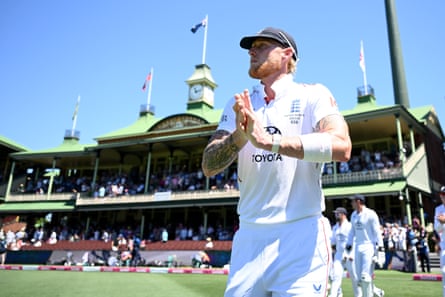
In the middle of this Stokes spent the day wedged in at first slip, nursing his newly acquired groin injury, a cricketer who is by this stage basically a hat, a collection of splints nailed together and a grimace. Again, it is no surprise that Stokes should be grimacing, stricken and wincing with agony. As a rule, unless specifically stated otherwise it should be assumed Stokes is always grimacing, stricken and wincing with agony.
Cricket demands a daylong public persona. Stokes has his own version down pat, a kind of performative doom state, a showmanship of pain, like the hero in a western holding his chest and staggering backwards slowly through the saloon doors, but doing it for six hours straight from mid-morning to the afternoon shadows.
Australia will do this to you. The Adelaide Advertiser ran an article midway through the third Test about the “captaincy killer” tradition of an Ashes tour, sniffing out blood, meltdown, collapse.
Positives, then: even in abject defeat, and England really have been feeble on this tour, ground into the dust by a depleted Australia, Stokes has not disintegrated. It has been a gruelling six weeks in new ways too. The first terminally online Ashes. The first 24-hour content tour. Seventeen days of proper cricket across 67 days of being in Australia, all of it consumed with a ceaseless rolling babble, screen rot and brain chatter, urgent un-happenings, headline non-events.
Stokes talked at one point about the urge to throw his phone in a river. Well, why not? This should be a consideration on future tours. England seemed totally unprepared for this refined form of exhaustion, brutalised by the experience of simply existing in Australia.
But then, nobody has seemed ready for anything here, at an Ashes series so rushed and sloppy you half-expected to look down and notice both teams have taken to the field with their pyjama trousers sticking out of the hem of their whites.
At the end of which some things are clear. Bazball is over. It’s goodbye to all that. The England and Wales Cricket Board’s three-year plastic branding exercise is done. Danger has been run towards. Transcendent game states have been attained and then misplaced. The wellness brand optics, jawline, tattoos, man-feelings, feet up on the balcony rail … it all feels not just dated, but terminally obnoxious.
A vibe is, in the end, just a vibe. And this was a chimera, a rebadge, the snarl of a manufactured Japanese punk band. It worked for a while, because the talent and the lone founding idea were both real.
It was fun for a while. We’ll always have the run chases, the creative captaincy, propped up by some all-time cricketers in their final flush. Bazball will always live in our minds and hearts. Oh, for a few years it will be considered passé and ridiculous. People will laugh about golf obsession, saving cricket and Ben Duckett discussing disruptive vibe energy. But we had nothing to do with those things and still loved Bazball. It’s got to come back some day. We can just hope it will be in our lifetimes.
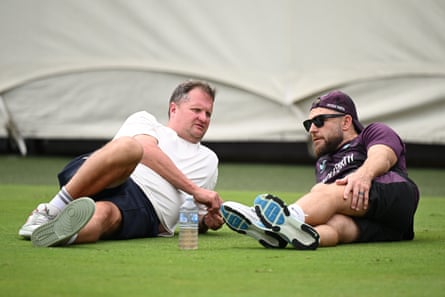
And yes, about half of that is probably true. But the only key element right now is that Stokes wants to stay, and that he will stay. For a start he has explicitly tied himself to Brendon McCullum, out of loyalty and perhaps also politicking.
McCullum should still go now. Not only has the planning been sloppy, his one superpower, taking away the pressure, demonstrably failed in Perth and Brisbane. McCullum may be granted a stay, depending on his willingness to work with more structure around him. But is this even desirable? Is Baz with brains no longer Baz at all? Why would you ask the guy whose authentic self is never learning, never looking around, to learn and look around?
Of all the people in the sniper sights, Rob Key looks most vulnerable. Managing directors have to actually manage and direct. Too many details have been glossed. England’s Test, white-ball, Lions and Under-19 teams are all underachieving in a fug of cliquishness and blurred lines. Sacking the person at the top rarely solves much. The real failings are deeply structural. But this is another massive problem in itself. Someone has to be held to account here. There have to be consequences. English cricket, and indeed England itself, must at least try to be something else.
Stokes is also not the problem here. The captaincy has been a little flat, hostage to some pretty wild bowling, But his playing returns are good. Stokes is arguably England’s best bowler now, with 42 Test wickets at 24 since December 2024. Aged 34, his batting has gone a little. His 10 innings in Australia include scores of 6, 2, 2, 5, 0, 1, five dismissals to the toe-singeing pace of Mitchell Starc. Maybe Stokes is actually Chris Woakes these days.
But none of the obvious failures belongs to him. No real practice games. Catch your first ever pink ball in a Test match. Cricket as a tech bro-style life hack, all short-cuts and eat-this-one-super-food voodoo. This is on McCullum and Key.
There are two problems for Stokes 2.0. Sporting eras do just run out of road. And no England captain has ever embodied so profoundly a complete way of playing, being, speaking. Any incoming coach or executive will have to refine and complement this. Stokes has also seemed a bit disturbed at times. He has blinked at key points in this tour, diverged in the messaging, seemed on the verge of checking out of his own project.
Ollie Pope, for example, has reconfigured his entire sporting identity into some kind of pressure-shifting run-at-the-danger merchant, been told this is the basis for selection; then been dropped as Stokes bats like the skipper of some snow-bound ghost ship, icicles dripping from his beard, feet rooted.
The mid-tour talk of “weak men” was perhaps an attempt to drip some kind of emergency mid-season mastic into an environment that had become flabby and unchallenging. But these are the parts English cricket will give him to work with, the pathway kids.
And it is here that Stokes faces his biggest issue. He wants to build again, to create something of substance. The problem is the England team represent nothing. England cricket has no content. It reflects no culture, expresses no vision other than high-performance gloss and TV rights money. This is clearer than ever in Australia, where cricket really is the national summer sport.
Whereas England cricket has long since been Thatchered, emptied out, atomised. It’s a private party, a silent disco for a small and privileged minority. The England team are at least expressing some truth, that the sport exists most vividly in private schools and private fields. We are the hollow men. We are the weak men. We are probably from Cranleigh, Weybridge and Clapham High Street.
We can have a root-and-branch review now. But what roots, what branches? Even the month of August has been sold off. The Overton window of what the ECB can do to improve its sport is increasingly small.
The Ashes will continue to revolve in its own pristine space. People still come to the grounds and tune in to the TV broadcasts in record numbers. There are useful things the ECB could do. Market the product properly. Re-engage with county cricket, because in the end this is it, this is what you have.
English cricket still has large resources. It is time to maintain, to look after the house, to react to the lessons in its own reports into elitism and alienation. But for all the heat and noise and colour this is a battle that feels in many ways like it has already been lost.