3 months ago
62
3 months ago
62
Copenhagen on the Thursday before Valentine’s Day is intoxicatingly romantic. That’s not hyperbole – you could breathe in and be drunk on it. The canals have frozen over, which only happens about once every 13 years, and couples are skating on them. You can see cosy bars from miles away because they’re strung with fairy lights – apparently not just a Christmas thing here. Everyone is beautiful.
But none of that comes close to explaining why young Danes in Denmark, unlike gen Z across the developed world, are still having sex. Winter isn’t even their frisky season. “You feel the atmosphere in the springtime,” says Ben, 35, half-British, half Danish. His friend Anna, also 35, originally Hungarian, says: “Post-hibernation fever, you can feel the sexual energy. Everyone is on. Everyone swims in the canals, a lot of the women will be topless – they’re like herrings.” (Which is to say: they are typically Danish, they love the water and they don’t wear clothes … I think.) Ben and Anna are millennials, of course, rather than gen Z: they provide the outsiders’ perspective.
Some of the data is starkly depressing: one US study from 2023 found that 24% of adults aged 18 to 29 reported no sexual activity at all in the past year. A global sex habits survey by Feeld and Kinsey’s the following year found that 37% of gen Z reported no sex in the last month, compared to 19% of millennials and 17% of gen X. In the UK, only a quarter of people across all age groups said they had had sex in the past week in a 2020 YouGov poll – compared with the Danish figures of nearly half of straight men and 43% of straight women, again across all age groups (Denmark’s survey data on sex is, predictably, the best in the world). The trend has its own vocabulary – “heteropessimism”, “voluntary celibates”, “boy sobers” (that’s girls who have sworn off boys; the boys aren’t sober). In Denmark, the age of becoming sexually active has remained constant since the 1950s, at 16.4 (the age of consent is 15, in common with a lot of Scandinavian countries). Gen Z Danes are having no less sex than previous generations, and most people report satisfaction with their sex lives.
“That’s the impression I get,” says Carl Christian, 23, a psychology student at the imposing University of Copenhagen, in the centre of the capital. “But I don’t know if it’s from the news or from my own life. At least, with the crowds I’m in, situationships are very common. Maybe in our early teens, if a girl lost her virginity, she’d be less likely to boast about it. But people don’t judge women in their 20s for being sexually active; we’d much rather celebrate when we hear that our female friends have met someone nice in a club.”
People get laid more often, says Frida, also 23 and studying psychology, “because it’s more accepted that you might have an intimate connection with just a friend. It takes a lot to get people to settle into a committed relationship.” “Danish people drink a lot – that doesn’t hurt, either,” adds Christine, 24, a student of global development.
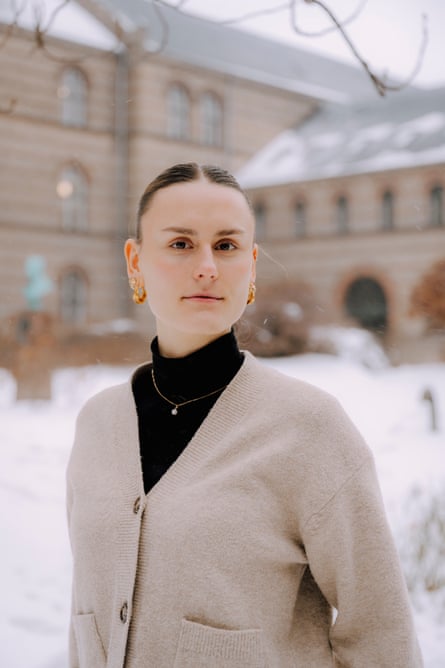
There’s certainly an economic factor: only 11% of Danes still live at home by the age of 24, compared with 18% here in the UK. There’s no student debt in Denmark; students get paid more than €600 a month to study; it’s very common to take a year or often two out between school and university, so everyone’s more confident by the time they start studying. Frida spent last term at the University of California, Berkeley, and says, “I talked to US friends about a lot, including dating. I noticed that it felt like everything for them revolved around the school and studying. It’s easier to pause that when you don’t have to maximise every minute.”
According to Katinka, 25, who is studying public health (she’s out in a bar with Christine; they were at primary school together), there has been a quiet revolution in sex education. When she was at school, they had a good practical grounding, she explains: they were taught how to put a condom on when they were 13. But now, “it’s become gradually more sex positive. There’s more focus on female pleasure. I would definitely say it was inclusive.”
“It didn’t really focus much on women when we were at school,” Christine adds, “and it was very heteronormative. Maybe the more inclusive you are, the more you speak about it, and the more you realise that it should be pleasurable for everyone.” The chat-up culture isn’t patriarchal here. “Women pick,” Anna says. “The men are more timid.”
That sex positivity runs across government departments. During Covid, the health minister announced: “Sex is good. Sex is healthy. Of course you can have sex in this situation.”
“They were worried that social distancing was very hard for young people,” says Thomas Hübertz from Checkpoint, part of the Danish Aids foundation, which does sexually transmitted infection (STI) testing and awareness-raising for young people. “In the year of Covid and the year after, we’ve never had that many sexually transmitted diseases, ever.” We’ll come back to chlamydia which, fair play, Denmark is the OECD hotspot for, by some margin.
First, Peech: a sex shop in the centre of town, which looks like a cross between a nail bar and a boutique, and is absolutely open about what it sells. “We wanted to stock things that were aesthetically pleasing,” says 30-year-old co-founder Clara Filippa Andersen, “because when it’s beautiful it takes some of the shame out of it.” Sex toys, she says, used to be “either super kinky or because you had a problem that you needed to solve. So they’ve always been stigmatised. But I really love the product because I think it’s a way to get to know your own body, your own erogenous zones.”
Denmark was the first country in the world to decriminalise pornography, in 1969, and the conversation here is more sophisticated than it is almost anywhere, picking a path pretty effortlessly between “all porn is dividing us from our authentic sexuality” and “everyone should have sex more like porn stars”. “Porn is not necessarily bad,” Andersen says, “but if we don’t know our own bodies and our own limits, it’s hard to make your own identity when you’re saturated with it.”
As a result of that legislation, Scandinavian erotica was huge in Denmark in the 60s and 70s, Anna says. She volunteers at an arthouse cinema, Huset Biograf: “They show a lot of the worst movies in the world, and also a lot of sexploitation, weird porn cinema content from back in the day.” It’s somewhere between a cultural artefact and a part of the liberated DNA. They really talk about this stuff.
“There’s a distinctive club culture in Copenhagen,” Anna continues. “A lot of dance clubs observe safer space rules: no homophobia, no transphobia, no misogyny, no crossing boundaries, no pictures – they have dark rooms.” In the UK you’d associate dark rooms and the rest only with sex clubs and gay clubs, not with mainstream straight clubbing. “Consent is a huge part of it,” she says. “They used to have groups of volunteers called the Club Mafia, explaining it to everyone. That’s really seeped into the culture of gen Z – they’re very sex positive.”
If there was already a lot of cross-pollination between gay and straight culture, gen Z has accelerated it, according to Kathrine Graa, 31, store manager at Peech. “Gen Z and alpha are very fluid, no boxes at all. The whole reason we’re called Peech is that it’s emoji language for butt. And everybody’s got a butt.”
Back at the university, in the actual hallowed Victorian halls, it’s nighttime, and the club in the students’ union has a chlamydia walk-by testing stand, staffed by Miranda, 29, and Nanna, 25. They work for Checkpoint, and are meeting a few needs. First, those left unaddressed by traditional GPs. Miranda explains: “You meet a lot of bias and a lot of stigma and ignorance. I’ve said before that I’m sexually active and not on birth control, and it’s like the doctor’s brain explodes – they cannot fathom what’s going on. It’s not even in their mind that you could have an active sex life without that being a heterosexual one. They test where they think sex happens [based on assumptions about straight, vanilla sexual activity], but we test based on where you had sex – your mouth or your vagina or your anus.” Hübertz says GPs will say: “‘Why are you here? You were here last year?’ They don’t understand that young people are going out Thursday, Friday and Saturday and [maybe] having 10 sexual partners , so they need to be tested more than once a year. But overall, the Danish health authorities are very supportive.”
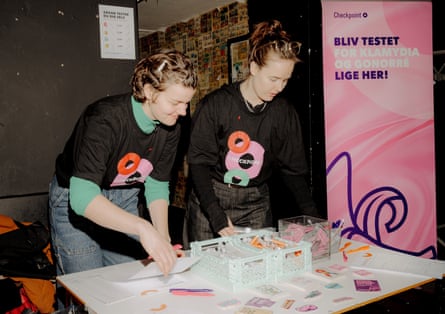
Second, as previously mentioned, there’s a lot of chlamydia. “I would say young people in Denmark are very bad at using condoms,” Nanna says. “I think maybe people feel fearless. A lot of women think: if I can’t get pregnant, I’m fine.” HIV has been more or less eradicated in Denmark – in 2024, 103 people were newly diagnosed, compared with 3,043 in the UK.
“It’s our first time trying the testing,” says Laurits, 23, who is on the student events committee. “People are not as ashamed as you’d think.” The only thing people complain about “is this one, for the penis”, says Miranda, holding up a swab that looks like a Covid test. “It goes up the urethra. People hype themselves up and then they hype each other up. But it’s only half a centimetre for three seconds.” I ask her if it hurts, thinking about the time my brother-in-law waved off the experience of childbirth as fine because it was quick, and my sister said she could cut his balls off in three seconds and it would still hurt. “Well, I don’t know. Obviously, I haven’t tried it,” she says, sunnily. “For this event, everybody has been so cute – they’re so happy we’re here. We had some stickers saying ‘real friends get tested together’ and we’ve run out.” Across Europe, public health authorities are trying to limit chlamydia testing to only people with symptoms, because they’re worried about antibiotic resistance, but 80% of women have no symptoms. The Netherlands has already instituted that reduction, and Belgium looks set to follow. “I can foresee potential challenges,” Hübertz says, carefully.
The most common hypothesis for non-Danish gen Z’s sex drought is a combination of social media and dating apps; the first isolating everyone and draining them of their real-life capabilities, the second reducing everyone to a two-dimensional version of themselves, so that everyone’s “having very surface conversations, swiping people as if they’re not people,” Frida says. Denmark doesn’t seem to be immune to doom-scrolling: “A lot of people have trouble with addiction,” Christian says. Late last year, the government announced plans to restrict social media use for the under-15s, citing worries about access to harmful content. It just doesn’t seem to be killing anyone’s sex drive.
It would be impertinent to come out with a pat answer, on this level of acquaintance, but if somebody said a combination of economic security, inclusivity, gender equality, straightforwardness, sex-positive education and policy, erotically experimental art, culture and commerce, and hedonism had all interacted to create a rabbit generation in a world of pandas, I wouldn’t fall out of my chair.