3 months ago
64
3 months ago
64
Dina Hernández was 35 weeks pregnant when she was arrested near her home in San Salvador in March 2024. The 28-year-old human rights activist, who was with her five-year-old son, was accused of “illicit association” with gang members and jailed without evidence.
Three weeks later, her family received a call from the prison authorities to collect the body of her newborn baby. The cause of death has not been investigated and the family has no idea what happened, or whether Hernández – who is believed to remain in prison – received any postnatal care.
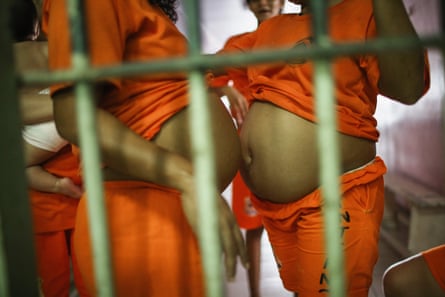
Cases such as Hernández’s are far from uncommon in El Salvador’s prisons, and throughout the world. Pregnant women are often kept in deplorable conditions and denied medical attention; some miscarry, others go into labour and give birth alone in a cell. Some babies die behind bars.
“Prison is not a good environment for women, let alone someone who is pregnant,” says Sabrina Mahtani, a British-Zambian lawyer and member of Women Beyond Walls, a global collaboration dedicated to combating the over-incarceration of women and girls. “There’s so much research that shows how harmful it is.
“Many prisons were built with men in mind, so women were an afterthought. There are lots of issues around violence, a lack of resources, a lack of sanitation, overcrowding, but also a real lack of gender-responsive care.”
It is 15 years since the UN general assembly adopted the Bangkok Rules for the treatment of female prisoners and non-custodial measures for female offenders. The first set of international guidelines to address the situation of incarcerated women, they were formulated in response to the growing female prison population worldwide. Since 2000, the number of women and girls in prison has risen by 57%, compared with a 22% increase in the male prison population over the same period.
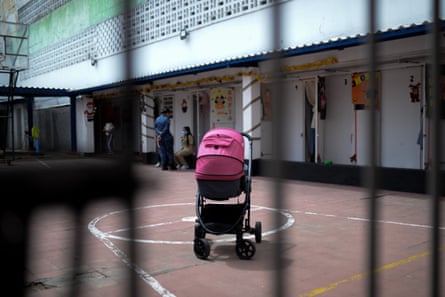
The UN rules state that prison should be a last resort for pregnant women and that non-custodial sentences should always be considered first. They also say that “instruments of restraint shall never be used on women during labour, during birth and immediately after birth”.
But the guidelines are consistently flouted around the world. “This isn’t seen as a global gender-equality priority,” says Mahtani. “It’s not visible, and there’s a lot of stigma and stereotyping. Countries think it’s a small number of women so it’s not an issue, but that’s not true.”
The jailing of pregnant women is also of huge concern, she adds, because of a lack of data and information, especially in poorer countries in the global south where prisons tend to have fewer resources and there is less media attention on them and unreliable access by civil society organisations.
In El Salvador, where the female prison population is estimated to have doubled since 2022 and has increased nearly sevenfold since 2000, conditions for pregnant prisoners and newborns are “really critical”, says Zaira Navas, a lawyer and member of Cristosal, a human rights organisation in the country.
Family visits have been banned since 2020, and civil society organisations are denied access to prisons. However, interviews with women who have spent time behind bars, carried out by Cristosal, reveal that they are subjected to beatings and torture and denied basic supplies. Some resort to having sex with prison guards to get food, sanitary products or medicine.
“Women have to climb up to three floors to get to cells, and do not receive adequate prenatal care,” says Navas. “Our organisation has documented miscarriages and the death of four babies, but obviously this is just what we’ve recorded. There will be more.” She also has reports of women who were shackled to hospital beds during labour and gave birth watched by male prison guards.
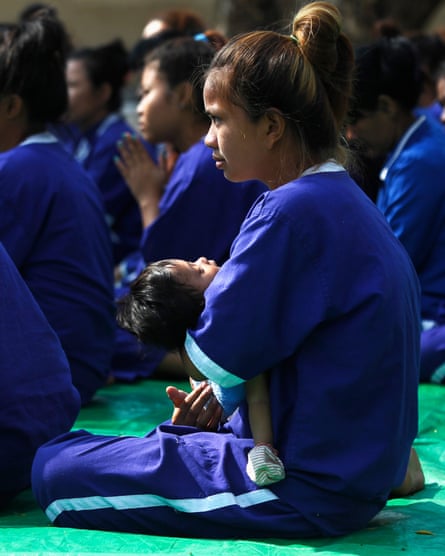
Data from the World Prison Brief lists Cambodia as having the second-highest prison occupancy level in the world behind the Republic of the Congo. At the end of 2024, 18 of the 19 prisons monitored by Licadho, a Cambodian human rights organisation, exceeded their official capacity, with 11 prisons at an occupancy rate of at least 200%.
Women are particularly vulnerable to overcrowding, says Naly Pilorge, outreach director of Licadho. “Women in prisons, most of whom have not yet been sentenced with a final verdict, suffer from atrocious conditions stemming from severe overcrowding. There is rarely enough space to fully lie down in prisons and there is a chronic lack of access to basic items.”
Pregnant prisoners, she adds, have been handcuffed to hospital beds before giving birth. There are worrying conditions for raising a newborn when they go back to prison, as a report of a five-month-old baby dying of pneumonia and severe malnutrition in prison in 2020 shows. The mother was detained for possessing a sachet of methamphetamine worth 10,000 riel (£1.90) and was eight months pregnant when she was sent to prison in 2019, according to Licadho.
In Zambia, Marjorie Banda, a pastor and businesswoman, remembers being in a cell with pregnant women during her six months in prison in 2019. The doors were locked overnight and the keys taken to the men’s prison. When someone went into labour at night, the women were left to fend for themselves.
“We would call the names of our officers because we didn’t know what to do,” says Banda. “We would be pleading. Others were praying. Others were hitting the ground and the doors, screaming: ‘Please come, somebody’s in labour!’”
Such events also happen in richer countries. In 2019, Rianna Cleary, then 18, lost her daughter, Aisha, after giving birth alone in a prison cell at Bronzefield prison in the UK. Cleary’s calls for help when she was in labour were ignored for 12 hours and she was forced to bite through the umbilical cord to cut it.
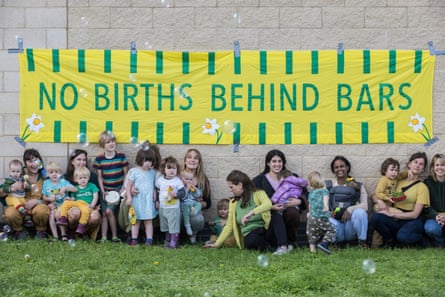
Some women have chosen to use their experiences of being pregnant in prison to instigate change. In the US, Pamela Winn, who lay in a pool of blood for five hours after miscarrying in her prison cell, set up her own organisation, RestoreHer, after she was released.
Winn has successfully pushed for legislation that bans shackling and solitary confinement for those who are pregnant in 24 states. Now she is working to pass legislation to end prison births across the US.
In 2020, Nora Calandra was appointed undersecretary for labour and community inclusion of people in conflict with the law for Argentina’s Buenos Aires province, a role that looks into issues encountered by current and former prisoners.
Her journey to this position started when she discovered she was pregnant a couple of months after she was sentenced to six years in prison in 2010.
For the first six months of her pregnancy, she was monitored by prison authorities. When it came to giving birth, the guards – one male, one female – chained her legs to the hospital bed so she was unable to move. They stayed in the room, watching her in labour.
Hospital staff performed a caesarean section to deliver her baby, a son. Thirteen years later, she still does not know why that happened. While she was still groggy from the anaesthetic, they offered to sterilise her so she could no longer have children. She said no.
“Why would you want to have more children, if you’re a prisoner?” came the response.
For years, Calandra accepted that the treatment she received was part of her punishment for committing a crime. It was only after she was released that she could speak about what she had gone through.
“What I experienced was obstetric violence. What I experienced should never have happened, but this is what women in prison go through,” she says.
Calandra started studying and advocating for herself and her son, and others, while still in prison. After she was released she founded an organisation to support people released from prison and help them find work.
Her experiences informed the guidelines around childbirth in detention for Buenos Aires, which were published in 2020. She acknowledges that women are still experiencing obstetric violence, and being forcibly sterilised, in the country.
Other countries have introduced policies for pregnant women in the criminal justice system. In Sierra Leone, bail regulations passed in 2017 require courts to consider alternatives to detention if a defendant is a primary caregiver, pregnant or a breastfeeding mother.
In some countries, such as Brazil, house arrest has been introduced as an alternative to being held on remand before trial, particularly for pregnant women or women with dependent children.
Other countries, including Georgia, Russia and Vietnam, allow for deferral of sentences for pregnant women.
Experts and people with experience of prison argue that, in most cases, pregnant women should not be in prison at all. “I question whether women should be criminalised for many issues in the first place,” says Mahtani, whose organisation has released a report on laws criminalising women for poverty or gender discrimination.
“Community-based solutions that address the root causes of women coming into contact with the justice system – for example, poverty, abuse and drugs – are really what we should be investing in.”