2 months ago
53
2 months ago
53
‘Uw doet wat, precies, meneer?’ My chic twentysomething hairdresser throws me a puzzled look: “You’re doing what, exactly, sir?” I am not behaving like an Englishman. I have just told her that I have bought tickets for the Muziekfeest van het Jaar (Music of the Year festival) in Amsterdam’s cavernous Ziggo Dome: a two-night extravaganza that is being recorded to be broadcast on New Year’s Eve as a kind of Dutch equivalent to Jools Holland’s Hootenanny, all dedicated to the brassy, sentimental, often untranslatable and still monumentally popular Dutch pop known as levenslied.
“Levenslied” roughly translates as “songs about life”, and although popular throughout the land, especially in North Brabant, it is commonly associated with Amsterdam, and specifically the formerly working-class district of the Jordaan. A social and local music, levenslied concerns itself with family, friends and close associates. Stylistically, it has a connection to the 20th-century French chanson réaliste of Edith Piaf and, when in a party mood, finds common cause with German schlager.
But Levenslied is more sentimental and forgiving in character than its cousins, and has a special Dutch warmth to it; the treasured gezelligheid – a word associated with home and family and a cosy form of social communion. It is also somewhat operatic in feel. According to Joost Heijthuijsen, programme manager at Amsterdam’s Muziekgebouw, “the Netherlands is a country of assimilation. At one point, the people living in the Jordaan adapted opera to their taste.” Vitally, you are supposed to sing along. The key songs of the genre concern themselves with sentiments stoked up by love, betrayal, family, the law, being skint, wild parties and the quirks of local chancers.

Talk to any local Dutch person about levenslied, however, and, after a good hour’s discussion, you realise that the term acts as a generous mother to a large and divergent family. You could create whole sub-genres out of the new, raw levenslied heard on pirate radio stations, festive music played carnivals, and marching-band style music to mop ice rinks to. The serious money that comes with a hit also widens interpretations. A schlageresque number can tap into the lucrative German market; others employ family-friendly takes on gabber or R&B.
Establishing which artists are levenslied artists is also tricky. The singing traditions around the fishing village of Volendam are apparently not levenslied, despite strong similarities. Many fine artists have played footsie with it: Wim Sonneveld, Robert Long, Ramses Shaffy, Liesbeth List and the great Rob de Nijs were all known for songs that could be termed levenslied, but they are more associated in the Dutch mind with the pop charts or cabaret. Vader Abraham’s Daar in Dat Kleine Café aan de Haven (“There, in that small cafe on the harbour”) is an example of levenslied van hart en ziel (from the heart and the soul), but his most famous work – The Smurf Song – most definitely isn’t.
For the non-Dutch, the essence of levenslied may be as tricky to grasp as the guttural G sound, yet in the Netherlands it is as popular as ever. There are playlists dedicated to all aspects of the genre: the official Spotify playlist Hollandse Meezingers (“Dutch Singalongs”) has more than 150,000 saves including chart-topping evergreens such as Engelbewaarder (“Guardian Angel”), recently given new life by Marco Schuitmaker. Contemporary levenslied artists Suzan & Freek are currently in the Dutch Top 40.
At the Muziekfeest van het Jaar, a very visible proportion of the 17,000-strong crowd are in their late teens and twenties, reflecting the appeal of younger singers such as Ammar Bozoglu, Lotje, Tino Martin and the cheeky and much-tattooed working-class soul boy Mart Hoogkamer, whom you might think of as Leiden’s Marti Pellow, and who sails above the crowd thanks to a hoist attached to his groin. The youth of many of the performers may also reflect that contemporary levenslied is this young crowd’s very own pop music: the music of lower-middle-class estate life, of provincial BBQs, bedroom screentime and sleepovers. And it’s a music that is happy to be Dutch in outlook. When an English-language number is sung, by a stalwart such as Gerard Joling, the younger crowd around me visibly lose interest, leaving it to the oldies to sway along.
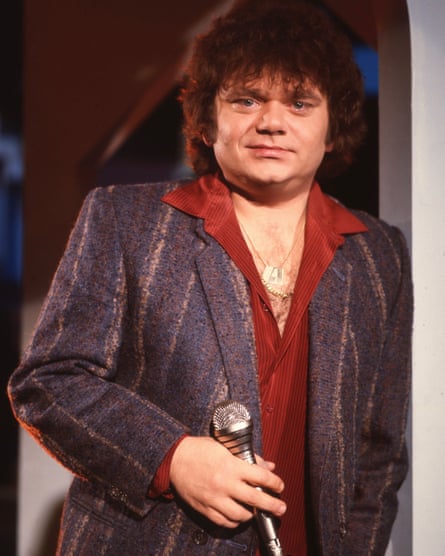
One of the genre classics, pumped through the Ziggo Dome speakers during the warmup, is the epic Bloed, Zweet en Tranen (“Blood, Sweat and Tears”), by André Hazes, which is taken up with emotion by a crowd determined to enjoy themselves. Blessed with a voice that could wake the dead, Hazes often personified a hero’s journey in his self-penned songs: the careworn loner in love, or an ordinary and simple man running up against the plodding bureaucracy of post-1945 wederopbouw (“reconstruction”) Netherlands.
Hits such as Zeg Maar Niets Meer (“Don’t Say Anything More”) are rousing numbers blessed with a considerable emotional hinterland. And the lyrics of Bloed, Zweet en Tranen, a guttersnipe’s take on My Way, are a great example of his brio: its chorus translates as: “With blood, sweat and tears I say, ‘Fuck off out of here’/ With blood, sweat and tears I say, ‘Friends, see you around, but the game’s up.’” Hazes was widely loved and his 2004 memorial service in the Amsterdam Arena drew a crowd of 50,000, with a further eight million watching live on television.

A serial drinker with a turbulent life, Hazes is probably the last great singer of what levenslied had originally stood for: the defiant and soulful independence of a tough urban poor not accustomed to hand outs. This is seen in lines from classics such as Johnny Jordaan’s 1955 number, De afgekeurde woning (“The Condemned Apartment”): “I live in a house they call a slum / But I see no proof of that / It says ‘Declared uninhabitable’ on the door / But to me, it’s still a palace!”
Hazes can be thought of as straddling two eras demarking the genre, reflecting the switch in a country that was no stranger to hard living to one that became prosperous. Levenslied’s first blooming was in the 1950s, through Johnny Jordaan and other Jordaneese artists such as Tante Leen, Willy Alberti, Jan & Mien, Manke Nelis and the accordionist Johnny Meijer. There are many clips to find of Jordaan, a wonderful singer who kept his homosexuality under wraps, chatting and singing with his cousin Willy Alberti in long-gone boozers such as Café Rooie Nelis. Jordaan lost an eye in a fight with Alberti when they were boys. A statue of them stands on the Johnny Jordaanplein in Amsterdam.
From the mid-80s onwards, the Netherlands revelled in its own wellbeing, and in the words of a Jan Smit number, threw “a party, from Goes to Purmerend”. The same sentiment is found in the words of Mart Hoogkamer’s summer smash, Ik ga zwemmen in Bacardi Limon (“I’m going to swim in Bacardi Limon!”). Songs about poverty and troubles at home, such as Zangeres Zonder Naam’s Ach vaderlief, toe drink niet meer (“Dear father, please don’t drink any more”) from 1959, made way for mild gluttony. René Karst, who died last month aged 59, flaunted his bon vivant approach to life with lines such as “Better too fat for the coffin than missing another party” and “On Saturday I start the day with a packet of crisps and some full tar ’baccy”.
Many classic levenslied songs have a knipoog (“knowing wink”) moment, like Jordaan’s assessment of his slum apartment. Nowadays the knipoog is saved for tales of harmless naughtiness: Frans Bauer sings of skiving off work for a day and putting a new bunch of flowers in the window. Some contemporary tracks are downright frisky. In one uptempo number, arch TV host Gerard Joling invites his lover to “make me crazy with your fingers and your tongue” in his clear, high tenor.
It can be argued that levenslied is no longer a proudly working-class, bottom-up phenomenon but one utterly in thrall to established media patterns, where the likes of Muziekfeest van het Jaar have replaced boozers like Café Rooie Nelis. Though some new levenslied numbers first get heard through unofficial broadcast networks known broadly as piratenmuziek, in recent years mainstream television talent shows have often determined who becomes popular, rather than something cooked up in a local. New numbers deal with gentle paeans to relationships, and often sound a world away from the likes of Corry Konings’ sensational 1974 hit, Huilen is voor jou te laat, (“It’s too late for you to cry”), a song about a woman kicking back hard at her ex.
As the show inside the Ziggo Dome edges towards a crescendo, there are fireworks, more dancing girls, more dry ice and a roving kiss cam that intermittently captures the happy crowd. Given the huge setting, the singers aggrandise their stage personalities, whether as cheeky Lotharios, feisty women, or soulful but misunderstood outsiders. They indulge in heartfelt duets in a spotlight, or appear from beneath the stage and from hidden points in the crowd. The crowd sway along and chat – which is not a sign of rudeness but of happy participation, in keeping with old feastday and carnival traditions. In fact, we are transported in time more than once: in a move reflecting Dutch time-saving productivity we join in with the bouncy presenter for the official countdown to 2026. Nothing is left to waste.
But for all the razzle-dazzle, it is a night full of fun and feels. Senna Willems’s spots are a great example of this, and the softening of the genre’s rough edges. A “normal lass” with a big, warm voice, Willems came to prominence thanks to a TV talent show, We Want More. On the night, we get a diva number from her, Je Hoeft Niet Altijd 6 Te Gooien (“You Don’t Always Have to Throw a 6”), replete with a speakeasy piano intro, and the singalong Kleine Vogel (“Little Bird”), which is accompanied by the official video on the huge LED screens, one that suggests a puppet version of Senna has been abducted by the old Twitter bird. It matters not, the crowd sway and clap along. Gezellig, toch?