3 months ago
66
3 months ago
66
Starmer says Romeo appointed cabinet secretary because of her ability to 'get things done'
This is what Keir Starmer has said about the appointment of Antonia Romeo as cabinet secretary, replacing Chris Wormald, who was in effect sacked after just over a year in the job.
Starmer said:
I am delighted to appoint Dame Antonia Romeo as the new cabinet secretary. She is an outstanding public servant, with a 25‑year record of delivering for the British people.
Since becoming prime minister, I’ve been impressed by her professionalism and determination to get things done. Families across the country are still feeling the squeeze, and this government is focused on easing the cost of living, strengthening public services and restoring pride in our communities. It is essential we have a cabinet secretary who can support the government to make this happen.
Antonia has shown she is the right person to drive the government to reform and I look forward to working with her to deliver this period of national renewal.
This statement could be read as an admission that the government needs to improve at ‘getting things done’. Starmer (like most of his predecessors as PM) has spoken of his frustration about how hard it is to get Whitehall to implement change. It is also an implict criticism of Chris Wormald, Romeo’s predecessor, who was forced out by Starmer, even though Starmer had appointed him (from a shortlist that included Romeo). Starmer’s first cabinet secretary was Simon Case, originally appointed to the job by Boris Johnson. Case stood down soon after Labour took office for health reasons.
Key events Show key events only Please turn on JavaScript to use this feature
Gisela Stuart, first civil service commissioner, says she approved Romeo's appointment as cabinet secretary
Gisela Stuart, the former Labour MP who is now a peer and first civil service commissioner (see 10.15am), issued this statement about the appointment of Antonia Romeo as cabinet secretary.
I approved the comprehensive due diligence process and agreed the conclusions drawn, to form the basis for the prime minister to make an appointment decision.
Dame Antonia Romeo has an excellent track record in leadership positions across the civil service, including three permanent secretary roles in some of the most complex operational departments in government.
Cabinet Office explains how Romeo's appointment was fast-tracked
The Cabinet Office news release about Antonia Romeo’s appointment includes, unusually, a section headed “appointment process” explaining how Romeo got the job.
That is because the normally process has been bypassed. Cabinet secretaries tend to serve around five years and, when they retire or stand down, in the past the job has been advertised, and a panel headed by the first civil service commissioner (the person who heads the civil service commission, which oversees senior civil service appointments to ensure they are done on merit) interviews candidates and draws up a shortlist of suitable appointees. The PM takes the final decision.
This is what happened when Chris Wormald was appointed at the end of 2024.
When Wormald stepped down, some civil servants wanted Starmer to go through the same process again. Simon McDonald, the former permanent secretary at the Foreign Office, spoke out on this topic, partly because he thought Romeo needed proper vetting because there were complaints about her conduct when she worked for the Foreign Office in 2017.
However, there were two arguments against the need for a standard, selection process.
First, Romeo was on the shortlist when Wormald was appointed, and at the time the panel decided she was suitable for the job. Gus O’Donnell, a former cabinet secretary who was on the panel, said last week she would be an “excellent” candidate.
Second, there was some urgency. Wormald left No 10 shortly after Morgan McSweeney resigned as the PM’s chief of staff, and after Tim Allan quit as his communications director. There is a leadership vaccum in Downing Streeet. There are good grounds for acting quickly.
Explaining how Romeo’s approval was fast-tracked, the Cabinet Office said:
Following the departure of Sir Chris Wormald as cabinet secretary, the prime minister and the first civil service commissioner agreed a process to appoint a new cabinet secretary …
Dame Antonia was found to be a suitable candidate for the role during the previous recruitment process in 2024. Under the direction of the first civil service commissioner, consideration has been given to her performance at the Ministry of Justice and Home Office since the previous recruitment process took place.
An enhanced due diligence process has also been undertaken by the permanent secretary of the Cabinet Office and the interim government chief people officer, which will form the basis for the appointments to the cabinet secretary role in future …
Once this process was complete, the first civil service commissioner confirmed that Dame Antonia Romeo is an exceptional candidate of the highest calibre, having run two of the largest operational departments in government, and confirmed her track record makes her the right candidate for the role.
What Cabinet Office says about why Romeo appointed cabinet secretary
This is what the Cabinet Office says about Antonia Romeo in its news release about her appointment.
Dame Antonia Romeo is currently the longest-serving permanent secretary in government and will become the first female cabinet secretary in the more than 100-year history of the role …
Antonia is the longest serving permanent secretary in government, with nearly a decade of leading economic, public services and security departments. As permanent secretary of the Department of International Trade, Antonia set up the new department from scratch as the UK left the EU, bringing together trade policy with promotion and finance for the first time.
As permanent secretary of the Ministry of Justice she led the official response to the civil unrest of summer 2024, working across the criminal justice system to keep the country safe, and launched the Sentencing Review.
At the Home Office she has launched a plan to restore order and control to the asylum system and the biggest reform of policing in decades, and led the publication of the strategy to build a safer society for women and girls in support of the home secretary.
Antonia Romeo says she wants civil service to be known for 'delivery, efficiency and innovation' under her leadership
And this is what Dame Antonia Romeo has said about her appointment.
It is a huge privilege to be asked to serve as cabinet secretary and head of the civil service.
The civil service is a great and remarkable institution, which I love. We should be known for delivery, efficiency and innovation, working to implement the government’s agenda and meet the challenges the country faces.
I look forward to working with all colleagues across the civil service to do this, in support of the prime minister and the government.
All cabinet secretaries say they want the civil sevice to be good at “delivery” and “efficiency”. But the civil service does not have such a good record when it comes to “innovation”, and the inclusion of that word helps to explain why Romeo got the job.
Starmer says Romeo appointed cabinet secretary because of her ability to 'get things done'
This is what Keir Starmer has said about the appointment of Antonia Romeo as cabinet secretary, replacing Chris Wormald, who was in effect sacked after just over a year in the job.
Starmer said:
I am delighted to appoint Dame Antonia Romeo as the new cabinet secretary. She is an outstanding public servant, with a 25‑year record of delivering for the British people.
Since becoming prime minister, I’ve been impressed by her professionalism and determination to get things done. Families across the country are still feeling the squeeze, and this government is focused on easing the cost of living, strengthening public services and restoring pride in our communities. It is essential we have a cabinet secretary who can support the government to make this happen.
Antonia has shown she is the right person to drive the government to reform and I look forward to working with her to deliver this period of national renewal.
This statement could be read as an admission that the government needs to improve at ‘getting things done’. Starmer (like most of his predecessors as PM) has spoken of his frustration about how hard it is to get Whitehall to implement change. It is also an implict criticism of Chris Wormald, Romeo’s predecessor, who was forced out by Starmer, even though Starmer had appointed him (from a shortlist that included Romeo). Starmer’s first cabinet secretary was Simon Case, originally appointed to the job by Boris Johnson. Case stood down soon after Labour took office for health reasons.
Starmer appoints Antonia Romeo as first female cabinet secretary
Keir Starmer has appointed Dame Antonia Romeo as cabinet secretary and head of the civil service.
The appointment follows allegations she was previously spoken to about her management style.
Romeo currently the permanent secretary of the Home Office, becomes the first woman to hold the role of cabinet secretary.
She has previously faced accusations of bullying related to her time as consul-general in New York in 2017, but was cleared by the Cabinet Office.
Good morning. In May last year the UK government signed a deal to transfer sovereignty of the Chagos Islands to Mauritius, with US consent. The agreement also included a provision for the UK and the US to continue operating their joint military airbase on Diego Garcia for at least another 99 years. Keir Starmer thought he had found a solution to a long-running diplomatic problem.
But, since then, it has been a bit of a nightmare because Donald Trump has repeatedly criticised the deal his administration approved, partly because Conservative and Reform UK politicians have been doing their best to get Washington to reject the deal. The latest outburst from Trump came on his Truth Social network yesterday.
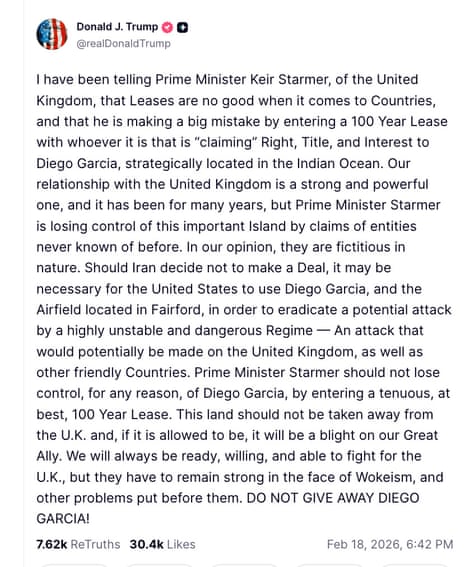
And here is our overnight story, by Nadeem Badshah.
This is not the first time Trump has denounced a deal that he previously supported. In their London Playbook briefing for Politico, Andrew McDonald and Bethany Dawson have a good round-up of Trump’s various U-turns.
Starmer must finally understand how his backbenchers feel when he piles up the U-turns. Trump said on Feb 27., 2025 he was “inclined” to go along with the deal, despite excitable (but perhaps ultimately prescient) noises from critics saying his administration would can it … He signed it off on April 1, 2025 … Then he described it as an “act of great stupidity” in a middle-of-the-night Truth post on Jan. 20 this year … Before he posted on Feb. 5 that it was the best deal Starmer could have made … Followed by official backing from the State Department on Feb. 17 … And then came his broadside on Feb. 18 apparently reversing all of that again. Trump’s press secretary confirmed later Wednesday that his view is that of the administration.
Only two days ago the US state department said it approved the Chagos Islands deal.
So where does this leave the deal? Last night the Foreign Office put out a statement saying the agreement negotiated by the government was “the only way” to guarantee the security of Diego Garcia. A Foreign Office spokesperson said:
The deal to secure the joint UK-US military base on Diego Garcia military is crucial to the security of the UK and our key allies, and to keeping the British people safe.
The agreement we have reached is the only way to guarantee the long-term future of this vital military base.
But Kemi Badenoch said that Trump was right to say the Chagos Islands should not be given to Mauritius, and that it was “time to kill this terrible deal”.
Trump is right.
As I’ve said before Starmer’s Chagos deal is an act of great stupidity. Paying £35bn to surrender the islands is complete self-sabotage.
Chagos is a strategic asset. If our closest ally is saying this, the PM should listen. It’s time to kill this terrible deal.
I will post more on this as the day goes on. Parliament is still in recess, and there is not much in the diary, but Starmer has given an interview to BBC Breakfast, mostly focused on the proposals to impose new sanctions on tech companies that don’t swiftly remove non-consensual intimate images that he has written about for the Guardian.
And details have been leaked about what will be in the plans to reform special educational needs and disabilities (Send) education that will be announced next week. Here is our overnight story by Sally Weale.
If you want to contact me, please post a message below the line when comments are open (between 10am and 3pm), or message me on social media. I can’t read all the messages BTL, but if you put “Andrew” in a message aimed at me, I am more likely to see it because I search for posts containing that word.
If you want to flag something up urgently, it is best to use social media. You can reach me on Bluesky at @andrewsparrowgdn.bsky.social. The Guardian has given up posting from its official accounts on X, but individual Guardian journalists are there, I still have my account, and if you message me there at @AndrewSparrow, I will see it and respond if necessary.
I find it very helpful when readers point out mistakes, even minor typos. No error is too small to correct. And I find your questions very interesting too. I can’t promise to reply to them all, but I will try to reply to as many as I can, either BTL or sometimes in the blog.