3 months ago
64
3 months ago
64
It is very hard to describe a work by the British conceptual artist Ceal Floyer because description overburdens it. Her practice was so finely wrought that it existed only in the experience between a work’s idea and its absorption. Ceal handled this equation deftly and with perfect poise, but it was a perilous and naked process with little or no place to hide, or none.
Resolving the relationship between an idea’s inception and its manifestation became increasingly fraught for her and many works never made it to fruition. Therein lay her courage. This is why I wanted to add something to last month’s obituary of her by Jonathan Watkins.
Ceal was exceptional and brave. Her work laid her bare to the vicissitudes of existence because that’s what it was made from. Her practice was so embedded in her life that living with a brain tumour for 23 years took a toll on it, despite her continued defiance and disregard for the time limits allotted to her by her prognosis. Her brain/work nexus was so unusual that her brain surgeon took an exceptional diagnostic interest in her art. But this same brilliance meant that she could not bear to be seen to lose control and therefore preferred to isolate herself than reveal any cracks. She continued to incubate ideas but often failed to realise them and over time this began to frustrate and disappoint her.
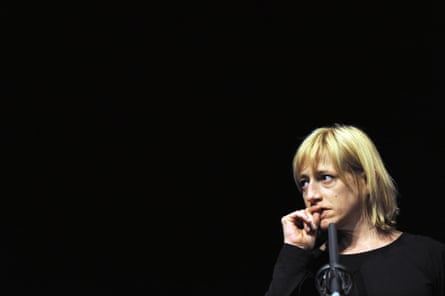
But in her last month, in the palliative care unit in a hospital dedicated to Saint Francis near Zoo station in Berlin, she was freed from this burden and, in the face of death, became briefly once more the artist she had been. Despite the terrible attrition in her body, she was purely and unequivocally Ceal, strangely vital and resolute. Many people visited her, which encouraged the dormant performative aspect of her practice.
On the wall was a wooden crucifix. She kept pointing at it and it was clear that it represented death, though she was still alive and present. She told us, as she tried to grab a glass of water, that she no longer knew if she were very old or very young. Then we watched her as she formed an idea: could we get her some colouring-in books? Adding later that she would only need black crayons. I bought her the books and the crayons, but they remained untouched; the idea was the point.
She became increasingly inaudible over her longer than anticipated hospital stay. On what would become her last full day, she raised herself up from sleep when we arrived, reached for, and clung on to, the triangular bar above her bed, holding on to it for what felt like an unbearably long time. It was clear it meant life in the way the crucifix on the wall meant death. Occasionally, Ceal shook the bar, as if willing it beyond its inert capabilities. Eventually, she let her hand drop and signalled to us to get her a nurse and, more clearly and audibly than had been possible for a long while, she answered to the doctor’s offer of morphine, “Yes please.”
And in the while they took to go and get it, as I stood beside her bed, she lifted her hand and gave the middle finger to the cross on the wall. The gesture was unambiguous, audacious and courageous: I was her audience and her viewer, and she was giving death the middle finger with me as her witness. Aware and pleased by my reaction (I was both shocked and impressed), and with the slightest of feline smiles on her face, she allowed the nurse to give her the morphine and did not, to my knowledge, really resurface.