3 months ago
67
3 months ago
67
Tensions between the United Arab Emirates and Saudi Arabia over the future of Yemen and the imminent possibility of the declaration of an independent southern state have reached boiling point with Saudi Arabia in effect accusing the UAE of threatening its future security.
The dispute has the potential to create a civil war within the south of Yemen and also spill over into other disputes including in Sudan and the Horn of Africa where the two countries often find themselves backing opposite sides. Yemen could yet become only one theatre in which the two vastly wealthy Gulf states vie for political influence, control of shipping lanes and commercial access.
The UAE has been dabbling in Yemen for years due to its support for the separatist Southern Transitional Council.
Many observers, including diplomats in Riyadh, had assumed that the UAE – often thought of as the junior if more ideological partner – would back down and tell the STC to delay or jettison its plan to declare independence and instead settle for negotiations on greater autonomy or more seats in Yemen’s coalition government body, the Presidential Leadership Council (PLC).
Saudi Arabia had always seen Yemen as its preserve, first trying to defeat the Iran-backed Houthi rebels in the north with a much-criticised bombing campaign in 2015 and then under international pressure reverting to diplomacy to try to reconcile the Houthis with the UN-recognised government in Aden.
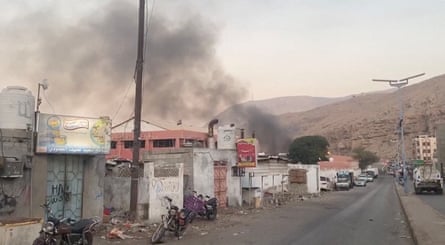
But in the past month, the UAE has kicked over many assumed red lines in Yemen, leading to the Saudi bombing of vehicles docking at the Yemen port of Mukalla. Riyadh pointedly said the vehicles had been sent for STC use and had come from an Emirati port.
Saudi Arabia said: “The kingdom stresses that any threat to its national security is a red line, and the kingdom will not hesitate to take all necessary steps and measures to confront and neutralise any such threat.”
But the UAE has been quietly considering commercial opportunities in Yemen for years. Tapping into the genuine, popular desire to restore the independence the south enjoyed before unification with the north in 1990, the UAE chose the STC as its vehicle.
It was a shrewd bet. The STC was finally recognised as a genuine player in 2019 when it was given seats on the PLC.
After years being sidelined in UN peace efforts, the STC leader, Aidarous al-Zubaidi, slowly gained western recognition and was allowed to attend events such as the UN general assembly.
But the STC, feeding off longstanding cultural and economic grievances with the north, was never content with federalist solutions, and felt anyway it had been sidelined in the PLC.
This month, the STC grabbed its opportunity, sending its forces into Hadramaut, the largest governorate in the south.
With its sudden eastward expansion, the STC controlled nearly all of the territory of the former South Yemen state, including its most productive oilfields.
After seizing Hadramaut, it was relatively easy to take al-Mahra, the most easterly governorate.
It was a severe shock to Saudi Arabia, which has since been applying diplomatic pressure on Abu Dhabi to demand the STC’s withdrawal.
In a ferocious diplomatic battle, Riyadh tried to isolate the UAE and the STC, making it clear that even if the STC stood its ground, southern Yemen would never progress beyond a micro-state lacking international recognition.
So far, the UAE is not buckling. The withdrawal of the few remaining UAE counter-terror forces in Yemen announced on Tuesday is of no significance since UAE support for the STC remains.
Abdulkhaleq Abdulla, an Emirati political scientist, is portraying the UAE defence of the STC almost as a litmus test of the UAE’s character. He wrote on X: “The UAE does not let down nor abandon its allies. It supports them with generosity and political and military abundance. It does not leave them midway on the road to face their fate without support. It is clear in its policies and steps. It does not flee nor evade confrontation. It has a clear vision of its national and humanitarian responsibility and fulfils it with utmost care.”
Equally patriotic statements are emerging from Riyadh. Farea al-Muslimi, a Yemen and wider Gulf research fellow at the Chatham House thinktank, is in little doubt about the enormity of what may be at stake.
“After years of indirect competition through local proxies, the dispute now appears to be moving toward a more direct confrontation, with Saudi Arabia publicly accusing the UAE of actions that threaten its national security along its southern border,” he said.
“The conflict reflects fundamental disagreements between Riyadh and Abu Dhabi over the future political structure of Yemen and the balance of influence within it. Notably, the UAE – despite its greater geographic distance – has pursued a more interventionist and experimental approach on the ground.
“Tensions between the two countries have been building for years. These actions suggest that the situation is entering a particularly dangerous phase. This development also evokes troubling parallels with the 2017 Gulf crisis involving Qatar, when Saudi Arabia and the UAE coordinated a major diplomatic rupture that destabilised regional relations for years.”
Muslimi added that the Houthis were “likely to view the growing rift between two of their principal adversaries with considerable advantage, observing as former coalition partners – who jointly fought and failed to defeat them – now turn against one another”.
Western governments, taking their lead from Washington, have shown in Sudan little desire to criticise the UAE in public, and in Yemen their sympathies will be with Saudi Arabia and the retention of a unitary state.