4 hours ago
6
4 hours ago
6
Like many Canadians, Tom Reid isn’t crossing the US-Canada border as often these days. But he needed a haircut.
The woman who cuts his hair lives in International Falls, Minnesota – her “sister is married to my wife’s cousin”, he explained – and so Reid, whose duty free shop in Fort Frances, Ontario, has to travel to her.
That’s how it goes for the residents of the two towns, divided by the Rainy River and an international border. They’re longtime friends and, in many cases, family. People cross the border frequently to shop, dine, go bowling, take their kids to sports and visit each other.
But Trump’s trade war against the US’s northern neighbor, and his derogatory comments about their country, has Canadians – known for their politeness – angry. Furious, actually. They’re shopping less at US businesses, and, in an unusual show of patriotism, encouraging consumers to “buy Canadian instead”.
Reid is buying Canadian more and more, he said at the register in his shop, with the Canadian flag on the wall behind him. “I don’t have that much choice, eh?” he said.
American business owners have seen declines in Canadian sales, while grappling with the uncertainty and costs associated with tariffs on their products. With tourist season winding down, and the leaves starting to change into yellows and oranges, the two towns are quieter.
Canada’s retaliatory tariffs went into force this week, though no one who lived in the towns had seen that directly reflected in prices yet. It was the latest heated battle between the two countries in the last nearly two years.
The mayors of the two towns call each other friends, and signed a joint declaration in 2025 affirming that friendship after Trump retook the White House. The flags of both towns, states and countries fly outside the town offices in Fort Frances. But there’s only so much – and really, nothing – that a local official can do to blunt the economic effects of slipshod tariffs put in place by one man, more than a thousand miles away in Washington.
Hoping for the best
Most Canadians recognize this, according to Andrew Hallikas, the mayor of Fort Frances. They like Americans, and Fort Frances residents can relate to Minnesotans a lot: they share similar interests, in the outdoors and in community, he said. But they’re “irate” at Trump – for bullying their country, for going against an ally – and for suggesting Canada should become the 51st US state.
“You cannot imagine how angry that makes us,” Hallikas said. “Please quote me on this. I cannot make this clear enough: we will never become the 51st state. We consider ourselves to probably be the best country in the world in which to live, and we’re quite content to remain that way, thank you very much.”
For two towns that rely on each other, the tension of the trade war simmers underneath the surface. They all want it to end. They don’t know how, or when, it will.

As the Guardian interviewed the mayor of International Falls at a coffee shop on the town’s main drag, a Fort Frances resident interjected angrily to tell the mayor that Canadians are “so pissed off” at Trump for how he’s attacked their country and that International Falls needed Canadians to survive. Their town was suffering, and their businesses losing longtime customers from Canada, because of it, he said.
“I’m originally from the Falls, but I’m an American living in Canada,” the man said. “I’m scared to put that American flag on my shirt, what he’s done.”
Residents, and the leaders of the towns, are worried about how they will rebuild the relationship between their two countries if this continues for much longer. Businesses will find other suppliers. Shoppers will replace their favorites with homegrown options. The sense of nationalism hardens.
“We just hope for the best at this point,” said the International Falls mayor, Drake Dill.
Grant Hauschild, a Democratic Minnesota state senator who represents 65% of the state’s border with Canada, said he’s heard from businesses that have lost up to 30% of their revenue from Canadians. With people already struggling with inflation and high costs, he said a hit like that goes from “a concern to devastation”.
“My hope is, of course, that the relationship goes back to normal once we pass these chaotic times,” Hauschild said. “I think that’s what really scares me most … Even if people want to go back to the way things were, they might have unfortunately kind of moved on – and moved beyond – the relationship.”
To cross the Rainy River into either side, people use a toll bridge, with the cost for an average car now $10. They present documents to customs agents on whichever side they’re entering, and answer questions about their purpose in town. People who cross regularly recognize the agents and ask after their families.
The main parts of each respective town sit on either side of the crossing, with both towns initially growing around paper mills. Fort Frances’ mill has since closed; International Falls’ is still running. Fort Frances is larger than International Falls, and because Canada is more sparse, Fort Frances serves as a regional hub. Its hospital will soon be getting an MRI machine – a huge boon for its aging population.
The shops on either side carry gifts from both countries, catering to tourists who fly in to fish, mostly for walleye, and largely on the Canadian side. In a Fort Frances store, kids books called “Little Minnesota” and “Little Canada” sat right beside each other on a shelf. In International Falls, shelves of souvenir cups carried designs for International Falls and Canada.

While Canadian flags line the shop windows and fly throughout downtown Fort Frances, Hallikas said this is not a reflection of increased patriotism, but just a border town welcoming visitors to their country. The two towns are “neighbors by geography, but we are friends by choice”, he said.
“The bridge is over 100 years old, and we’ve been going back and forth it for over 100 years,” Hallikas said. “Before that, there was a ferry. But our friendship is still going to exist when Trump is long gone.”
Dill, the International Falls mayor, owned a business and lived in Canada for 11 years. Many of his friends are Canadian. This fall, he will go up to an island in Canada to meet up with friends.
“There’s no politics in that. There’s no thought of exchange rate, or trade war, or tariffs. It’s just – we’re friends,” he said. “But then you come home and you talk and you watch the news. … I would be really disappointed if it gets to a point where we can’t work through it, and there’s a fundamental change that will hurt International Falls significantly.”
Residents on both sides have favorite products they grab whenever they cross. For Heather Johnson, executive director of the Fort Frances chamber of commerce, it’s Top the Tater, an iconic Minnesota chive and onion dip. She also checks prices on cheeses, and peruses the wider variety of pastas for sale in US stores. Johnson bowls weekly in a league in International Falls, made up of both Americans and Canadians.
Leanne Guba, a Canadian who owns Hometown Hobby and Crafts in International Falls, crosses back into her home country once or twice a month, usually walking across the bridge, to buy ketchup chips, chocolate bars and Dad’s brand oatmeal chocolate chip cookies.
American liquor is no longer on the shelves at government-run Ontario liquor stores, by order of Premier Doug Ford. The push to buy Canadian is “pretty well elbows-up”, Johnson said. “I’m drinking Canadian red wine now.”
‘Mr T took care of that’
Reid, the duty-free shop owner, said the tourist season was about average for him, with no noticeable decline in sales. He has seen some change in his customers.
A couple of years ago, they’d come in with the signature red Maga (Make America Great Again) hats. Last year, not as many. This year, he didn’t see any red hats, and customers would tell him they didn’t vote for Trump. They’ll ask about the missing American bourbon from his shelves, and he’ll tell them, “Mr T took care of that”.

He used to cross the border to go to a show, or the grocery store, or Menard’s, a hardware store, but not anymore. His daughter and her husband used to cross weekly for a date night and shopping, but no longer. People over here are “really upset” with Trump, he said. It has renewed his sense of Canadian pride, but “I’ve always had good pride”.
Johnson, whose kids are now grown, said: “I’m glad that my kids grew up knowing both countries, and they know that there really isn’t a difference in people.”
Across the border in International Falls, craft store owner Guba said she was seeing fewer Canadians, for several reasons. They’re dealing with rising costs, too, and the exchange rate is unfavorable. Some of it is politics, she said. Canadian regulars are coming less frequently.
“They’re definitely being a little more picky about when they come over or being more careful about what they buy,” she said.
The decline, while dealing with unpredictable tariffs on goods she brings in from overseas, has had an impact on her business. She’s adapted by seeking out new suppliers, bringing in new merchandise lines, and trying to reduce costs. She has a few companies she orders from in Canada – including a toy brand and a puzzle company – and expects the new tariffs will likely increase costs on those products.
People are upset about the political dynamics, but they don’t tend to vent their political frustrations openly, she said. There may be the odd joke here and there, but not usually full-blown political debate. “We tend to try to stay friendly,” she said.
The latest tourist season was “decent”, she said. “Overall, we’re still surviving … You can’t really control it.”
‘We remain neutral’
It’s tough to gauge the full impact of declining Canadian spending in the border town, though anecdotally, people are noticing it. The International Halls chamber of ommerce wouldn’t comment on the impact of the tariffs, or deteriorating relationship between the two countries, on the town.
“We remain neutral on political matters so that we can best serve our diverse membership, which includes individuals and organizations with a wide range of views. Because of that, the Chamber does not have an official comment on the political issues surrounding the US-Canada relationship,” the chamber said in an email.
Isaac Johnson, who owns the Coffee Landing café in International Falls and lives above it with his wife, said he still sees a lot of Canadians who come over to grab espresso and breakfast. He loves his Canadian customers, including the couple he watched meet up at the coffee shop from across the border. They later married.
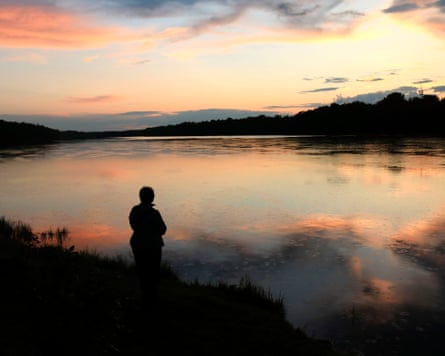
28 July 2018 Photograph: Don & Melinda Crawford/UIG/Getty Images/Collection Mix: Subjects RF
The locals are caught in the middle of political games, said Johnson, who tries to just focus on himself, his family, and his faith. But people do get emotional about it at times, and “if you definitely bring up politics, for sure,” he said – just as the man who confronted Dill, the mayor, did.
The man, who didn’t share his name or want to have a longer conversation with a reporter, said he’s noticed far fewer Canadians around town, nothing like it used to be. He described Canadians as “very pissed off” and said snowbirds were selling their houses in the US. International Falls voters went for Trump in 2024.
These broader issues, like the trade war, “pit us against each other”, Johnson said, noting that the man got mad at the mayor “over a guy that’s making billions off us all”.
“I love the Canadians, I love Americans, and I love them coming over here and enjoying what we have here, and we can go and enjoy what they have,” Johnson said.
Dill, the town’s mayor, said Canadians are “definitely” not coming to International Falls as much as they were, though he thinks it has more to do with the exchange rate. Still, he said later, “we need all the Canadian commerce we can get, and I would like to think they feel the same way”.
Local officials are in a tough position. They have no control over the tariffs, though with their communities at the center of the impact, they are expected to answer questions and concerns over levies. They have no direct line to the Trump administration, if that would even make a difference. And their communities are suffering.
Hope springs eternal
Hauschild, the Minnesota state senator, said he meets regularly with the Canadian consulate in St Paul, and reiterates his belief in a strong relationship with Canada. But as a state lawmaker, he has little to no control over any of it, beyond using his bully pulpit.
Hallikas, the Fort Frances mayor, said most Canadians have “no rancor for individual Americans” and treat them kindly when they visit, largely avoiding talking about Trump or American politics. Americans will have to work to undo the damage Trump has done to the relationship between the two countries, and that will take time, even after the trade war simmers down or ends, he said.
“But we’ll still be friends with the folks in Minnesota and International Falls,” Hallikas said.
Dill said he doesn’t often run into the frustrations directed at him by the man in the coffee shop, though it happens. He doesn’t have any way he can directly fix the issue.
“The US elected our current president and he has his own agenda and I don’t see that I can stop it,” he said. “I don’t want it to affect us locally. We’ll see. Hope springs eternal. I mean, I thought that everything was going along fine, but apparently it wasn’t.”
The uncertainty of it all is “frustrating”, and he’s most curious about where it all lands, when a truce could be signed so that businesses can have a sense of comfort in planning for their futures. The two countries are engaged in a heated dispute – or a “donnybrook,” as they would say in Canada, noted Dill.
He likened the current situation to two longtime best friends, who hunted and fished and vacationed together for years – until one of them said, you’ve been taking advantage of me for years.
“That’s like driving a nail in a fence,” he said, “and then you pull it out, and even if the fence still stands, there’s a hole where the nail was.”