2 months ago
47
2 months ago
47
It was nearly dark on 19 January 2022 when the knocking began. At first soft, then insistent, the sound echoed through the flat in the Afghan capital, Kabul. Zarmina Paryani and her sisters froze. They had known this day was coming.
“We always knew the risks of protesting and we were prepared to die on the streets,” the 26-year-old activist told the Guardian. “But I never imagined they would come for us like that – in the middle of the night, breaking into our home.”
Just three days earlier, she and dozens of women had protested on the streets and burned a burqa in a symbolic act of defiance against the Taliban’s growing restrictions. The protest had been organised via WhatsApp groups and word of mouth.
The image of the burning burqa, shared on social media, had gone viral and ignited uproar among Taliban soldiers and supporters, who were demanding the women be stoned to death for disrespecting the garment. Now, they were at her door.
As masked men began forcing their way inside, Paryani says she made a desperate decision. “I couldn’t bear to be taken alive. I couldn’t watch them enter our bedroom, violate us or behead us in the night.” She jumped from the three-storey window.

Miraculously, she survived the fall with minor injuries. Just as fortunately, before the Taliban could break down their door, her sister Tamana Paryani recorded a short video in which she screamed that the Taliban were outside. She sent the footage to a journalist and it was immediately posted on social media, with their arrest initially denied by the militants.
“That video saved our lives. It was the only weapon we had.”
Zarmina grew up in Panjshir, in a deeply religious family. For years, before she moved to Kabul, her education consisted only of mosque schooling. “From a young age, we were taught that women were ‘deficient in mind’. I believed it. I adjusted myself to it.”
But school brought questions. Why were her high marks never enough to prove her worth compared with her brother? Why did neighbours mock her for attending school at all? Her mother, who had been denied an education, encouraged her daughters to keep going. “She used to say: learn so you will never need to depend on a man.”
Zarmina trained as a midwife, but when the Taliban returned to power in August 2021, the small gains that women and girls had made evaporated overnight. “It felt like a storm had come. Everything we had, even the little things, they took away.”
In the early weeks of the takeover, a spontaneous women’s protest movement emerged. Largely leaderless, composed of ordinary women – students, police officers, teachers, midwives – it began as scattered, small-scale marches. Zarmina and her sisters joined.
“We didn’t tell our father. He would never have let us go. Like many families, they didn’t support the protests because they feared for our safety.”
They covered their faces with masks, met in secret, and hid signs inside black plastic bags. Sometimes they changed locations at the last minute to evade Taliban patrols. Their demands were simple: the right to study, to work, to live without fear.
“We were not affiliated with any political party. We were just women asking for our rights,” says another protester, who was detained and beaten by Taliban officials after a protest near Kabul University in December 2022.
By January 2022 and the raid on Zarmina’s home, the sporadic arrests had turned into a targeted suppression. The video her sister sent to the journalist spread across international media and prompted global outrage. But inside Afghanistan, the result was clear: dissent would be met with brutal force.
The Taliban were arriving at the site of protests sometimes before the protest had started, says Zarmina, with women repressed into silence.
Today, no women come to the street to protest. The last known public protest took place in west Kabul in September last year. Indoor protests, symbolic acts, such as dancing alone in a mosque or burning the burqa, are now the only forms of resistance.
Since the Taliban’s return to power, women and girls have been barred from nearly every aspect of public life: schools, universities, most jobs and even parks.
Zarmina spent 27 days in detention before being released and told: “If you speak again, we will cut your throat.”
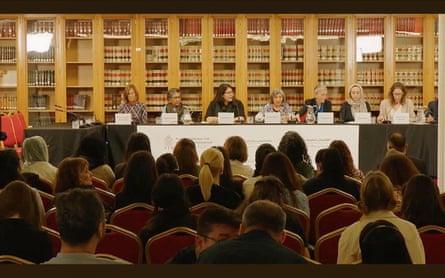
She managed to escape to Pakistan disguised in a burqa and plastic shoes and now lives in exile in Germany. “I don’t feel secure even here. And when I write or speak, I wonder: will my father be harmed? Will my family be punished?”
Despite her fears, she testified at the People’s Tribunal for Women of Afghanistan during a hearing in Madrid in October, one of the few venues where Afghan women have spoken publicly about gender apartheid under Taliban rule. “It didn’t change what happened to me, but at least it’s a record for history.”
Rashida Manjoo, chair of the Tribunal, said: “The systematic exclusion of women and girls [by the Taliban authorities] from education, employment, healthcare, freedom of expression, public life and freedom of movement constitute gender persecution.”
Zarmina and other anti-Taliban protesters in exile say they continue to get messages from girls in Afghanistan who have been pushed into marriage, or forced to do sex work to be able to afford to feed their children.
“We used to think the Taliban were just a group of religious men. Now we see what their rule really means. Maybe next time, people won’t be fooled. Sometimes I think this generation, with all this suffering, might finally learn who the real enemy is.”
Zahra Nader is editor-in-chief and Sayed Abdali a reporter at Zan Times journalist