3 months ago
64
3 months ago
64
There haven’t been many police dramas quite like Blue Lights. While it might feel as if you’re simply watching a superior spin on a generic format – the gritty, urban cop show – Declan Lawn and Adam Patterson’s Belfast-set thriller is actually an outlier. Paradoxically, police procedurals usually work as entertainment because the police defy the procedures. The rule-breaking maverick cop is among the sturdiest of all TV archetypes. Blue Lights is the opposite. It works so brilliantly because it’s a stickler for the rules. It has to be.
Rule-breaking mavericks generally come a cropper in Blue Lights. Shane (Frank Blake) nearly loses his career because of some shady evidence-gathering via a mobile phone. When Aisling (Dearbháile McKinney) pays an after-hours visit to a domestic violence suspect, catches him abusing his wife and arrests him, she doesn’t get a pat on the back; she is suspended for behaving like a vigilante.
But the strictly procedural nature of Blue Lights isn’t a killer of tension – it’s the source. Has there been a more terrifying cliffhanger in recent TV memory than the ambushed suspect convoy in episode five of this third season? It began with an ominous question from HQ (“Is your vehicle armoured or soft-skinned?”) and culminated in a visibly panicking Grace (Siân Brooke) pleading “Will someone tell me what to do?!” The stomach-churning dread lay in the powerlessness of the car’s passengers – at this point, we can trust that Grace isn’t going to go rogue as she might in a lesser show. She isn’t going to perform a ludicrous manoeuvre or take out a van-full of paramilitaries on her own. Salvation will come (if it comes at all – after all, if the writers can kill Gerry, they can kill anyone) from someone on the other end of a radio following procedure properly.
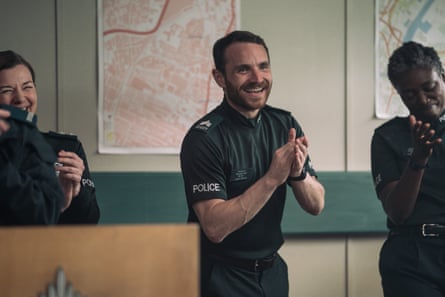
There’s a wider powerlessness at play here too, which gives Blue Lights real historical weight. While the cocaine trade is the basic plot-driver, even that has a subtext. Many British people did their best to ignore what was effectively a civil war going on in a corner of their country for nearly three decades. The Good Friday agreement of 1997 meant it could be forgotten completely. But for many communities it continues, as a menacing ambient hum. And its parameters – both political and social – are too big to reckon with. Convincingly, and with real humanity around the emotional costs, Blue Lights mines the long tail of the Troubles for tension and narrative force. Cops still routinely check under their cars for bombs. Sometimes, they still find them.
After the Good Friday agreement, many former combatants simply transferred their talents into drug dealing. In fact, Michael Smiley’s intelligence officer Paul “Colly” Collins seems sardonically nostalgic about the clear lines and perverse moral clarity of the Troubles. He recalls a lengthy conversation with an IRA gunman about the Catholic theological rationale for a just war. The good old days, eh? It turns out that organised crime gangs are even less biddable and more volatile than sectarian paramilitary groups. Again, this is not a situation that invites maverick approaches to police work. Being a maverick could get you killed.
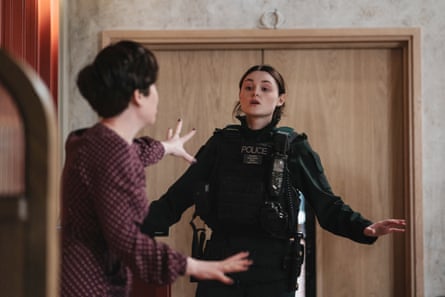
And this is where we find the flawed, likable “Peelers” of Blackthorn station, with their delicious cupcakes and clandestine tequila parties and Westlife fixations. How can normal police reckon with history like this? They can’t, and the result is trauma. There’s enough genuine anguish to make moments that might otherwise seem emotionally exploitative feel fully earned. After the death of her mother, the parish priest tells Annie (Katherine Devlin) that “this world is mainly faith versus shite”. As the shite piles up, how do the coppers keep that faith?
Tommy (Nathan Braniff) and Sandra (Andi Osho) sit on a sofa, listening to an elderly man with dementia play Gerry’s favourite Kris Kristofferson song. It’s incredibly moving, and hits home in the context of the brutally unsentimental police work that surrounds it – the severed femoral arteries, the desperate teenage runaways, the realpolitik of having to watch the gangster who killed your husband walk free and not knowing what deals have been done to make this unavoidable. Blue Lights gets away with being softly sentimental every now and then, because it’s granite hard too.
Since it launched in 2023, critics have cast around for shows resembling Blue Lights. It’s usually a good sign when nothing much springs immediately to mind. There are traces of Line of Duty’s intense pocketbook precision. Its ensemble cast maintaining an uneasy balance between work and domesticity occasionally recalls 1980s US classic Hill Street Blues. But increasingly, it bears comparison to HBO’s Baltimore epic The Wire. It is constructing a loving, despairing, characterful portrait of a city. It examines dysfunctional municipal systems through the perspectives of the people trying to work within them. Each season builds on the work of the last, creating a richer, fuller picture. And it finds big contexts for its smallest constituent parts. To borrow The Wire’s tagline, in Blue Lights, all the pieces matter.