2 months ago
53
2 months ago
53
History used to be about wars and dates, but to the architecture writer and TV presenter Dan Cruickshank, it’s more about floors and grates. In his new book, he takes a keen-eyed tour of eight English houses, from Northumberland to Sussex, dating from the early 1700s to exactly 100 years ago, and ranging from an outlandish gothic pile to one of the first council flats. In Cruickshank’s pages, classical influences from Rome and Greece give way to a revival of medieval English gothic and the emergence of modernism.
He is particularly interested in who commissioned and built his chosen dwellings, and how they got the job done. It’s a new spin on the recent fashion for historians to explore the homes of commoners, as opposed to royalty and aristocrats, in order to tell the life stories of their occupants. This probably began with the late Gillian Tindall, who wrote a highly original book about the various tenants of an old house by the Thames next to the rebuilt Globe theatre. That was followed by several series of A House Through Time, fronted by Traitors star David Olosuga.
At first sight, Cruickshank seems to have set himself a thankless task – and dragged the reader into it alongside him. When it comes to establishing how early buildings went up, there isn’t a lot to go on. “Few contemporary or intimate documents – such as letters or diary entries – survive in significant number that chronicle [their] creation,” he says. But all is not lost. “What does survive are building accounts that list names of tradesmen, sums charged and dates on which bills were paid.” He concedes that this throws up “somewhat arid evidence”, and he isn’t kidding: for lengthy stretches, “The English House” is constructed out of yellowed builder’s dockets mashed up with dense architectural jargon (“… a semi-elliptical colonnade formed by four free-standing Ionic columns supporting a full entablature and flanked by pedimented door surrounds”). Cruickshank could be forgiven for wishing that his book was accompanied by a TV series – with graphics to explain various construction techniques – and if so, he wouldn’t be the only one.
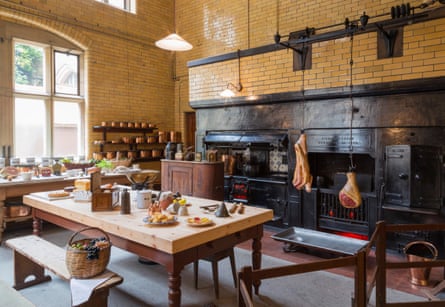
A house is not a home, as Bacharach and David rightly told us, and fortunately Cruickshank’s research ends up revealing a surprising amount about the inhabitants of his eight properties. Pallant House in Chichester, now an art gallery, was the scene of lively arguments between the young swell who commissioned it and his older wife who paid for it all. This didn’t go unnoticed by their tradesmen, whose records of work on the house expose the couple’s frequent disagreements about what should go where and how much they should fork out for it. In Hull, a man called Henry Maisen built a fine house for himself in the mid-18th century but left most of the work to his brother, Nathaniel, while he enjoyed himself in London. In 1744, Nathaniel wrote him an exasperated letter care of “Mrs Rawlinson’s, A Toy Shop, Bedford Street, Covent Garden”. This was a red-light district, and as Cruickshank notes, the first children’s toy shop in the capital wouldn’t be open for another 16 years – so “it seems not unlikely that the toys available at Mrs Rawlinson’s were of a distinctly adult nature”.
If the author is a little uncomfortable with this evidence of the ageless human comedy, he’s more receptive to the darker stories he uncovers. The Boundary Street estate in London’s Shoreditch, begun in the 1890s, was home to the first council flat “as we know it”, says Cruickshank. Though it replaced a notorious and fetid slum, most of the luckless inhabitants of the rookery were moved on rather than rehoused. A banker’s residence in Liverpool prompts an exploration of the port’s role in the transatlantic slave trade. A house built by Huguenots in Spitalfields, east London, might nowadays be close to the homes of millionaire artists including Tracey Emin and Gilbert and George (and of Cruickshank himself, though he doesn’t say so) but these French Protestants, fleeing Louis XIV, were only the first wave of embattled immigrants on the premises. It was later a synagogue, now abandoned. “It takes only a little imagination to fill its shadowy corners with spectres, and it’s hard not to strain to hear the voices of the long dead.”