3 months ago
61
3 months ago
61
Now in his 80s, Ian McKellen appears to have taken a strategically sedentary route for his appearance as Gandalf the Grey in the next year’s Lord of the Rings weird-quel The Hunt for Gollum. You’ve probably heard about this thing: it’s the new movie that’s based on bits and pieces of JRR Tolkien’s esteemed high-fantasy epic that were only mentioned in passing during the three original three-hour movies, and didn’t get much more of a mention in the extended cuts that came out later.
In the original novels, Gandalf reveals to hobbit Frodo Baggins that he and Aragorn, AKA Strider, AKA the future King of Gondor and Arnor, searched for decades for the creature Gollum in an effort to find out what might have happened to the ring he once held. In the new movie, though, things will be different. According to McKellen, Aragorn will take charge of the quest to find Gollum, while Gandalf will operate more like a wizardly mission controller. “The script is designed to appeal to people who like Lord of the Rings,” McKellen told the Times. “It’s an adventure story, Aragorn trying to find Gollum with Gandalf directing operations from the sidelines.”
So it seems the wizard will be putting his feet up while his Númenórean pal does most of the heavy lifting.
Meanwhile, earlier this month, the Tolkien fan site TheOneRing.net revealed what it insists is an official synopsis for the new Andy Serkis-directed film:
“Before the Fellowship, one creature’s obsession holds the key to Middle-earth’s survival – or its demise. In The Lord of the Rings: The Hunt for Gollum, we meet young Sméagol – an outsider drawn to trinkets and mischief – long before The One Ring consumed him and began his tragic descent into the tortured, deceitful creature Gollum. With the ring lost and carried away by Bilbo Baggins, Gollum finds himself compelled to leave his cave in search of it.
Gandalf the Grey calls upon Aragorn, still known as the ranger Strider, to track the elusive creature whose knowledge of the whereabouts of the ring could tip the balance toward the Dark Lord Sauron. Set in the shadowed time between Bilbo’s birthday disappearance and the Fellowship’s formation, this perilous journey through Middle-earth’s darkest corners reveals untold truths, tests the resolve of its future king, and explores the fractured soul and backstory of Gollum, one of Tolkien’s most enigmatic characters.
Directed by original cast member Andy Serkis, produced by Peter Jackson, and written and produced by Fran Walsh and Philippa Boyens – the creative team behind the Oscar-winning trilogy – this live-action movie bridges the beloved films with new characters, returning heroes and a deeply engaging origin story that resets the stage for, and changes everything you know about, the legendary Lord of the Rings trilogy.”
There’s much to unpick here, if the synopsis is to be considered genuine. Firstly, this sounds almost like a Gollum biopic rather than the scattered fragments of backstory we were told in passing during the original trilogy. Sméagol was only briefly described, retrospectively, as “young” in Tolkien’s books, and only appeared on screen in his hobbity, pre-ring-grizzled state during the opening of The Two Towers film, where he stole the One Ring from the doomed Déagol because the latter had the misfortune to find it on his birthday.
The writers can of course go wherever they want. Perhaps we will meet Gollum’s mum and dad, a gently bickering riverside couple, or maybe we’ll see his first day at hobbit primary school. And why stop there? If modern franchise logic holds, this could be just the first instalment in the Sméagol Cinematic Universe, perhaps to be followed into multiplexes by Gollum Begins, Gollum: The Reckoning, and Sméagol v Shelob: Dawn of Snacktime. By 2035 we may well be watching a six-part prestige drama on Now TV about the early economic conditions of the Gladden Fields, narrated in solemn tones by Cate Blanchett.
All of which rather underscores what The Hunt for Gollum actually represents, and it’s not pretty. Tolkien wrote vast, elliptical, gorgeously expansive and detailed mythic histories in which entire wars are summarised in half a paragraph and crucial events occur off-page because the author had the good sense to know that not everything needs dramatising. Hollywood, however, has developed a horror of empty space. If a character once spent three sentences doing something, that now constitutes at least one feature film, two streaming spin-offs and a tie-in podcast. This, sadly, is the trap into which Serkis, Jackson and the rest of the once-garlanded Lord of the Rings team have fallen – and the danger is that, in trying to wring every last story from Middle-earth, the franchise may end up leaving Tolkien’s world feeling rather like Bilbo himself under the ring’s influence: thin, stretched, and scraped like butter over too much bread.
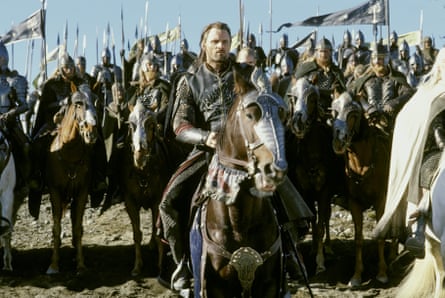
But back to Gandalf. Once a roaming wizard of mystery and myth, he now finds himself reduced to Middle-earth’s first remote operations manager, dispatching Aragorn while monitoring his mate’s progress from the high-fantasy equivalent of a group chat. And yes, it’s probably a better idea than recasting the role, but the suspicion is that Serkis et al. knew they couldn’t get away with that after Viggo Mortensen politely pointed out that he would only be up for returning if the character’s age somehow tallied with his own – which, given the timeline, rather complicates matters since he is now 67. Recasting a single major character, for a movie most Tolkien fans never actually asked for, would be one thing. Replacing two would start to look like a Middle-earth tribute act wheeled out because the nostalgia mines must be kept operational at all costs. The unfortunate suspicion is that this is exactly what happened.