3 months ago
74
3 months ago
74
“Perfection,” the French writer Antoine de Saint-Exupéry once wrote, “is achieved, not when there is nothing more to add, but when there is nothing left to take away.” The Little Prince author was talking about elegance in design, but it’s not a bad principle to apply to having a productive day. Rather than thinking about how many things you can cram in, perhaps it’s better to ponder how few you really need to do, and focus on doing them really well.

Where do you start? With a list, obviously. To the chronically overstressed, taking the time to handwrite all the stuff you already know you need to do can feel like a waste of time, but it’s always worth the effort. “You can’t prioritise tasks if you feel overwhelmed,” says Graham Allcott, the author of How to Be a Productivity Ninja, “but you can be totally overloaded and still not feel overwhelmed. The key to this is getting all the various things you have to work on out of your head so you can start to make sense of them. Get a piece of paper, and write on it all the things you need to make progress on, all the stuff that feels unfinished, everything you care about that isn’t done. It will take you longer than you think, but the very act of getting it all out of your head will help you get clarity, perspective and a sense of control.”
Build momentum
The best next step is controversial: some productivity experts suggest doing the hardest task first, while others advocate building momentum by rattling off some easy wins. The best approach is a mix of both: go through your list and clear out anything you can do in under three minutes, from making dentist’s appointments to writing quick notes to friends or family, then ride the dopamine wave into the more challenging stuff.
“Most people think they’re tired from overwork,” says Scott Clary, the host of the Success Story podcast. “They’re not – they’re tired from mental clutter. The unanswered text, the apology they’re avoiding, the decision they keep postponing. These run in the background of your mind all day like 20 browser tabs, draining your battery. Close those loops first thing, and the energy comes back immediately. The actual work of closing them is almost always less exhausting than carrying them around.” Research bears this out: in a 2011 paper titled Consider it done!, the psychologists EJ Masicampo and Roy F Baumeister found that, though unfulfilled goals can cause cognitive drain, making plans to tackle them mitigates the effect – as long as you eventually carry them out. So many people have written entire books about planning, most of which boil down to chopping things up: if there’s a big, daunting task you’ve been putting off, split it into smaller and smaller steps until you’re left with one “first thing” you can do immediately.

At this point, you’re ready to settle in for the working day, but do try to remember that not all of those hours are created equal. “Each of us has a very limited supply of what I call ‘proactive attention’ – the two to three hours a day where we feel most alive and most able to push things forward,” says Allcott. “It varies from person to person, but for most people it’s in the morning once we’ve had coffee and woken up a bit. What we choose to have our attention on during these hours is what defines our productivity.” A key part of this, he says, is about protecting our proactive attention from distractions – “our phones, emails, meetings, other people. Put your phone on silent, get out of the emails and messages, and close down all the other windows on your laptop. Focus!”
Stop putting it off
There might be any number of explanations for why you’ve been putting off certain jobs, but often procrastination is a way of coping with negative emotions that come up when you think about these tasks, from boredom and frustration to anxiety, insecurity and self-doubt. The trick here is to fight the natural instinct to berate yourself over procrastination and to not be too hard on yourself: in a 2010 paper, researchers found that students who were able to forgive themselves for procrastinating when studying for a first exam ended up procrastinating less when studying for their next exam. They concluded that self-forgiveness supported productivity by allowing “the individual to move past their maladaptive behaviour and focus on the upcoming examination without the burden of past acts”.
One simple way to do this is to mentally rehearse a procrastination situation ahead of time. “Think of a situation that you find yourself in regularly and the behaviour you’re going to do when it arises – which sets up an association before you’ve even started doing it,” says Prof Benjamin Gardner, a specialist in behavioural change at the University of Surrey. “The more specific the better.” You might make what’s sometimes known as an “if-then” plan along the lines of, “If I find myself procrastinating, I’ll gently go back to my work without any self-recriminations.”
Obviously, staying off X and Instagram is a good idea for your productivity (and possibly your sanity), but don’t stop there. “Adding usage limits to the apps on your phone or computer is a gamechanger, but don’t just think of them for social media,” says the productivity coach Teresa Richards, who believes in “achieving more by doing less”. “For my business, I have a 20-minute daily limit for emails, which forces me to be intentional about the ones I reply to and stops me from wasting time reading every marketing newsletter that comes my way. It’s the same with the news – there’s a fine line between burying your head in the sand and becoming overwhelmed by the inequalities in the world. Think about spending a little less time reading the news, and using the few minutes you save to do something more positive.” Stuck for inspiration? Search for “micro-volunteering” opportunities that interest you: the Be My Eyes app, for instance, allows you to be on call to provide real-time descriptions and assistance for people with visual impairments, while Macmillan Cancer Support are always looking for volunteers to handwrite thank-you notes.
And relax
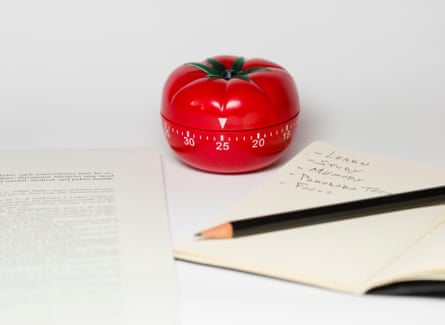
How regular should your breaks be? It really depends on how demanding your work is, and what works for you. Plenty of people follow the popular “Pomodoro” method – using an app, online clock or tomato-shaped cooking timer to work for 25 minutes, take a break for five, and repeat until lunch – and it’s certainly worth a try. Recently, there’s been a bit of a shift towards longer bouts of concentration: the time management expert Nir Eyal reports getting good results from 45-minute sprints, while the Slow Productivity author Cal Newport suggests that you can’t really get things done without settling down for at least 60 minutes. For entry-level productivity optimisers, though, it might be worth taking things the other way: Progressive Pomodoro, a flexible alternative to the traditional version, claims to nudge users into a “flow” state by starting with shorter work blocks and building up to longer ones. To give it a go, start with just five minutes of work: after you’re done, take a (very) short break and decide how long your next “block” should be. Eventually, the theory goes, you’ll be fully immersed in deep work and (hopefully) enjoying at least some of it.

What are you doing in all of these breaks? That’s partly going to depend on whether you’re in the office or working from home, but either way, movement is non-negotiable. There’s a growing body of research showing that active breaks, even if they’re just a bit of a stretch or a stroll to the kettle, can yield measurable benefits for office workers, particularly in terms of wellbeing and health, but also possibly productivity. One recent study conducted on 70 remote administrative workers, for instance, found that workers who were encouraged to take active micro-breaks reported reductions in post-lunch sleepiness, perceived stress and bodily discomfort. An active micro-break could simply entail standing up, moving around a bit, then sitting down again with good posture, or doing something that compensates for working in one position all day. The doorway stretch is a great example: bend one elbow and put your forearm vertically against a doorframe so that your elbow’s just above your shoulder, then move forward until you feel a stretch across your chest and shoulder. Hold for three deep breaths, then repeat on the other side (or, if you’re really time-pressed, do both at once) to counteract some of the forward hunch you’ve been cultivating with hours at the keyboard.
Get out for lunch

At lunchtime, it’s helpful to get out for a walk if you can: and if you can wander past some trees, even better. Spending time in nature, and especially in wooded areas, seems to improve mood by increasing positive feelings such as happiness and optimism, decreasing rumination and providing a buffer from everyday stress. Don’t be put off if it’s raining – who doesn’t find that wet-earth smell oddly soothing? Our noses are incredibly sensitive to geosmin, the compound responsible for the fragrance, probably because it helped our ancestors find water.
What about the afternoon slump? Well, the effect can be worsened by factors such as poor sleep, diet, dehydration and stress. But there’s mounting evidence that it’s an unavoidable feature of human life, thanks to a natural dip in your body’s circadian rhythm, with some researchers from Loughborough University suggesting that it’s less to do with having a carb-heavy lunch than the fact that we’ve evolved to expect a snooze every 12 hours or so. If you can get away with an afternoon nap, great: five to 15 minutes is the sweet spot where you’ll get cognitive benefits for a few hours without needing to overcome any sleep inertia afterwards. If you can’t get away with snoring in the conference room, a short walk and a glug of water are probably the next best thing. And, of course, if you regularly slump in the afternoon, work around that – schedule low-effort tasks such as appointment-making, email replies and invoicing for the post-3pm period when doing anything else feels like wading through treacle.
As for the end of the day – try to go out on a high, and set yourself up for success the following morning. “I encourage my clients to schedule three check-in points each week,” says Liz Hardwick, a productivity trainer and speaker. “On Monday I suggest setting three clear goals for the week. On Wednesday it’s time for midweek reflection: what’s working? What needs tweaking? What would make you feel good if you could finish [it] by the end of the week? And if you can face it, your last working day of the week is time for a look back: what made the biggest impact? What should you refocus on next week?” Take 30 seconds to get rid of any obvious clutter from your desk – at least one study suggests that office clutter is positively related with risk of work-related burnout – shut down all your tabs, and congratulate yourself on a job well done. Tomorrow’s another day.