3 months ago
80
3 months ago
80
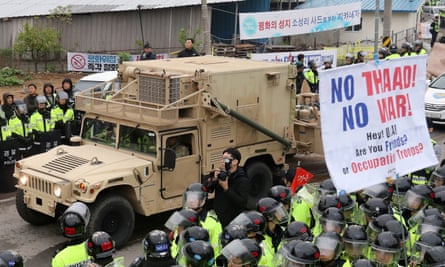
It has been almost a decade since the sleepy South Korean village of Seongju was transformed overnight into a key location in the country’s ability to counter an attack from North Korea.
Early on a spring morning, camouflaged trucks carrying the US-made terminal high-altitude area defense (THAAD) missile-defence system rolled into Seongju, as the country’s government ignored protests from locals who said the deployment would make them a target for Pyongyang’s ballistic missiles.
The conservative government in Seoul, backed by Washington, insisted that Thaad was the most effective way to locate and destroy North Korean missiles before they threatened the South and the 28,500 US troops stationed there. The deployment also angered China and Russia, which said Thaad’s powerful radar could compromise their security.
But nine years on, the US has reportedly started moving parts of the system, along with other military hardware, out of South Korea for deployment in its war against Iran. US media has reported that the Pentagon is moving parts of a Thaad system to the Middle East, citing two officials.
The move, reported this week, has triggered doubts over Donald Trump’s security commitment to South Korea – the US’s most important east Asian ally along with Japan – and warnings that the nuclear-armed North could seek to ramp up pressure on its neighbour. Why, critics are asking, did South Korea invest so much political capital in a defence system that could one day be removed?
South Korea’s liberal president, Lee Jae Myung, sought to reassure the public that the country was able to deter threats from the North, even if the US redeployed weapons and other military assets to the Middle East.
Noting that Seoul had opposed the redeployment of US artillery batteries and air-defence units, Lee told a cabinet meeting: “If asked whether that would seriously hinder our deterrence strategy against North Korea, I can say with certainty that it would not.”
He added that South Korea’s defence budget is among the highest in the world and is estimated to be 1.4 times greater than North Korean gross domestic product.
The South’s foreign minister, Cho Hyun said on Friday that US and South Korean militaries were also discussing the possible redeployment of some US Patriot missile defence systems to the Middle East. South Korean media carried unconfirmed reports that some missile batteries were likely to be redeployed to US bases in Saudi Arabia and the United Arab Emirates.
“For operational security reasons we do not comment on the movement of specific military capabilities or assets,” an officials from United States Forces Korea told the Yonhap news agency.
Even if Lee is right to play down the security risk to South Korea, the weakening of US defences there have raised concerns that the war with Iran signals a downgrading in Trump’s commitment to North-east Asia, where North Korea’s nuclear weapons programme and the Taiwan Strait are potential flashpoints.
“There is a risk that North Korea could miscalculate the relocation of some of these weapons as a pretext for low-level provocations to test the allies’ defence posture,” said Choi Gi-il, a military studies professor at Sangji University.
Japan, too, is having to adapt to the US’s hasty redeployment of military hardware to the Middle East – a move that lends weight to criticism that Trump went into the Iran war without a clear plan, leaving American forces in danger of being sucked into a prolonged conflict.
Japan hosts about 50,000 US troops, more than half of them on the southern island of Okinawa. Two US guided-missile destroyers based in Yokosuka, south of Tokyo, are currently deployed in the Arabian Sea, according to a report by the US Naval Institute.
The head of Japan’s main opposition party has raised concerns about reports that the US was poised to send vessels based in Japan to the Middle East. “Japan has not permitted the stationing of US forces so they can sortie from those bases to fire missiles towards the Middle East,” Junya Ogawa told MPs this week.
The JoongAng Daily, a conservative South Korean newspaper, said any reduction in the country’s ability to defend itself “inevitably raises concerns”.
“The [South Korean] government should work to ensure that any redeployed assets return promptly once their missions end, minimising potential gaps in deterrence against North Korea. Efforts to strengthen Korea’s own defence capabilities should also accelerate.”