2 months ago
56
2 months ago
56
Tai Po, Hong Kong, China, 26 November
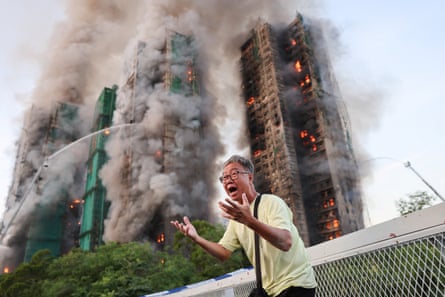
A man cries out in distress as a fire spreads across multiple buildings on a housing estate in Hong Kong
Tyrone Siu/Reuters
A massive fire broke out around 3pm at Wang Fuk Court, a densely packed housing estate in Tai Po, and I arrived about an hour later. By then, the flames were raging across multiple blocks, with thick black smoke. Unsafe bamboo scaffolding and foam may have led to what became Hong Kong’s worst fire in decades. Residents were streaming out in panic, while emergency crews fought a losing battle against the inferno spreading from one tower to the next.
It felt like a nightmare unfolding. Outside the cordon line, I saw crowds of nearby residents and this 71-year-old man, Mr Wong. He was pacing near the barrier, his face crumpled in agony. This photo captures his pure desperation, shouting that his wife was trapped in the blaze, yelling the apartment number to police officers in the hope they could reach her. He had last spoken to her in a phone call when the fire broke out.
In the days afterwards, I couldn’t stop thinking about Mr Wong and his wife. I searched for updates, hoping for good news. Three days after the fire, while shooting near the site again, I spotted him across the road. I reintroduced myself as the photographer, and he said he’d seen my photo everywhere, then pointed to his son behind him. His son said something that struck me deeply: “I thought the home was no more, but home is still here.” His mother had left them, the apartment was ash, but his father, his sister and the rest of his family were together.
Neko Harbour, Antarctica, 22 February
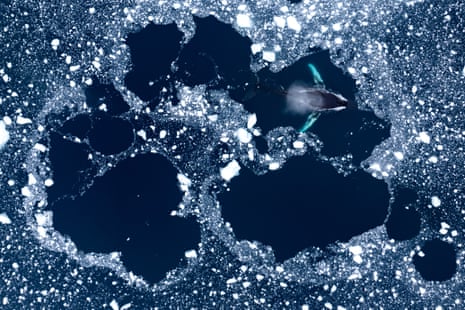
A humpback whale breaks the surface, surrounded by ice, after a dive for krill in Antarctica
Roie Galitz
I was in Neko Harbour, guiding an expedition of photography enthusiasts. There were more than 20 humpback whales swimming around that morning, which was towards the end of the 18-day trip. Some were sleeping, some were feeding. There were a lot of little growlers – small chunks of ice calved from the nearby glacier – that were floating around, and I saw one whale swimming towards there, so I flew my drone up to capture the image. When the whale came up to breathe, the ice was pushed away, and it created this shape of a flower, which I found fascinating.
What I find encouraging is that we have been seeing an increase in whales, especially humpbacks, which were once hunted to the brink of extinction. The whales here are migratory and come to the Antarctic in summer to feed – there are more than 500m metric tons of krill in the Antarctic Ocean, although there are threats from krill harvesting vessels.
Humpback whales are extraordinary creatures. They are in the genus Megaptera, which means huge wings. One of the things I like about this photo is you can see the size of them.
New York City, USA, 5 November
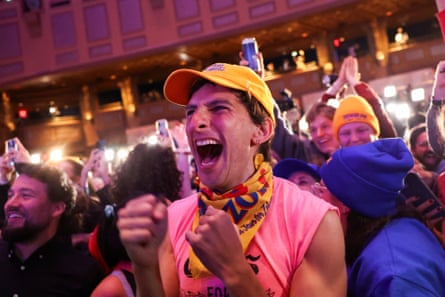
A man celebrates at an election night party for New York City mayor Zohran Mamdani
Shannon Stapleton/Reuters
I’ve been fortunate to cover a lot of campaign politics, so for me, Zohran Mamdani’s election night party was kind of a standard night, but at a really beautiful theatre, the Paramount in Brooklyn. The energy was palpable and I think everybody thought it was a foregone conclusion that he was going to win. It was called just after 9.30pm.
Mamdani really tapped into social media and reaching out to a younger and diverse audience. I think that had a lot to do with him getting elected, and you could see that reflected in the crowd.
Whenever I go into one of these things, I try to pick out faces before I shoot and then hover around where I think something is going to happen. I look for body language, excitement, T-shirts with logos, hats. I was drawn to this guy’s “Jews for Zohran” hat and scarf, which has a cool logo.
An hour or so later, Mamdani walked on stage. I covered Barack Obama a lot when he was running, and those events were always full of incredible emotion and passion, and joy at times. I felt that same kind of energy on this night.
Kathmandu, Nepal, 9 September

Protesters take selfies at the Singha Durbar government complex, after it was set on fire
Niranjan Shrestha/AP
Anti-corruption protests had erupted the day before, sparked by the government’s ban on social media, and were largely organised by young people, so they became known as the gen Z protests. Many protesters were killed by armed police.
That day was terrible. I was covering the protest in front of the parliament and I witnessed lots of shooting – I almost got shot in the chest. I was standing with a photojournalist friend, and a live bullet passed between us. Within a few seconds, he was hit by a rubber bullet in the back of his head, and blood was streaming out from his neck. Along with other colleagues, we carried him to an ambulance. Many young people had been killed, and there was a lot of anger and grief at the bloodshed, which grew throughout the night.
It felt like a revolution had started. The following day ended with people looting and burning buildings, including prisons, shopping centres and hotels. The prime minister KP Sharma Oli resigned and fled.
Protesters set fire to the offices of political parties, then soon after government buildings including the supreme court, and the building in this picture, the Singha Durbar. Like many others who had gathered there to express their anger, fear and frustration, these boys were present, not as instigators, but as witnesses. It was very chaotic, but there was also excitement that these buildings were on fire, a way of expressing the anger about the violence aimed at protesters the previous day. These boys decided to do a selfie and I just captured it.
New York City, USA, 20 August
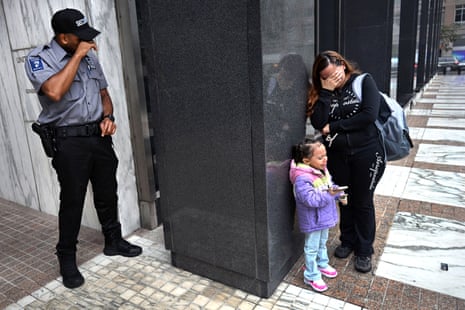
A security guard breaks down after an Ecuadorian man is detained by ICE, leaving his wife and children distraught
Carol Guzy
For more than five months, I’ve been going every day to Federal Plaza and covering the detainments by Immigration and Customs Enforcement (ICE), and the family separations are by far the most heart-wrenching. This was a late afternoon. Normally we’re able to travel up and down the halls, but this time they blocked the halls. I’m pretty sure it’s because they knew it was going to be a bad family separation.
The father of this family from Ecuador was detained. I didn’t see what happened, but the mother immediately started screaming and the kids were crying. As he was led away, she was saying: “Please help me. Take me too.”
I followed her out of the building. She was with a court observer who was trying to help her, who then went back into the building because the woman’s husband had their house keys and she wouldn’t have been able to get home. I stayed with her, and I called my Spanish-speaking friend to talk to her.
The security guard came over, to see what he could do. He was overcome, because the family were just in inconsolable despair. It’s not usual for security guards to act like this and I was surprised that he showed this humanity. They’re more likely to be reserved and do their job, and it was so touching to witness him breaking down too. I’ve talked to him since, and he’s proud that he was a human being in that moment, not just a security guard.
I try to report everything fairly, and I’m respectful to everyone, including the ICE agents, but of course, personally, the detainments feel soul-crushing, especially the family separations. I think these children will be traumatised forever by what happened, especially if they never get their dad back.
Dayr Atiyah, Syria, 5 January
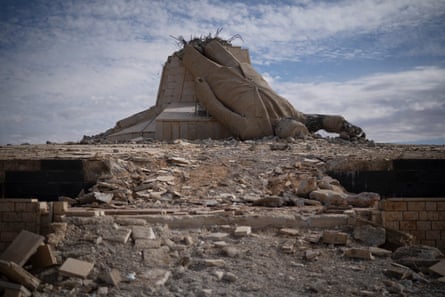
A statue of the late Syrian president Hafez Assad is destroyed
Leo Correa/AP
I had been on assignment in the Homs region with colleagues, and we were driving back to Damascus. The town of Dayr Atiyah is about halfway and until a month earlier a huge statue of the former president Hafez al-Assad had stood on a mount overlooking the town. Over just a few days in December 2024, a rebel offensive had ended the 53-year Assad authoritarian rule and ousted the president Bashar al-Assad. Celebrating the end of the regime, symbols of the Assads’ power were toppled across the country. This had been the biggest statue of Hafez al-Assad.
When we arrived, a member of the new security forces did turn up to see what we were doing, but nobody else was there. We were there for about half an hour, looking around the derelict site. There is a beautiful view of the town and surrounding mountains.
The way people had pulled down this huge monument felt very powerful, representing a significant moment in this country of people taking power, and hopefully of peace. As a photographer working in the region, to be able to see these places feels like living history. Around the country, places have been destroyed after years of civil war. A toppled statue of a repressive leader is an important symbol of what’s happening in Syria, and the need to rebuild the country.
Virginia, USA, 29 November

A drunk raccoon passes out in a bathroom
Samantha Martin/AP
One night in late November, a liquor store in the small town of Ashland, Hanover County, was broken into. Bottles of alcohol were pulled off shelves and smashed, their contents consumed. Officials on the scene found the perpetrator passed out in the shop’s bathroom – a raccoon. He was, they say, “very intoxicated”.
There are signs that the raccoon is a serial offender. Samantha Martin, an animal protection officer, suspects he was responsible for breaking into a karate studio, and the offices of the Department of Motor Vehicles, where he “ate some of their snacks”.
Of his liquor store raid, Martin said: “I did see his eyes going back and forth like a typical drunk person, and he obviously could not stand up.” She was able to take him to a shelter, “in order to sober up a little bit”. Then he was released back into the wild. The story went viral, and people donated money to the shelter. It was so relatable, she said. “Everybody’s had a few extra and passed out by the toilet, and hopes somebody can come get you the next morning.”
Chicago, USA, 19 September
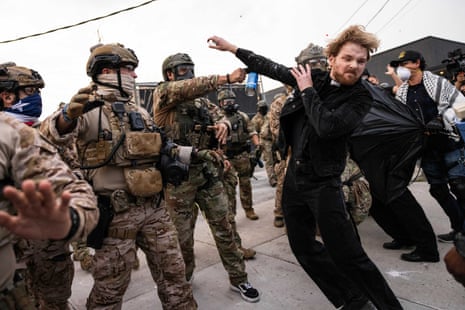
Rev David Black is pepper-sprayed during a demonstration outside an ICE facility
Ashlee Rezin/Sun Chicago Times
Operation Midway Blitz was a sweep by ICE, supposedly of “illegal” immigrants. When it began, the community in Chicago started organising on Fridays outside an ICE facility in suburban Broadview, protesting and trying to block the agents’ vehicles as they were coming and going.
Throughout the day, the federal agents had been using non-lethal ammunition against the mostly peaceful protesters. All the photojournalists on our team have hostile environment training, and carry respirators, goggles, helmets, bulletproof vests and more.
Reverend David Black approached the sidewalk with his hands raised. Agents were positioned on the roof above with pepper ball guns. He was struck on the head.
Other protesters came over to him, grabbed him and pulled him away from the area. He was yelling and upset. Within a few minutes, a vehicle was leaving the facility. The gates opened, and a dozen or so agents came out to escort it and lined up outside the gates. Then, they advanced on the protesters – that’s when one of them sprayed Rev Black with pepper spray.
ICE made several arrests that day. It was chaotic. Weeks later, a fence was erected to prevent protesters’ access to the front of the facility and the Illinois state police took over crowd control. In my experience as a photojournalist, I’ve never seen Chicago police or other local law enforcement agencies use non-lethal munitions at this level.
South Dakota, USA, 28 June
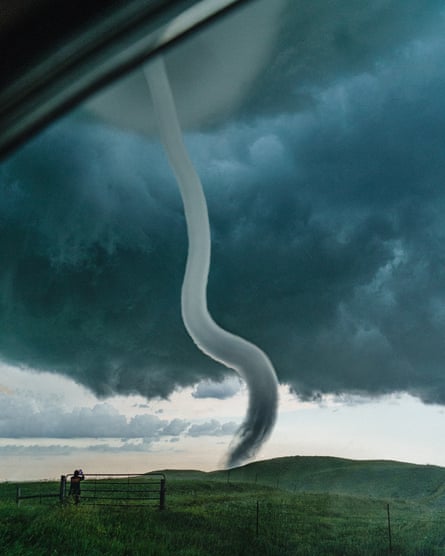
A tornado rages on in South Dakota
Ty Newcomb
I wanted to go storm chasing, so I reached out to fellow photographer, and storm chaser, Paige Vincent, who has a lot of experience. We started hanging out and going on storm chases, starting in April when the storm season in the US starts to kick up. This season, we were successfully able to intercept 18 tornadoes.
This one near Clear Lake in South Dakota was the best. It was strange, because normally when tornadoes are about to dissipate, they do that rope-out phase, and they get really skinny, and usually wobble around. Most of the time that breaks up the vortex. But this one was odd because it started out that way, then it actually gained momentum and strength, and turned into a strong EF3 tornado. It sounds like a freight train, a whooshing, or like a low drum. It’s unsettling, for sure. I think it hit a small farmhouse, but luckily there were no major injuries.
We were less than a quarter of a mile away – which is a dangerous place, because it can take a left turn towards you really quickly. That’s why I was shooting from the car, because you have to be able to get out of the way in seconds.
I love the thrill of the chase, and being able to take photos and videos that help understand how tornadoes work. By better understanding these storms and documenting them, we’ll be able to better protect people.
Twickenham, UK, 27 September
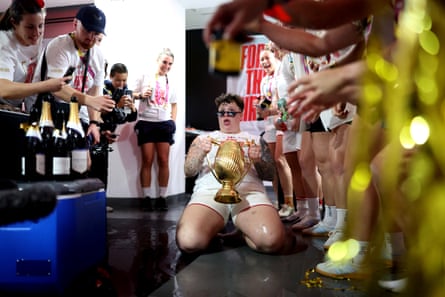
Hannah Botterman celebrates after England win the Women’s Rugby World Cup
Morgan Harlow/Getty Images
England’s women had just beaten Canada to win the Rugby World Cup and it was an incredible moment. I had covered the tournament and had behind-the-scenes access. It was a while after the final whistle that they all came back to the changing room, after greeting fans and all the trophy lifts. There were lots of mixed emotions. Some players were sitting down, taking it all in, some were up dancing. It wasn’t until the rest of the team came into the changing room a couple minutes after that they started to really celebrate properly.
They were popping champagne and it was going everywhere. There was music, lots of dancing, confetti, champagne on the floor. It was all a mess, but a fun mess. I knew the prop Hannah Botterman was known for doing a knee slide, and I think everyone knew, once the floor was slippy, that she probably would.
This was her third slide. I was standing next to her when she did the first two, then I saw her grab the trophy, and I thought this was going to be the moment, so I had to run and get into the right spot, and just hope she came straight towards me. She did, with the trophy, and a pair of sunglasses. Hannah is a bold personality and what you see is what you get. This picture just sums her up, and the team winning in style.
Kolyuchin Island, off Chukotka, Russia, 18 September
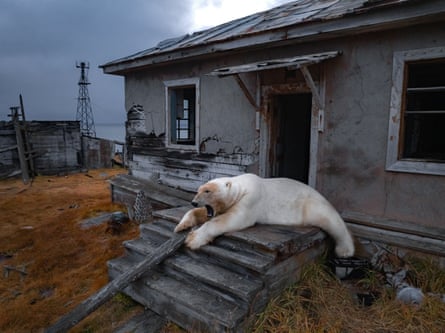
A polar bear relaxes at an abandoned research station on Kolyuchin Island
Vadim Makhorov/AP
I was travelling across the sea around Chukotka. On the way to Wrangel Island we stopped by Kolyuchin Island. By September, the sea ice has melted, so polar bears are forced to spend some time on land and most of them were using the abandoned polar research station there as shelter. I spotted them by drone, and counted about 20. We visited Kolyuchin Island twice along the route, so I ended up filming the bears over the course of two days.
They had temporarily settled into these little buildings. This bear is relaxing on the porch of one. They hunt on the ice, but they had to wait for new ice to form, so they simply waited, using these buildings as protection from wind and rain. I didn’t notice any conflict between them.
It would have been too dangerous to go ashore, so I stayed on the ship and filmed with the drone. I often film wildlife with a drone, including polar bears, so I know how to fly in a way that doesn’t frighten the animals or cause them any harm.
The bears’ reaction was simple curiosity. Since I approached very slowly and gave them time to get used to it, they either didn’t notice it at all or found it interesting. To them, the drone was just another noisy bird.
Off Lanzarote, 6 January
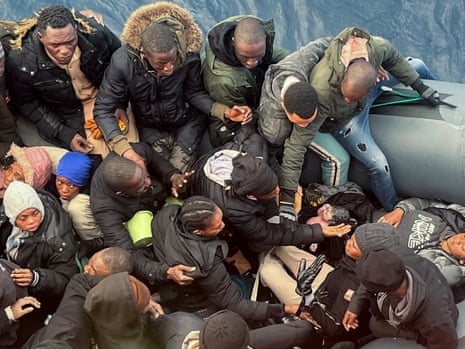
Migrants on a boat surround a woman who has just given birth
Salvamento Maritimo
On board a crowded boat, as 60 people made the deadly Atlantic crossing from the north-west African coast to the Canary Islands, a baby boy was born. When the sea rescue service, Salvamento Maritimo, reached them, he was about 20 minutes old. The rescue crew knew that a pregnant woman was among the people on the boat, including 13 other women and three children, but not that she had given birth. Domingo Trujillo, the captain of the search and rescue vessel, told Spain’s state broadcaster TVE that the mother was lying on the floor of the crowded boat, and someone was holding the baby. “I covered him up, took him here [to my chest] and patted him so he would stop crying,” said Trujillo. The mother and baby were transferred to hospital by helicopter.
As of early December, 17,000 migrants arrived in the Canaries by sea – significantly lower than 2024, as immigration patrols stepped up – and it remains a perilous journey. Last year, more than 10,000 people died while trying to reach Spain by sea.
AlUla, Saudi Arabia, 27 January
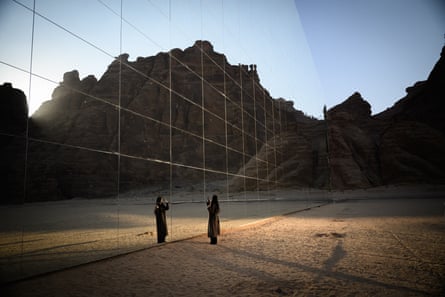
A woman takes a photograph in front of the Maraya, the world’s largest mirrored building, in AlUla
Loic Venance/AFP
I was covering the AlUla Tour cycling race, and one of the stages was scheduled to start from this building. Called Maraya – Arabic for “mirror” – it’s a large events venue, and the world’s biggest mirrored building, set in a beautiful desert landscape.
A couple of days before the start of the stage, I went to have a look so I could work out where best to position myself on the day. In the desert, the light during the day is very hard, so I went later on. When I arrived, there were still a lot of tourists visiting the building, but most left just before sunset. But that was when the light and the reflections were magical.
The Maraya could be almost invisible, depending on the point of view. I was turning around to shoot when I saw this woman. She was taking a selfie in the sunset, with the mirror reflection creating a continuous landscape. It looked so curious – if you look quickly, you might think there are two different people. It takes a moment to understand it.
Istanbul, Turkey, 23 March
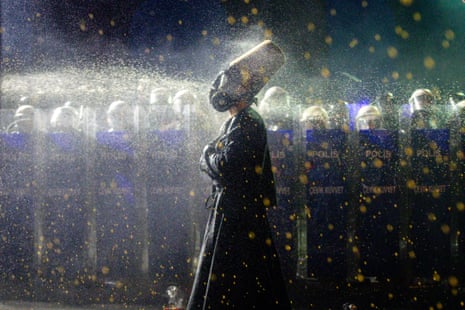
A protester wearing a gas mask is pepper-sprayed during a clash with police in Istanbul
Chris McGrath/Getty Images
Ekrem İmamoğlu, the mayor of Istanbul and the main political rival to President Recep Tayyip Erdoğan, was arrested on corruption charges, which was seen by some as politically motivated. Protesters started gathering, and police became more and more heavy-handed with them.
There were several days and nights of clashes. There’s a famous aqueduct in Istanbul that blocks a road that goes into the city centre, and so the police set up under it as a natural barricade. As the protesters tried to move down this road, the police were using pepper spray if they got too close.
Lots of protesters wore masks, and I noticed this man dressed as a dervish. I could see straight away what the picture was – silent resistance, with the spectre of the police in the background. The police lights had lit up the place, and when they sprayed him with pepper spray, it became a resistance picture. I don’t think he was genuinely part of the Sufi order; I think he was a protester who decided to use this traditional dress as a way of showing resistance. Sufism is all about the values of love and service. Then to have the gas mask on was extremely unusual.
Once he got sprayed, he walked back into the crowd of protesters, and I didn’t see him again. The protest went on into the early hours, until the police decided to clear them out, and would rush them until they all dispersed.
Gaza, 21 July
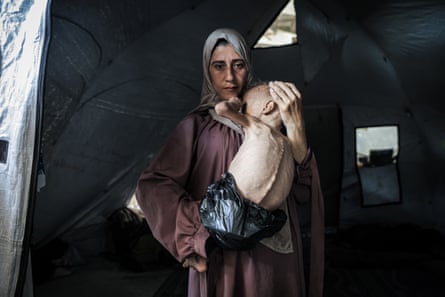
A woman cradles her emaciated child in Gaza
Ahmed al-Arini
I’ve covered the war on Gaza from the beginning. For two years I have been living in Gaza under displacement, killing and devastation. My family and I have lost everything, and we are still here. My work is filled with hardship – danger, hunger and the absence of any real shelter. You walk between rubble and destroyed buildings, through neighbourhoods erased from existence.
There is a hunger war, and the bodies of Palestinians in Gaza have become frail and emaciated, and children’s bodies have turned into skeletal frames. This boy, Muhammad, is a year and a half. His mother was living in a tent built inside the ruins of a destroyed building in Gaza City. She had no food, no baby formula, no nappies. Everything around her reflected the dire situation that Palestinian families were enduring. They had endured displacement and repeated evacuation from one area to another. Her husband had been killed during the war, leaving her alone with two children.
When I first arrived at the tent, she wasn’t there. She had gone out searching for food – anything they could eat. She returned empty-handed – prices on the hidden market were unimaginable. She had no source of income, like most families in the Gaza Strip. Muhammad was in a very dire state. He was lying on the ground, crying. I was shocked by how thin he was – his body had turned into a skeleton.
Making this photograph had a profound impact on me. I was exhausted and had not eaten since morning. I couldn’t hold myself together when I saw him. I said to myself, this image must reach the world so they can see what is happening. I want to show the world that an entire population is besieged, starved and subjected to the machinery of killing and destruction. The world must look at our suffering. Our lives have turned into hell.
After publication of this image, information came to light that Muhammad is extra vulnerable due to pre-existing health conditions and was suffering without access to sufficient food and nutritional supplements. Many experts say that in a hunger crisis, children and those with existing medical conditions are among those most at risk.
Pavlohrad, Dnipro, Ukraine, 19 July
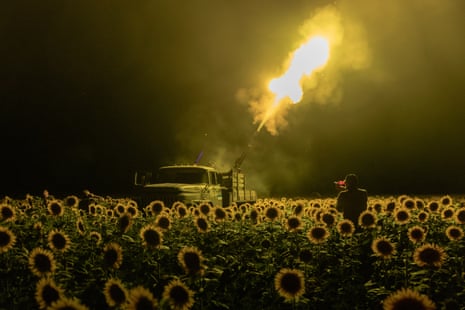
Ukrainian soldiers fire an anti-aircraft auto-cannon at Russian drones in a field of sunflowers
Roman Pilipey/AFP
We spent the night with the 59th brigade air defence unit, during the biggest air attack on Pavlohrad. This unit was one of several others working. They just happened to stop in this sunflower field because it was the best location to watch and wait for Russian drones, packed with explosives, to fly over.
This photograph was taken at about 1am. The unit uses a Soviet anti-aircraft auto-cannon on the vehicle. It’s old, and hard to operate and to hit drones – especially the new drones that Russia is using, which can fly higher. The machine also gets stuck, because it’s old. It stopped working, and they were trying to repair it on the spot, while drones were still flying. While it was being fixed, some of the soldiers were using old AK-47 machine guns to try to shoot down drones.
The cannon is not able to hit many drones per night. Usually it’s a small number, but even if they hit just one drone, that can save lives. They were firing from after midnight to about 5am. In the morning, when the drones were flying lower, the soldiers were firing at them again with machine guns.
It’s a hard job. The soldiers sleep rarely, because they are always on standby, and drones also attack during the day. But they keep focused.
La Paz, Bolivia, 4 December
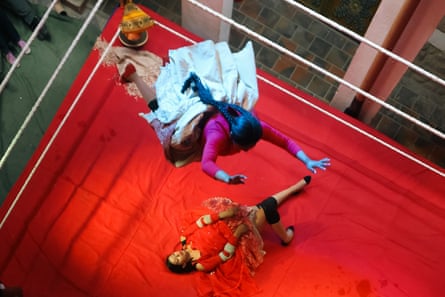
A woman flies over her opponent in a Bolivian cholita wrestling match
Juan Ignacio Roncoroni/AFP
In this wrestling match, Yolandita Jr has just propelled herself off the ropes and flies over her opponent, Nayel La Bonita, who is on the ground. The shows are theatrical, and contain humour and acting, and each fighter embodies a different character. Normally in every fight, you have the “good” fighter and the “bad” one.
Cholita wrestling began around 20 years ago and matches now occur in several venues around La Paz. They have become a tourist attraction. I was on a different assignment, but this match caught my attention and I went to see it. This photograph was taken from a balcony on the upper floor.
The term “chola” was once a derogatory name for indigenous Aymara and Quechua women, who have been historically marginalised and discriminated against. The wrestling cholitas are an expression of indigenous pride, reclaiming the name, along with the traditional dress of colourful voluminous skirts, shawls and bowler hats.
Allahabad, India, 29 January
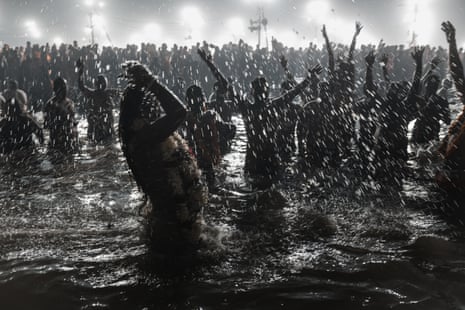
Hindu holy men take a bath in the Ganges
Elke Scholiers/Getty Images
The spiritual bathing ritual in Uttar Pradesh’s Prayagraj’s river banks taken by the Naga Sadhus, or Hindu holy men, to absolve sins and obtain moksha (freedom from the cycle of birth, death and rebirth) at this year’s Kumbh Mela had already been postponed for around 12 hours. In the early hours of the morning, there had been a stampede, in which more than 40 people had died. The atmosphere was tense because many people’s relatives were still missing, or their family members were fighting for their lives in the hospital. At the same time, Uttar Pradesh chief minister Yogi Adityanath posted on X that that the holy baths happened peacefully and authorities continued to underplay the situation hours after it occurred. There were more than 400 million attendees in six weeks - despite severe security concerns.
I had arrived as the stampede was unfolding around 1.30am. I saw bodies lying on the ground. It was chaotic and dangerous. More stampedes were happening. The first aid team were angry at us for photographing dead bodies, but many bereaved relatives wanted a document of what was happening.
This picture happened at a time when the head of the holy men decided at the last minute to jump into the water. I was in the water for 30 minutes before the Naga Sadhus jumped in. They dipped their hair and naked bodies in the water in groups, around 10 to 15 minutes each, multiple times. Some of them enjoy the media attention. There was no panic among them – this purification ritual is one of the most important events of their year.
Odesa, Ukraine, 11 July

A woman hugs her horse after it’s killed in a Russian drone attack
David Guttenfelder/NYT/Redux/eyevine
I’d gone to cover the return of the remains of Ukrainians who had been killed in action. While I was there, there was a wave of Russian long-range drone attacks. We heard the explosions, and I could see smoke rising from a neighbourhood.
They had targeted a military recruitment centre, and at least one of the drones had exploded in the residential area next to it, where there was a stable. The place was on fire. Before I arrived, people had smashed down a wall and were freeing horses, dragging them out. Some of them were injured and needed medical attention.
When I arrived, all that was left was this smouldering block. A 20-year-old horse named Kamelia had been killed. The owner of the stable and horse, Yulia, had climbed through the rubble and she knelt, weeping and holding the horse in her arms. Someone handed her a knife, and she cut a lock of the horse’s mane and put it in her pocket.
In war zones, we focus on the effect on humans, but animals – especially our pets – are also affected. I remember seeing, at the beginning of the war, refugees crossing the border into Poland and so many of them had cages with cats, or a puppy in their backpack. That’s something we can all relate to, but we don’t often permit ourselves to feel that, because the scale of the suffering of people in a war zone is so dramatic.
Photographers’ images of the war are meant to make an impact, but year on year, sometimes, our images go unnoticed. Maybe a picture like this allows us to feel something a little bit different, that we can relate to, and put ourselves in the position of the people who have been suffering there for so long.
Los Angeles, USA, 13 June
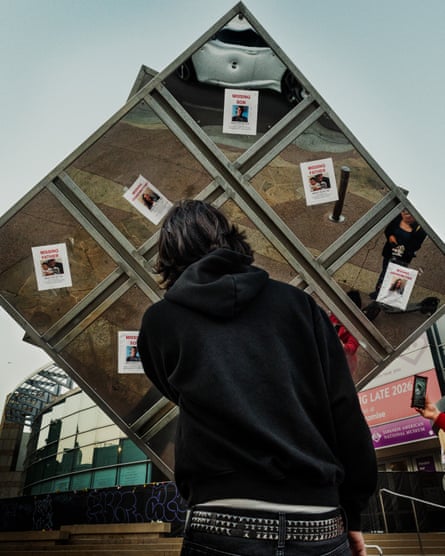
A man looks at missing signs for people arrested and deported by ICE
Ethan Noah Roy
There had been small protests against mass deportation throughout the year, but on 6 June, big protests erupted after several immigration raids and the arrest and detainment of a trade union leader. People gathered at the Metropolitan Detention Centre, and it turned into a clash between protesters and police.
For the next few days, there was more violence. People sprayed anti-ICE slogans on Waymo self-driving taxis and set them on fire (one reason they’ve become a target is because, equipped with cameras, protesters believe the cars are part of the surveillance state). People would gather outside the detention centre, where ICE agents would go in and out, and once clashes began to escalate, the mayor of Los Angeles put a 6pm curfew in place.
People had put “missing” posters, of people detained by ICE, up on the OOMO Cube, a public art installation by Nicole Maloney, outside the Japanese American National Museum, around a block away from the detention centre. It was about 5.50pm and I was heading to my car, and I saw students running, trying to get to the metro line.
This one kid was riding his skateboard, trying to get home as fast as possible, but when he saw the missing signs, he stopped in his tracks, got off his skateboard, and just looked. He told me that it had really hit home, and that he knew people this was affecting. He was a young Latino man.
I grew up in LA and I know a lot of people who haven’t left their homes in months for fear of being detained. LA has a huge Hispanic community, it’s a part of the culture here. It felt like that very culture was under attack. Most people I’ve seen who were stopped were Latino, Black and Asian people. This was around the time the national guard were deployed, so it was this feeling of authoritarianism right on our doorstep.
New York City, USA, 11 February
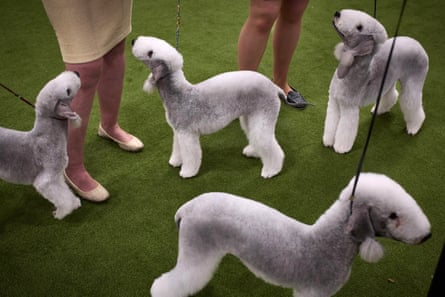
Bedlington terriers compete in the Westminster Kennel Club Dog Show
Andres Kudacki/Getty Images
I really like this breed, bedlington terriers. They look a bit surreal, like a cartoon character, especially when they are groomed like that. This was just after judging in their category at the Westminster Kennel Club Dog Show, the biggest of its kind in the United States. The show is quite chaotic, with different categories such as agility and breed competitions running straight after each other and big crowds watching. People are preparing the dogs, sharing the space, going into the competition area, so there is a lot of action.
I think this photo shows a different moment of calm after the competition. I spent a little bit of extra time in the judging arena, while the handlers were chatting with their dogs, and getting ready to leave. I don’t know if any of these dogs had won their class, and would go on to the finals at Madison Square Garden, but they were all well behaved – they’re highly trained.
I’ve been covering a lot of hardcore news this year, but this picture is a little more joyful.