3 months ago
88
3 months ago
88
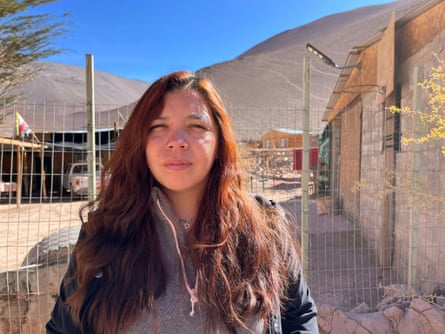
Miriam Rivera Bordones tends her goats in a dusty paddock in the russet mountains of Chile’s Atacama desert. She also keeps chickens and has planted quince and peach trees and grapevines, which are watered by a stream winding down the hills towards the Indigenous community of Copiapó.
But now the huge British-Australian mining multinational Rio Tinto has signed a deal to extract lithium, the “white gold” of the energy transition, from a salt flat farther up the mountains, and she fears the project could affect the water sources of several communities in the area.
“We could be left with no water,” says Rivera. “How will we plant crops or feed our animals? It will make it very hard to survive here.”
Rio Tinto has signed a joint venture agreement with the state-owned copper mining company Codelco to exploit Salar de Maricunga, Chile’s second-largest salt flat, 3,760 metres (12,340ft) above sea level in the Atacama region.
Lithium is a critical element for manufacturing smartphones, laptops, electric vehicles and battery storage for wind and solar farms, but its extraction is highly water-intensive.
The project will pose a direct threat to the Colla Indigenous people living here, says Lesley Muñoz Rivera, secretary of the Copiapó Indigenous community.
“The Maricunga salt flat is the source of all life here. Hydrological studies suggest that it is the source of our water. It’s a sacred place for us.”
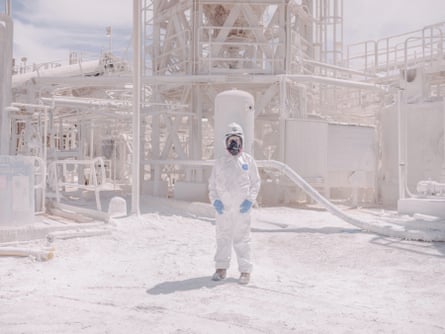
All commercial lithium production in Chile currently uses an evaporation method: water is pumped from natural salt lagoons into pools, where it is exposed to sunlight for 18 months, leaving behind lithium salts. Between 85% and 95% of the water is lost in the process.
Rio Tinto acknowledges “the sensitive environments” where it will operate and emphasises its commitment to “responsible water use” and “minimal impact on local communities and ecosystems”.
The company also says it is still determining which direct lithium extraction (DLE) method to adopt for its early-stage projects developed in partnership with Codelco and Chile’s state-owned mining company, Enami, referring to a technique that extracts lithium from brine more quickly and then pumps the brine back into the lagoon.
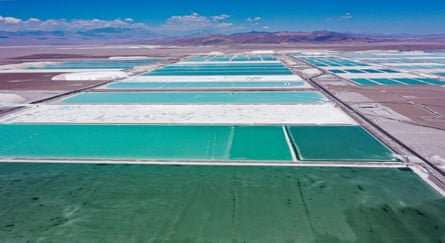
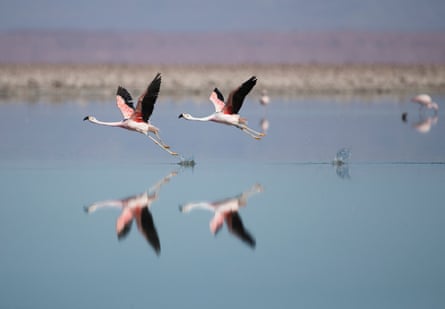
But Cristina Dorador, a microbiologist at the University of Antofagasta who has studied Chile’s salt flats for decades, says reintroducing treated water into the Maricunga could destroy a unique and fragile ecosystem that is home to 53 animal species.
This includes Andean flamingos, horned larks, rheas and guanacos, as well as 11 native plant species and prehistoric micro-organisms found only in the Atacama salt flats.
“Maricunga is a hotspot of unique flora and fauna,” Dorador says. “The reinjected brine could have traces of chemical compounds such as surfactants and detergents that could affect the whole ecosystem of the salt flat.”
The southern part of the Maricunga salt flat is within a protected national park, Nevado Tres Cruces. Although lithium will be extracted from the northern part of the salt flat, Dorador says it is unrealistic to regard them as separate bodies of water. “Everything in the local ecosystem is connected,” she says.
Rio Tinto said: “DLE supports water conservation, reduces waste and requires less land. The aim is to minimise fresh water consumption through recycling, and the use of processing and reinjection technologies that maximise the recovery of lithium with the lowest environmental footprint.”
The company uses DLE at two lithium mines in north-west Argentina: its starter plant at the Rincón salt flat and the Fénix project on the Hombre Muerto salt flat, which it acquired through a takeover of Arcadium Lithium this year. Rio Tinto’s partner, Codelco, confirms it has not yet decided on the method of lithium extraction at Maricunga.
The Indigenous communities in this region are still recovering from the repression they faced under Augusto Pinochet’s dictatorship, which lasted from 1973 until 1990. Rivera’s 91-year-old mother, like most of the older generation of Colla Indigenous people, was born in the Atacama mountains.
During the 1970s, the military regime sold tracts of territory to landowners and banned residents from collecting firewood, which they needed to survive, forcing many Colla people to migrate to the nearest city, Copiapó. But they often returned to their mountain communities to visit older relatives or participate in ceremonies.
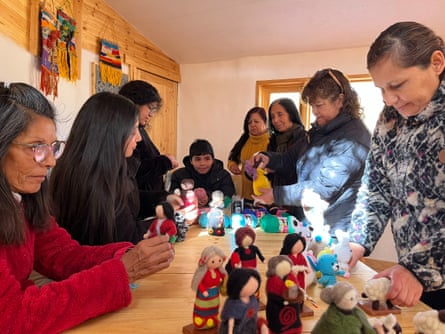
Since democracy was restored in 1990, Colla people have been reclaiming their ancestral lands and rebuilding their villages. Rivera lived in this desert community until she was six, then moved to the city. She returned 15 years ago. The Copiapó community has a museum that showcases its struggle for survival and justice, and Rivera is building a guesthouse there.
Muñoz says: “The idea is to have Indigenous-run sustainable tourism, which will safeguard the environment and sustain our communities.”
However, she believes this could all be threatened by commercial-scale lithium mining. As well as the Maricunga contract, Rio Tinto has been selected as the preferred partner to extract lithium from another salt flat in the Atacama region, Altoandinos, with Enami.
Six local communities, including Copiapó, were invited to participate in a consultation over the Maricunga project, but Muñoz says this was just window-dressing. “We are completely opposed to lithium extraction, but there was no opportunity to say that,” she says. “The project’s going ahead whether we like it or not. We were only asked about peripheral details.”
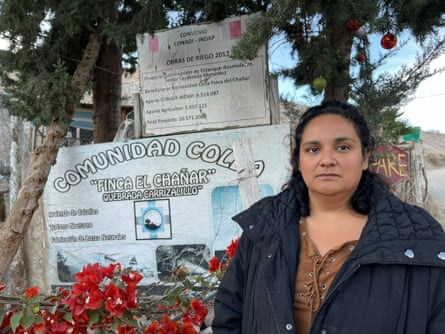
Across the wider Copiapó region, 24 other Colla communities also allege they have not been consulted. Cindy Quevedo, president of the Finca Chañar Indigenous community, is angry that she has had no say about a project on her ancestral lands.
“Our biggest worry is the impact on water because Atacama is the most arid place on Earth,” she says. “And these are sacred territories for us; places where our great-grandparents prayed, made offerings and performed ceremonies. It hurts me so much that this land is being destroyed.”
Only 10% of the local Indigenous population have been consulted about this lithium project, says Isabel Godoy, from the National Council of the Colla People. The council has launched a legal challenge to expand the consultation process.
“We want our views to be heard. We won’t benefit from this; we don’t use expensive electric vehicles, it’s not going to improve our quality of life, and we’ll just be left with the rubbish,” she says, adding: “When you take the water from a territory, you destroy it.”
Codelco says the six communities within the project’s area of influence are being consulted. It added: “We value dialogue with all original peoples. Respect for ancestral territories and Indigenous rights are an essential principle of this project.”
Chile has the world’s largest lithium reserves and is the leading producer of copper, two vital elements for renewable energy generation. Rio Tinto said: “We, along with our partners Codelco and Enami, are acutely aware of the sensitive environments where these projects are proposed to be built, especially in terms of water use, the impacts on the salt flat and the local communities.
“We are committed to building strong, respectful and enduring partnerships with local communities,” the mining company said.

On 11 March 2026, Chile’s new ultra-conservative president, José Antonio Kast, will be inaugurated. He advocates a faster commercialisation of lithium extraction, led by the private sector, and has announced a decree to expedite the issuance of permits, which ecologists say will weaken environmental protection and regulatory institutions.
Kast has also criticised Chile’s national lithium strategy, in which the state plays a central role in overseeing the extraction of the critical mineral.
Lucio Cuenca, director of the Observatory of Latin American Environmental Conflicts, says: “The state’s role in the protection of ecosystems and the communities that inhabit them will be diminished. These measures could be disastrous for many high-altitude Andean salt flats and their microbial ecosystems.”
He adds that the poorest Chileans are bearing the brunt of the green transition driven by the global north. “Industrialised countries are not changing their consumption habits; instead, they are vastly increasing the scale and intensity of extraction in the name of the energy transition,” Cuenca says.
“This is deepening the impact on ecosystems, water systems, land, and the health and livelihoods of people in Chile.”