3 months ago
65
3 months ago
65
Jeffrey Collins has watched 14 men draw their final breaths.
Over 25 years at the Associated Press, the South Carolina-based journalist has repeatedly served as an observer inside the state’s execution chamber, watching from feet away as prison officials kill men who were sentenced to capital punishment. South Carolina has recently kept him unusually busy, with seven back-to-back executions in 14 months.
The state revived the death penalty last September after a 13-year pause caused by the decision of pharmaceutical makers to stop selling lethal injection drugs to the state. Officials acquired pentobarbital, a sedative, only after legislators passed a law shielding the identities of suppliers.
That secrecy surrounding the execution process means the role of observers has never been more vital. Executions aren’t filmed, making journalists’ accounts the only impartial record of state-sponsored killings, their words often cited by lawyers and courts. South Carolina dictates that three journalists, including one from a wire service like AP, can serve as witnesses, acting as pool reporters for other media.
Under current law, the state directs people on death row to choose between injection, electrocution or firing squad. Three men this year selected to be shot.
The first execution Collins witnessed, on 3 May 2002, was of Richard Charles Johnson, convicted of killing a state trooper. He has since witnessed more than a quarter of South Carolina’s executions since the death penalty was reinstated in the US in 1976. He has observed all three methods and seen one case where the process appeared to go awry. He and a corrections spokesperson were the only people in the witness room for all seven recent executions.
The Guardian spoke to Collins, the sole AP reporter covering South Carolina, about firing squads, his approach to covering executions and takeaways from 23 years of documenting capital punishment.
This conversation has been edited and condensed for clarity.
How did you become the go-to reporter witnessing executions?
When you’re a reporter in a conservative southern state, this is what you end up doing. If your state has the death penalty, the Associated Press wants to be in the room to witness. Our mission is to let people know what happens. When I first started, there were many more reporters in the South Carolina bureau. After the 13-year pause in executions, I was the last one left. Now I go to each one, which is important for continuity, because I can compare what happens. In total, I’ve witnessed 10 lethal injections, three firing squads and one electric chair.
Do you remember what it was like to observe your first case in 2002?
You have no idea what it’s going to be like. I remember just wanting to make sure I got every detail right. It’s a very somber experience, because you realize you’re getting ready to go see someone die. The government only gets to kill people in rare circumstances – war, police shootings. This is really the only time where the killing is scheduled. I told myself back then, and still tell myself today: “How many people actually see someone die, especially where you know it’s going to happen?”
Can you tell me about the electrocution you witnessed in 2004?
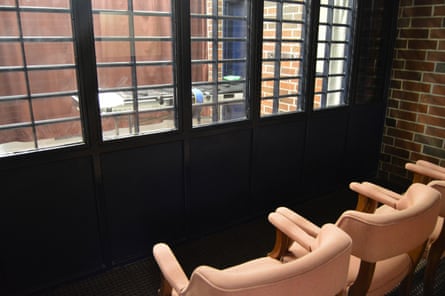
The witness room and death chamber are each probably a tad smaller than a large master bedroom. So you’re close. The electric chair is maybe 10ft-15ft away. They pull down from the ceiling this little cap that [goes over the skull and] finishes off the circuit, and then they put a hood over the guy’s head. You hear a thunk when everything starts – that’s keys turning that causes electricity to begin. There’s one big jolt, then a smaller jolt, followed by more than a minute of low current to make sure the inmate is dead. The current goes through every muscle in their body, which tenses up. A colleague described it like the person wants to stand and run away.
How do you prepare for executions?
I read up on the entire case. It’s important to know everything that happened, why the victims ended up there. On the day, I get to the prison around 3.30pm before the 6pm execution. There’s a lot of waiting. I run through a mental checklist. With lethal injections, which can take about 25 minutes, I remember to look at different places – the inmate, the victims’ families, the warden, to tune in to reactions. In firing squads, everything happens instantaneously. Once it’s over, the media witnesses gather and compare notes. Then we do a news conference. I’m acutely aware this is the only on-the-record details of the execution. I see it cited in court. There’s no video. There’s nothing but my words. So I try to be very circumspect and careful.
How do you approach documentation? It’s so high-stakes.
I tell you what I see and try not to get in front of myself or interpret anything. All we get is a pad and pen provided by the corrections department. Once we’re in, I sit down and note everything. Sometimes that’s hard, because you see all sorts of things. In the lethal injection of Richard Moore [in November 2024], his lawyer cried quite a bit. She had fought for so long. I’ve also seen victims’ families who feel they’re getting justice and you see that in their reaction. You can’t allow yourself to react too much. But we’re all human beings. In Jerry McWee’s execution [in 2004], his mother was a staunch anti-death penalty advocate and was in the room. I remember they locked eyes and communicated the best they could. I remember a tear forming in McWee’s eyes, rolling down his cheek as he looked at his mom. You have to remember emotion is part of the story.
In the last year, you’ve observed four lethal injections in a short span. Are there trends that have stood out?
The curtain opens, the inmate usually looks at the people in the witness chamber. If the glass wasn’t there, I think you could almost reach out from the front row of the chamber and touch the person. They’re strapped down and because of the glass, can’t really say anything, but maybe they mouth words at their attorney. Mostly, they look up at the ceiling. Then it’s only about 45 to 90 seconds where the breathing starts to slow, usually a couple of loud snorts or breaths. The chest starts to rise a little less, then it stops. Then you sit for 15 to 20 minutes as the process runs its course. One thing that stood out was the first three lethal injections were African American and the fourth was Caucasian. In that one, I noticed 10 to 15 minutes into the process, he turned blue. That was new. You could see the color change.
Can you paint a picture of the three firing squad executions?
The inmate is strapped to the point where they almost can’t move. They’re not facing you. They’re facing the firing squad [of three shooters, out of view]. A red target bullseye has been placed over their heart. The warden places a hood on the inmate’s head, then they open up a pull shade, like a bedroom curtain, and there’s a rectangle opening. You can’t see the guns. Then you’re just waiting. The first wait was about 60 to 70 seconds, the last two around 40 seconds. Then suddenly there’s a bang. I tell people, they’re going to flinch, because there’s no warning or countdown. Sometimes people gasp. I focus on the inmate and the target. The most recent one, the target was blown across the room out of sight. In the first, it was obliterated, just disappeared.
Mikal Mahdi’s lawyers alleged his firing squad killing was botched, with shooters missing the target area on his heart, causing prolonged suffering. What did you see?
It looked like the target was pushed into Mahdi’s chest. He let out almost instantaneously a groan. That was the only noise I heard an inmate make in the firing squad executions. You see him breathe and make more noises that I’d say were sounds of some kind of discomfort, though it’s hard to characterize. Then there was a final moan about 80 to 90 seconds in. He was the second person to be killed by firing squad, and it was so different from the first one. At that moment, I was wondering what happened? But I couldn’t go out and tell people maybe this didn’t happen the way it was supposed to. I just had to say what I saw. We had to wait for the autopsy. [Mahdi’s lawyers said the autopsy showed the bullets largely missed his heart. A corrections spokesperson said the bullets did hit his heart and denied the execution was botched.]
What’s the impact of witnessing so many executions?
I tell folks it has to affect you in some way. I try to do something life-affirming the next day, maybe a little out of my routine. Go to a festival. Take one of my daughters out for lunch. It’s important to remember, you’re part of this process, but not involved. You’re telling people what happened, but there’s nothing I did to start it, there’s nothing I could do to end it or make it go faster. I’m just there to observe. I remind myself I’m witnessing this because it’s important this information gets out. The people of South Carolina have decided through their elected representatives to have the death penalty. People need to know what it looks like.
The process in South Carolina is shrouded in secrecy. How does that challenge your work?
I’m all for sunshine. I don’t think executions should be publicly broadcast, but I think they need to be videotaped. You could put it under seal. The questions asked about Mikal Mahdi may have been answered by video. We should know as much about this process as we can. We don’t know the training involved for the shooters. I get frustrated because we don’t get to see everything. With lethal injections, there could be problems if the needle isn’t put in the vein correctly or the drugs are bad, but we don’t get any look into either of those things. We don’t see the needle being put in the vein. With firing squads, the shooters could miss or the target could get placed poorly. But when the curtain opens, the target has already been placed, so we don’t get to witness that either. The secrecy prevents the entire story from being told.