3 months ago
61
3 months ago
61
Whether it is embellishing elaborate costumes, delicately applied as eye makeup, or smeared across bare skin, glitter is everywhere at Rio de Janeiro’s carnival in Brazil. The world’s largest party, which ended on Wednesday, leaves a trail of sparkles in its wake.
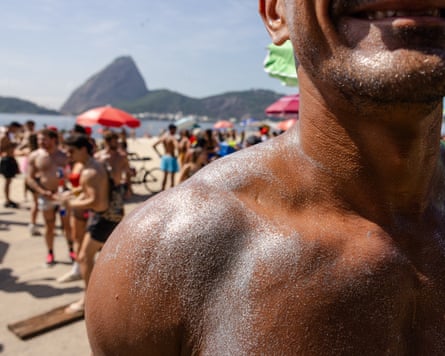
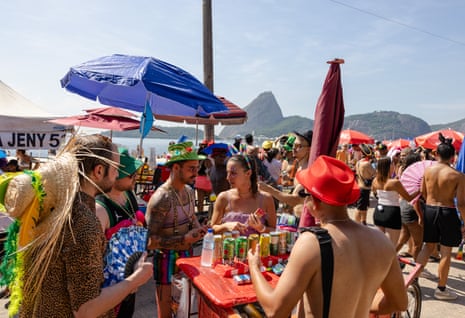
At one bloco last weekend, a huge sound truck and dancers in leopard print led thousands of revellers down the promenade at Flamengo beach. Among them was Bruno Fernandes, who had jazzed up an otherwise minimalist outfit of navy swimming briefs by smearing silver glitter over his body.
“I just cast around for what I had at home before heading out,” says the 39-year-old consultant, the sun glinting off specks of glitter in his beard. “Glitter is the basics for getting dressed up with minimum effort.”
“There has to be glitter,” says Lucia Dias, 22, wearing a metallic bikini and waving a glitter-encrusted fan. “If you don’t apply it at home, you do it on the way out.”
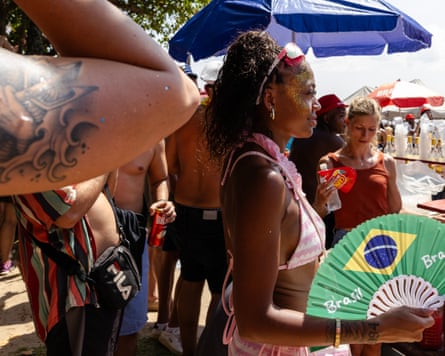
But this glitter mania carries a heavy environmental toll, driving up pollution on the city’s seafront and leading to calls for the several million carnival-goers to find alternative ways to shine. A study on microplastics pollution published last year found that contamination on a beach in Rio increased significantly during carnival, with glitter the main culprit.
Researchers took samples of sand along Flamengo beach, a popular location for the street parties known as blocos, before, during and after the carnival, as well as a control sample eight months later, to measure the concentration of microplastics.
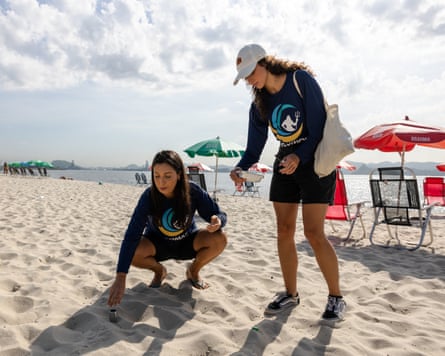
“During carnival, there is an infinitely higher concentration [of microplastics] than before and after,” says Tatiana Cabrini, a professor of ecology and marine resources at the Federal University of the State of Rio de Janeiro (Unirio) and a co-author of the paper.
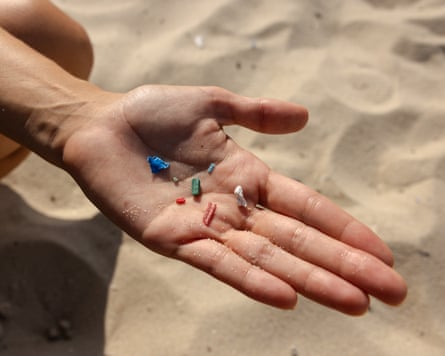
Gabriela Sodré, a Unirio student and the paper’s lead author, says: “You could see glitter clearly in the samples. Some looked like a constellation.”
Typically made from a plastic called PET and coated in aluminium, glitter is a primary microplastic, which means the particles are manufactured to less than 5mm in diameter, or even microscopic. Larger pieces of plastic also break down into tiny particles eventually. This, along with the release of fibres from costumes and wigs, contributes to carnival pollution.
“People hug, people sweat, and this friction ends up releasing particles,” says Cabrini.
“Outside of carnival, there will be plastic, microplastics coming from the water, from the land. Carnival puts huge pressure on the beach; it’s millions of people throughout the days.”
The research was carried out when 18 blocos were held on Flamengo beach, of which three were “mega-blocos”, drawing more than 100,000 people.
The microplastics on the beach can be carried into the sea by the tide and wind, where they harm marine life and move up through the food chain, potentially carrying contaminants to the top of it.
Cabrini says: “A mole crab might filter a fibre. It will be eaten by a fish. This small fish will be eaten by a larger fish. And if we eat this fish, we’ll also be consuming microplastics.”
Microplastics have been found all over the planet, from the summit of Mount Everest to the deepest point in the oceans, as well as in the human body.
There is still little research into the impacts of microplastics on human health, but there are associations with reproductive health harm and higher risks of heart attack and stroke.
“Plastic glitter should be banned,” says Cabrini. “If glitter must be used, it should be biodegradable.”
Frances Sansão, a Rio set designer who founded one of Brazil’s first biodegradable glitter brands, Pura Bioglitter, in 2017, says: “Brazilians are a bit addicted to glitter.”
The EU banned the sale of plastic glitter in 2023 and other countries, including the UK, the US and Canada, have banned microbeads, another type of primary microplastics used in cosmetics. Public concern with the damaging impact of glitter has also led to a ban by a number of music festivals in the UK.
But in Brazil a bill banning the sale and use of plastic and metallic glitter has been stuck in the lower house of congress since 2020. Although the number of brands selling biodegradable alternatives has increased in recent years, their use remains a fringe practice.
“In an ideal world, it would be a concern of mine, but it’s not financially accessible,” says Dias at the bloco, where a street vendor is selling sachets of glitter for five reais (less than £1). Small 2.5g pots of bio-glitter sell online for about seven times that.
Carla Rocha, 44, wears a cluster of non-biodegradable gold stars on her temples. “I think we’ve got bigger problems. Of course, everyone must do their bit, but when we see big business messing things up, we’re just a grain of sand,” she says.
Sansão, who uses algae and minerals to make her bio-glitter, says: “I don’t think Brazil is as concerned with sustainability as European countries are. It’s not just glitter, carnival is a very wasteful party.”
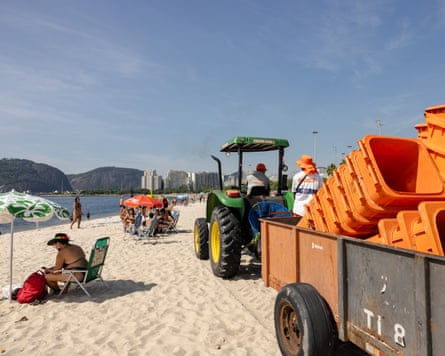
Last year, Rio’s waste service collected more than 1,600 tonnes of rubbish from street parties and parades.
Sansão would like to see a more sustainable carnival. “Carnival is about creativity, and I think there’s a way for us to be happy without leaving such a trace,” she says.