3 months ago
60
3 months ago
60
Last spring, as the Trump administration was freezing billions in federal research funding for universities and threatening the visas of thousands of international students, Emily Hettinger, a senior at Yale, joined a campus protest in defense of higher education.
It was a strange place to be for Hettinger, who had been growing disillusioned with Yale over what she saw as its elitism and disinterest in the disadvantaged community surrounding its Connecticut campus. “I remember feeling this sort of dissonance,” Hettinger said. “I wanted to defend higher education, but I didn’t want to defend it in its current form.”
Hettinger’s mounting discomfort with US higher education led her last spring to Class Action, a two-year-old grassroots network of students and recent graduates promoting a critique of elite institutions’ contributions to an increasingly divided American society. At times, the group’s criticism echoes the one exploited by Trump in his campaign to reshape US higher education to fit his ideological agenda. But where the administration has responded to growing mistrust in US universities by launching a scorched-earth campaign seeking to dismantle everything from equity initiatives to the principle of academic freedom itself, Class Action believes US universities have abandoned their civic duty and wants them to restore their commitment to educating students for the greater good. At a time when many universities are on the defensive, its members seek to defend the university – but also transform it.
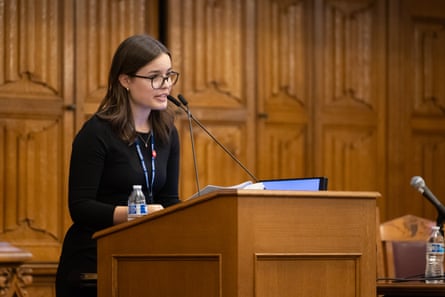
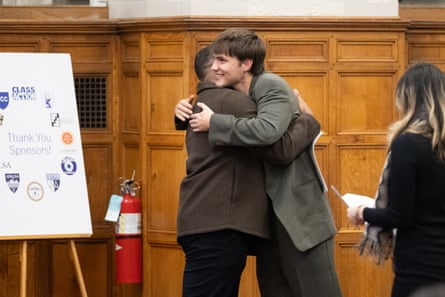
In November, Hettinger co-chaired a conference at Yale that brought together some 300 participants from dozens of campuses nationwide and sought to channel their criticism of universities’ elitism into the drafting of a new “academic social contract”, a working document seeking to re-envision what US higher education should be – and for whom.
“Elite universities stand at a crossroads,” the document, a draft of which was shared with the Guardian, reads. “They can remain citadels of privilege, or they can help kindle a renaissance in higher education. To merit continued public investment, these institutions must align their wealth, influence and prestige with the public good.” The group plans to eventually make the document public and use it as a roadmap for individual college campaigns.
“What’s hard about this moment is that there seems to be a binary of choices – either support Trump and tear down universities or support the status quo,” said Hettinger. “What if there’s a third option, a better path forward, where we can be critical of universities but also defend them and build something better?”
‘Why should you trust elites?’
Class Action was born in 2023, against the backdrop of a US supreme court ruling against affirmative action in university admissions that rocked the higher education world. Ryan Cieslikowski, then a senior at Stanford University, had long since grown disillusioned with the promises of elite universities like his own.
“I was very sold by this vision that private universities in the United States like to sell about themselves, that they admit students from all sorts of walks of life, and give them an education and confidence and connections, so they can go off and make the world a better place,” he said.
Instead, he watched as many of his friends pursued careers in tech, finance and consulting they had no passion for. He wrote a master’s thesis about the phenomenon – titled “Buying into selling out” – interrogating why so many universities were directing students away from public interest work. When Evan Mandery, a professor at John Jay College and author of a book about how elitist US colleges contribute to deepening divisions in US society, gave a talk on campus, Cieslikowski decided to turn that analysis into action.
“I watched as he undressed Stanford in front of a hundred Stanford faculty and students,” Cieslikowski chuckled. When he sat next to Mandery at a dinner after the talk the two came up with the plan to launch Class Action.
Mandery believes that leading universities like Stanford have laid the groundwork for Trump and Maga “to foment such gross mistrust of elites”, he said.
“If you grow up in rural Appalachia and you have no chance of going to one of these colleges – any college at all perhaps – and you don’t know anybody who’s ever worked at one of these institutions, why should you trust elites?” said Mandery, drawing from his experience teaching at a state university in the region. “The one person in a million who threads the eye of a needle and makes it from West Virginia to Harvard, none of those people go back, because they go become investment bankers and management consultants. It just fuels this massive divide, which is what’s undoing America: you have these overwhelmingly democratic liberal cities and the rest of the country that just feels completely alienated.”
After the meeting, Cieslikowski quickly got to work on a “listening tour” of students’ frustrations with their institutions. Among the critiques he heard most consistently were elite universities giving preferential access to wealthy and privileged students and the funneling of upwards of half of their graduates into lucrative careers of little benefit to society at large.
Class Action’s resulting first nationwide campaign contributed to California’s decision last year to ban “legacy” admissions for the children of alumni and donors – though Stanford and the University of Southern California forfeited some state funding in order to keep admitting students on that basis. The group is involved in similar campaigns to end legacy admissions that are under way in Connecticut, Rhode Island and Massachusetts. Class Action has also launched efforts to tackle “career funneling” – by which universities encourage students into a narrow set of lucrative corporate careers – on several campuses where it has a presence, often in coalition with local student groups. At Amherst College in Massachusetts, for instance, students successfully lobbied the administration to diversify career services to support students pursuing public interest jobs.
Class Action’s message has resonated. Cieslikowski’s first organizing call drew students from a dozen campuses; two years later, more than 50 were represented at the Yale conference and the group has worked with students on 76 campuses. It is now in the process of establishing a network of formal chapters.
Nazlı Dakad, another recent Stanford graduate, found herself “applying to places like Goldman Sachs” despite earlier aspirations toward a career in environmental advocacy. But then she learned of Class Action, where she has become one of four full-time staff organizers. Trump’s return to office in January, and his immediate focus on US universities, inadvertently made Class Action’s message more resonant, even as the group seeks to steer clear of politics and remain inclusive of different viewpoints.
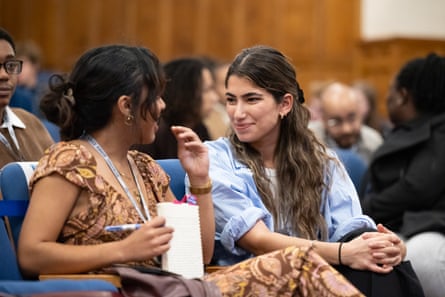
“There are attacks on higher education that are coming from a place of some validity and where that is going needs to be shaped by students at these institutions rather than these political figures who are quite removed from what’s actually happening,” said Dakad.
Students with varying political views often find common ground on issues like free speech and legacy admissions, those involved with Class Action say, and the group has made an effort to contend with good-faith conservative critiques.
“What’s beautiful about Class Action is that we’re much more about our principles than we are about ideological agreement,” said Zane Khiry, a recent Amherst College graduate active with Class Action, though he conceded that outreach to conservative students has at times been challenging. He says the organization welcomes political difference “as long as you can agree with the idea that there is reform to be done”.
‘Promise unfulfilled’
Some of Class Action’s critiques echo those voiced on the right, but the group offers a vision for higher education that’s fundamentally progressive. In addition to calls to reform elitist admissions processes and career funneling, the academic social contract the group has been drafting calls for giving students’ greater representation on universities’ boards and for universities to become more accountable to their local communities. The document also calls on universities to return to their core mission of educating students “for meaningful lives” and encourages them to redeploy their significant resources in the interest of the broader public while simultaneously defending academic freedom and democracy.
Amy Binder, a sociology professor at Johns Hopkins University whose research focuses on conservative youth and who serves as an adviser for Class Action, noted that while the group’s analysis at times recalls talking points from rightwing figures like Chris Rufo or even the US vice-president, JD Vance – himself the product of the elite education he frequently attacks – the agenda is fundamentally different, targeting elitism and privilege rather than diversity and inclusion.
While the group initially wanted to call higher education “to the carpet”, she said, Trump’s attacks prompted its members to reflect on what it would mean to reform rather than destroy the university. “We want to start from a place of respect, recognizing that there is promise unfulfilled, rather than coming at it purely antagonistically.”
While Trump’s attacks have bent many university administrators into compliance, and left faculty and students reeling, the current crisis in US higher education offers an opportunity, Cieslikowski believes.
“When everything is up in the air, and nobody agrees, that’s the time to bring everybody to the table,” he said. “What we want to do is propose a new vision for how these schools can reorient themselves and be better stewards of democracy, and really represent the interests of most Americans.”