2 months ago
66
2 months ago
66
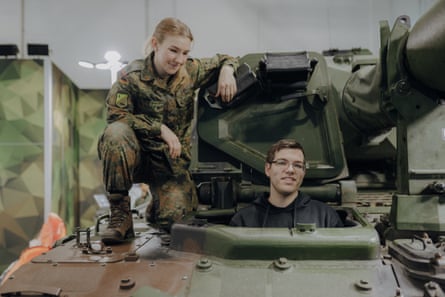
Sitting in the cramped interior of a Panzerhaubitze 2000 armoured vehicle, Tom, 20, hangs on every word coming from Achim, an officer with the German military, as he breathlessly talks students through the workings of “the most modern tank in the world”.
“What damage would you expect its ammunition to inflict?” Tom asks.
Achim replies: “A standard round has a range of 30km, and anything within a 100-metre radius of that would be a direct hit,” Achim says. The students exchange surprised glances.
They are on a day out at the Essen Motor Show in western Germany, where among the many exhibitors is the Bundeswehr, or German army, showing off its wares – including quad bikes, an armoured weapons carrier, VR vision equipment and a khaki Porsche sports car – and hoping to convince a mainly male audience of all ages of its benefits as an employer.
The Bundeswehr is on a recruitment drive on a scale not seen for decades. According to experts, the size of the professional military needs to expand by about 80,000 members to 260,000 over the next 10 years, and its reservists by 140,000 to 200,000 within a similar timeframe.
Intense public outreach work is considered necessary. It aims to convince a population – which for decades has defined itself by pacifism owing to the scars of the Nazi era – that the military’s role is primarily to defend Europe’s largest economy and that soldiers are not warmongers, but citizens in uniform.
From 1 January, young men who turn 18 will have to fill out a questionnaire assessing their suitability for armed service, and in about two years will be expected to undergo an obligatory health test so authorities have on record who is potentially available in the event they are needed to fight in a full-scale war.
In an attempt to attract more volunteers, army wages are to be boosted, while recruits will have access to language courses, subsidised driving licences, free second-class train travel (if they’re in uniform) and the opportunity to obtain new qualifications.
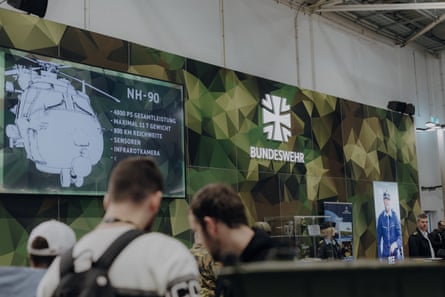
The motor show is just one of many places the Bundeswehr is choosing to recruit these days. It is setting up career lounges around the country everywhere from sports venues to equestrian events, supermarket forecourts and truck stops, as well as hosting its own “discovery days” and female-focused “girls’ days” at barracks and training grounds.
Outside the confines of the armoured vehicle, Tom, a trainee car mechanic from a vocational school in Aachen, says he needs little convincing about the merits of a career in the German military. “I’m in the final phase of my apprenticeship and have made plans to join the paratroopers so I can defend my country,” he says.
Luca, 21, an IT specialist from near Koblenz, admiring the military’s racing car, says he struggles to understand why Germany suspended its conscription model the year he started school in 2011. The political justification given was that, since the cold war ended, it was no longer needed. However, at the very least, he says, since Vladimir Putin’s full-scale assault on Ukraine in 2022, “it is very clear how much we need it. It was a very short-sighted thing to do.” Abolishing conscription also removed the infrastructure around recruitment. Rebuilding that is proving to be costly and time consuming, everyone involved agrees.
Luca would be in favour of an obligatory year of service for everyone, he says. He would be “prepared to defend Germany”, he adds, “but not to go abroad to attack a foreign country”.
Increasing numbers of young men are actively submitting applications to preemptively declare their conscientious objection to serving, should compulsory military service be reinstated. “I personally would not go that far,” Luca says. “I would not know how to justify that. At the same time, I don’t think you can force anyone to serve either.”
Jennifer and Matthias Schleicher, lift fitters from Erkelenz, watch as their son Erik, five, clambers over a four-wheel drive, all-terrain quad bike. “It’s about time our army was strengthened,” says Jennifer, referring in part to the billions of euros of military funding unleashed by the previous government, with billions more to follow, after Germany pledged this summer to raise its defence spending to 3.5% of GDP by 2029. “We’ve been spending too much for too long on other people’s defence systems, whilst ignoring our own. It’s only right and proper to adjust that and become war-ready ourselves,” she says.
Like more than 50% of Germans, she and her husband are in favour of a conscription model, which 63% of young people oppose. “As the times have changed, so have the views on this,” she says. And if her son Erik was called up to fight? “As a mother, of course, it’s difficult, but I can’t keep him out of it if it becomes necessary. The same rules should apply to everyone.”
Specially trained on-site recruiters are here to address any queries. Among them, Marco, who is overseeing the Bundeswehr stand, says the Essen Motor Show enables the Bundeswehr to reach more than 200,000 visitors over 10 days. Interest has grown exponentially since they first exhibited there in 2007, he says.
“Back then people asked: ‘Why are you here?’” he says. “Now that the security situation has changed, people are more inclined to want to get into conversation with us, and say: ‘Thank you for your service.’”
Achim, the tank operator, joined when he was considerably short of his 18th birthday, in 2006. “I got in with a Muttizettel [mother’s note],” he says, jokingly using the colloquial term for a written parental declaration of consent.
Having completed tours in Norway, Lebanon and France, he has never been motivated by any ambition to participate in warfare, he says, “but to contribute to ensuring that we provide such a deterrent that no one comes up with the idea of attacking us and our democracy in the first place. This I strongly believe, has helped ensure peace for over 70 years.”