3 months ago
68
3 months ago
68
Donald Trump’s aggressive rollback of environmental protections directly contradicts the promises of his “make America healthy again” campaign, according to new research.
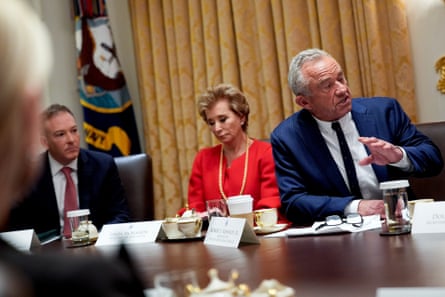
Helmed by Robert F Kennedy Jr, Trump’s health and human services department has touted pledges to “transform our nation’s food, fitness, air, water, soil and medicine” and “reverse the childhood chronic disease crisis”. But the president’s Environmental Protection Agency (EPA) is pushing the country in the opposite direction, says the new report from the liberal research and advocacy non-profit Center for American Progress (CAP).
An EPA spokesperson called the CAP report “fake news”, saying that EPA is in “lock-step” with Maha and the entire Trump administration.
Under administrator Lee Zeldin, EPA is dismantling dozens of environmental regulations, weakening efforts to limit pollution and has exempted facilities from clean air regulations. These actions will make children more vulnerable to many of the same chronic diseases the Make America Healthy Again (Maha) agenda says it wants to eradicate, including cancers, heart diseases, diabetes, obesity, autism and attention deficit disorder, according to the new report.
“The administration is trying to pull the wool over Americans’ eyes, claiming that they care about our health, that they care about kids’ health, when in reality, they are moving so aggressively to eliminate dozens of safeguards,” said Cathleen Kelly, a senior fellow at CAP and report co-author. “It’s really been heartbreaking to watch.”
The EPA spokesperson said the agency is delivering on its mandate to overturn “wasteful” policies “while also protecting the environment and public health”.
“We have banked environmental win after environmental win, and under president Trump and administrator Zeldin, children and families are safer and healthier than ever,” the person said.
The Guardian has also contacted the department of health and human services (HHS) for comment.
In March, Zeldin announced plans to overturn dozens of the country’s most significant pollution regulations, the report notes. The EPA has since moved to implement those rollbacks, proposing the formal repeal of regulations such as a strengthened Mercury and Air Toxic standard (MATs) – which limits mercury, acid gases and other toxic pollutants from coal and oil-fired power plants – and carbon pollution limits for power plants.
The EPA also finalized a rule to delay key compliance deadlines for limits on methane pollution, allowing the oil and gas industry to continue, or increase, emissions. It also proposed narrowing the risk assessment process informing standards on dozens of substances, a move critics say would constrain regulations.
The EPA spokesperson said: “It’s simply wrong to claim that EPA’s actions will worsen air quality” as “America’s air is the cleanest it has been in decades”. The person also said federal figures project CO2 emissions to decrease by 16m tons under the Trump administration amid economic growth.
Experts say far larger cuts are needed.
The MATs amendments which Trump’s EPA proposed repealing have “directly result[ed] in coal-fired power plants having to shut down”, the person said, adding that the changes would revert to the 2012 standards “that have driven sharp reductions in harmful air toxic pollutants”.
“Even the Biden-Harris EPA admitted in 2024 that the 2012 MATS rule provides ‘an ample margin of safety to protect public health,’ and that their proposed 2024 additions would be a net cost to the country,” the spokesperson said. “Given the Center for American Progress is full of former Obama and Biden staffers, they should know this already.”
In perhaps its boldest move, the EPA also announced plans to roll back the 2009 endangerment finding, the legal foundation for all federal climate regulations. The repeal has reportedly been delayed over concerns the proposal is too weak to withstand a court challenge.
These actions and others would expose children to more toxic pollutants, the report says, including asthma-triggering particulate matter, heavy metals linked to brain damage, toxic and hormone-disrupting chemicals such as benzene linked to increased risk of early childhood autism, and polycyclic aromatic hydrocarbons which have been linked to attention deficit disorders.
“The hypocrisy of this has been stunning,” said Kelly.
The EPA also invited polluting facilities to seek air emission exemptions – a move that will further increase exposure to pollution, the report says.
“That basically give these companies a free pass to avoid compliance with toxic air pollution standards that were designed specifically to protect kids, families and communities from pollution that causes serious harm to human health,” said Kelly.
The agency offered these two-year regulation waivers to 170 power plants, chemical and petrochemical manufacturers, and other industrial facilities, the authors found in consultation with the green group Environmental Defense Fund. More than 565,000 children under the age of 18 live within 3 miles of a polluting facility that received an exemption, the report found, while over 2 million live within 3 miles of facilities still eligible for waivers.
The EPA spokesperson said the president had the authority to issue Clean Air Act exemptions “for national security reasons”.
“Any claims that EPA is weakening enforcement are flatly false,” the spokesperson said, adding that the agency is “committed to protecting children’s health and making America healthy again” and is “carrying out our core mission of protecting human health and the environment”.
The Trump administration is also “gutting” public health programs that support asthma prevention and pediatric care, Kelly said. “As kids get sicker, they will have less access to treatments and essential health care services,” she said.
Maha leaders have also promoted increasing US birth rates as a goal, but EPA’s actions could undermine that effort, the report says, by abandoning soot pollution limits and rescinding restrictions on certain PFAS — “forever chemicals” linked to fertility problems.
Adam Finkel, a former EPA science advisory board member and former senior executive at the Occupational Safety and Health administration who did not work on the CAP report, said he is “sympathetic” to Maha supporters’ concerns.
“Maha have got their finger on a real problem: we do have a dysfunctional health system, we have the worst life expectancy among the richest countries, and so something is clearly wrong that Americans can see,” he said.
The problem, he said, is that the administration’s actions are “completely inconsistent” with efforts to improve health outcomes, including for children,
“Maha has glommed onto things like red dye No 3 … but since we’ve already gotten rid of some of the most dangerous dyes in the US, that was just not on the high priority list on a progressive science agenda,” he said. “For whatever reason, they’ve glommed onto the these idiosyncratic things while they are just looking the other way with respect environmental concerns.”
In some cases, the deregulatory push may not even save companies money, Finkel noted, since certain environmental standards have historically reduced costs.
The report comes as some Maha supporters have voiced disappointment with EPA’s actions. Some well-known leaders from the movement last month issued a petition calling for Zeldin to be fired over his environmental rollbacks. In the weeks since, Zeldin reportedly attended a Maha-focused holiday party, invited movement supporters for a meeting at EPA’s headquarters, and said EPA will adopt a “Maha agenda”. He also called the agency’s decision to regulate some chemicals used in plastic production as a “massive Maha win”.
But more Maha-contradicting efforts could be on the way from EPA, as the agency is reportedly planning to stop estimating the health benefits of curbing certain air pollutants, Kelly noted.
The Maha agenda also states aims to take on corporate capture. But EPA’s moves have raised concerns about former chemical industry executives leading agency chemical safety efforts, and record donations made by oil and petrochemical companies to Trump’s campaign, said Kelly.
“Administrator Zeldin could lead a master class on corporate capture and how to rig the system to benefit the oil and gas industry, chemical companies, gas and coal power plants and other industry interests,” she said.