3 months ago
65
3 months ago
65
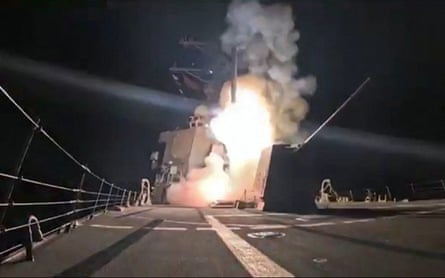
Two weeks after the US carried out Christmas Day airstrikes in north-west Nigeria on what it described as Islamic State fighters, questions remain over the specific group that was targeted and the operation’s impact.
In the aftermath of the strikes, Donald Trump said in a post on his Truth Social platform that “ISIS Terrorist Scum in Northwest Nigeria, who have been targeting and viciously killing, primarily, innocent Christians” were hit with “numerous perfect strikes”.
The operation, coordinated with Nigeria, targeted an Islamist group known as Lakurawa, which extorts the mainly Muslim local population and enforces a strict version of sharia law that includes lashes for listening to music.
Very little information has been shared by either the US or Nigeria about the strikes’ impact and it is unclear how many Lakurawa fighters, if any, died. The US Africa Command branch of the US military said on 25 December that its “initial assessment is that multiple Isis terrorists were killed in the Isis camps”.
Malik Samuel, a researcher with Good Governance Africa, said he had spoken to a Lakurawa member who said about 100 fighters were killed in a forest camp in the Tangaza area of Sokoto state. He said he was told that about 200 were missing, with many of the remaining fighters now trying to cross into Niger. This could not be independently confirmed.
Residents of Nukuru, a village about 6 miles from the reported camp, told the BBC that fighters on about 15 motorcycles had fled through the community, riding three to a bike.
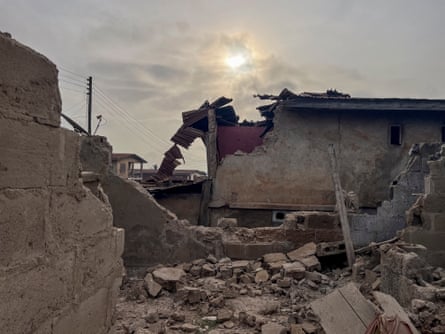
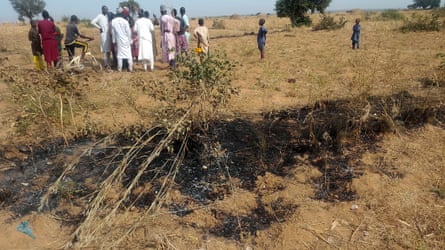
Missile debris fell on empty farmland about 60 miles south in the town of Jabo, which local people said had never been attacked by Lakurawa. Debris also reportedly damaged a hotel 500 miles south of Tangaza, injuring three workers.
It remains unclear why the US specifically targeted Lakurawa, which operates in a rural, underdeveloped and almost entirely Muslim area in the north-west near the Niger border. Most violence in the area is perpetrated by armed gangs known as bandits.
Trump had previously accused the Nigerian government of failing to stop the killing of Christians, an important theme for his evangelical base. Two US officials told the New York Times that the airstrikes were a one-off aimed at allowing Trump to claim he was going after a group that had killed Christians.
Murtala Abdullahi, a Nigerian security consultant, also said Lakurawa was probably a symbolic target. “How do you establish a link that [a] bandit group has been hitting the Christian community?” he asked. “That’s difficult. But if you hit a jihadist group then you don’t need to establish a link.”
Abdullahi said he did not know why the US had chosen to hit Lakurawa rather than Boko Haram, which is far more notorious internationally and attacks both Christians and Muslims.
Since the airstrikes, global attention around Trump’s unpredictable, militarised foreign policy has turned to Venezuela, where US forces abducted Nicolás Maduro on 3 January, and Greenland, where Trump and other senior US officials have expressed renewed interest in a US takeover.
Very little is known conclusively about Lakurawa, from the year it started to the number of fighters. Even the meaning of its name, which some analysts say is a Hausa pronunciation of “les recrues” (“the recruits” in French), is not an agreed fact.
Nigeria designated the group as a terrorist organisation in January 2025. Some analysts say the group is linked to Islamic State’s Sahel branch. However, Samuel said he had interviewed Lakurawa members who professed loyalty to al-Qaida.
Researchers agree that the group’s senior members are from Mali or Nigeria. Local people in Sokoto state report that fighters speak Hausa with a foreign accent and a different language among themselves.
In about 2017, Lakurawa was invited by some local communities to protect them against bandits. However, the group has since turned to violent methods similar to those of the bandits, as well as enforcing their extreme version of Islam.
“That coercive authority that they started asserting turned communities against them,” said Kato Van Broeckhoven, a United Nations Institute for Disarmament Research researcher.
Even before the US intervention, military action alone had failed to quell Nigeria’s numerous, proliferating security crises. Just last week, gunmen killed more than 30 people in Niger state, in the centre-west of Nigeria, and abducted an unknown number of people. Local people told reporters they included students from a Catholic school where 300 pupils and teachers were kidnapped in November and only freed in December.
“Why is Nigeria a fertile ground for all these groups to come in and operate?” Samuel said. “It is simple: because of governance issues … You see clearly the level of poverty in these places, you see clearly the absence of the state, the vacuum that has been created.”