1 month ago
57
1 month ago
57
Introduction: UK economy faces recession if strait of Hormuz remains closed
Good morning, and welcome to our rolling coverage of business, the financial markets and the world economy.
EY has kicked off the week with a warning that the UK could fall into recession next year if the strait of Hormuz remains closed.
The consultant’s latest economic outlook has suggested that gross domestic product (GDP) could slow sharply to 0.5% this year and contract by 0.2% next year if the conflict is not resolved and the vital waterway – through which a fifth of the world’s oil and gas is normally carried – remains shut until early or mid-2027.
On the other hand, if the strait reopens by the end of the third quarter of this year, EY’s base case forecast suggests growth will remain fairly resilient, at 0.9% in 2026 and 1.2% in 2027.
Peter Arnold, EY UK chief economist, said although the UK economy was more resilient than many expected this year (which has prompted his team to upgrade its growth forecast for the year from an 0.8% estimate made in May to 0.9%), there is still uncertainty ahead.
Ongoing disruption to global energy markets will now start to test this economic resilience. If the strait of Hormuz reopens in the coming months, we expect the UK to avoid a more pronounced downturn, but an extended closure into 2027 would raise inflation and could push the economy into contraction next year.
As growth becomes harder to sustain, the UK is likely to rely increasingly on those sectors that have underpinned economic performance in recent years, particularly technology and high-value business services. At the same time, longstanding pressures in construction remain a concern. Rising project costs, persistent labour shortages and weak productivity growth risk constraining the delivery of major infrastructure projects at a time when demand remains high. Enhancing productivity in the sector will be critical if the UK is to deliver its infrastructure ambitions while supporting broader economic growth.”
The warning comes as oil prices have fallen back today, with the international benchmark Brent crude now down about 5% to $83.49 a barrel as tensions in the Middle East ebb.
Over the weekend, Donald Trump said he cancelled planned military strikes against Iran on the basis of “rapidly” reaching a deal on its nuclear programme and the full reopening of the strait of Hormuz.
The US president paused the strikes in expectation of a breakthrough and in response to requests from Iran and other countries in the region, he claimed on his Truth Social platform on Saturday.
He wrote:
Based on this request, I have agreed, for the future benefit of the WORLD and, likewise, the survival of a successful and prosperous Iran, to cancel the attack, subject to being able to rapidly make a DEAL.”
Elsewhere this morning, there are reports that the UK drugmaker AstraZeneca is in talks to combine with US rival Bristol Myers Squibb, in a deal that would create a pharmaceutical group worth nearly $400bn.
The Financial Times first reported that the companies have held discussions about a tie-up in recent months, citing unnamed people familiar with the matter.
AstraZeneca, which is London’s second most valuable listed company, has a market value of about £196bn, while BMS is worth roughly $133bn. A combination of the two would make one of the biggest pharmaceutical companies in the world.
The agenda
-
9am BST: Eurozone manufacturing PMI
-
9.30am BST: UK manufacturing PMI
-
3pm BST: US manufacturing PMI
Key events
Wall Street opens higher as oil price drops
The US stock market has kicked the week off higher, with the blue chip S&P 500 up 0.5% at the opening bell.
The Dow Jones Industrial Average is up 1.1%, and the tech-heavy Nasdaq is up 0.4%.
The rise comes after a sharp drop in the oil price today, with Brent crude currently down 4.9% to $83.60 a barrel.
The US stock market is poised to open higher this afternoon, as the oil price continues to fall.
Futures for the Dow are up 1.12%, while the blue chip S&P 500 is poised to rise 0.55%. Futures for the tech-heavy Nasdaq are up 0.16%.
It will be another busy week for US corporate earnings, with SpaceX due to report on Tuesday its first quarterly results since its stock market debut. Palantir, Advanced Micro Devices, SanDisk and Western Digital are also reporting this week.
Oil falls below $83 a barrel
The oil price is continuing its fall today, with the international benchmark Brent crude now down 5.63% to $82.98 a barrel.
It comes after Tehran’s foreign ministry said on Monday that Iran has held talks with Oman about the creation of a new temporary route through the strait of Hormuz that would allow commercial shipping to resume, but is not yet reviving talks with the US.
UK petrol prices continue rise over weekend

War in the Middle East is still driving up the price of petrol in UK forecourts, adding financial pressure on millions of households preparing to embark on summer holidays.
The breakdown service RAC found the average pump price is now at 160.85p a litre, compared with 150.72p in early July after the announcement of a ceasefire between the US and Iran.
Simon Williams, head of policy at the RAC, said:
Fuel prices continued to rise over the weekend with petrol climbing to a new Iran War high of 160.85p and diesel going back over 180p, something drivers haven’t seen since 9 June.
Unleaded has now risen more than 10p a litre – 7% – since bottoming out at 150.59p on 6 July while diesel is up 16p (15.8p) a litre, or 10%, almost fully reversing June’s 16.6p reduction which was the biggest monthly drop on record.
Positively for petrol car drivers, RAC analysis of wholesale fuel data shows prices at the pump should begin to stabilise this week. But the news for those who rely on diesel, including many businesses, is worrying as it looks set to carry on rising, possibly reaching 185p in the next week or so.
Shell has announced it is selling its European onshore wind and solar business to TotalEnergies, as it continues to scale back on its low-carbon investments.
Europe’s biggest oil and gas company said the deal includes its onshore renewable assets across Italy, the Netherlands, Spain and the UK, although it did not disclose the sale price.
It comes as chief executive Wael Sawan shifts the business focus away from renewables and back toward oil and gas projects.
Last week, Shell reported its second highest quarterly earnings on record as the energy market surge caused by the Middle East crisis helped to double its net profit to almost $10bn in the three months to June.
Machteld de Haan, president of downstream, renewables and energy solutions at Shell, said:
This agreement reflects Shell’s continued focus on actively managing and high-grading its power portfolio in line with the strategy set out at Capital Markets Day 2025.
We are recycling capital and prioritising areas where we have differentiated capabilities and can create the most value over time, including through asset-backed power trading and customer-focused energy solutions.
Yen hits three-month high after Trump helps prop up currency

Graeme Wearden
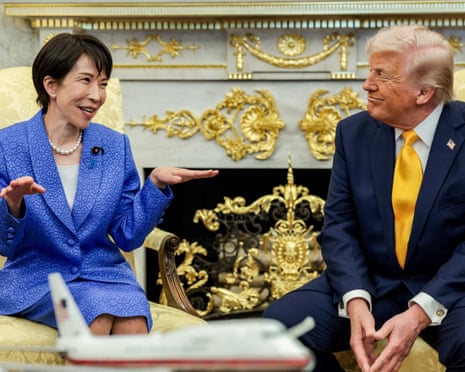
The yen has hit its highest level in three months after Japan and the US launched a combined operation to support the Japanese currency.
The yen strengthened to ¥155 to the US dollar on Monday, its highest level since early May, after Tokyo and Washington confirmed they had carried out a rare joint currency intervention late last week.
Tokyo’s finance ministry said on Monday the two governments had conducted coordinated yen-buying intervention and would not hesitate to take further action.
The intervention came after the yen had weakened to a 40-year low of almost ¥164 to the dollar last week.
Donald Trump told reporters on Sunday:
They have a weakening yen, and they wanted a little bit of help. And we’re always there for Japan.”
Matt Swannell, chief economic adviser to the forecaster ITEM Club, says the loss in UK manufacturing momentum was likely triggered by the breakdown of the US-Iran ceasefire early in July and the uncertainty surrounding the future of the conflict.
We expect the sector to endure a difficult period in the latter half of this year. The conflict in the Middle East is the key wildcard, but the breakdown of the ceasefire has led to a resurgence in both oil and gas prices and increased business uncertainty. Higher energy prices will filter through into higher business costs while demand will be hit by the squeeze on disposable incomes from rising inflation and weakening wage growth.
Output price inflation cooled to a four-month low in July, with manufactures noting that an easing of supply chain tensions had slowed the rise in input costs. However, just as with the wider economy, we anticipate that this relief will be temporary. The impact of the recent rise in oil and gas prices, along with indirect effects of higher energy costs, will push up goods prices, although the inflation outlook is highly dependent on the situation in the Middle East.”
UK manufacturing activity grows at slower pace in July
British manufacturing activity grew for a ninth straight month in July, but at the slowest pace in four months, according to the S&P Global Purchasing Managers’ Index.
Its reading fell to 51.9 in July from 52.5 in June, and weaker than an earlier provisional reading of 52.8. Any level above 50 represents growth.
Rob Dobson, director at S&P Global Market Intelligence
July brought further encouragement for the UK manufacturing sector, as rates of growth in output, new orders and new export business all accelerated. The increase in production was the fastest in almost two years, as improving market conditions led to better hit rates in securing new contracts.
There was also positive news on the price and supply fronts. The rate of increase in input costs slowed sharply to a five-month low as supply chain delays eased to their lowest since the outbreak of the war in the Middle East. Better resource availability and supplier reliability will hopefully provide further respite to squeezed supply chains in the months ahead, though developments in the Middle East will be key to supply and price developments in the coming weeks.
These positive price and demand trends were not fully reflected in the labour market, with the upturn in manufacturing hirings grinding to a near halt in July, but the first rise in backlogs of work in over four years suggests employment could pick up in the coming months. This would be assisted if business optimism recovers from its current subdued level.
Hopefully progress relating to geopolitics, global trade tensions and the direction of the new UK government’s industrial and tax policies will aid, and not hinder, this process.”
AstraZeneca shares drop sharply after merger talks with Bristol Myers Squibb
AstraZeneca is the worst performer across the FTSE 100 today, with its shares down 6% after it emerged the drugmaker is in talks to take over its US rival Bristol Myers Squibb in a deal that would create a near-$400bn (£300bn) pharmaceutical group.
AstraZeneca, run by its longtime chief executive Pascal Soriot, is the second-biggest listed company in the UK, with a market value of nearly £196bn before the news broke. BMS, headquartered in Princeton and known for its cancer treatments, is worth $133bn.
A tie-up would be one of the biggest-ever pharmaceutical deals and create the world’s fourth-largest drugmaker by market value. The talks were first reported by the Financial Times.
Russ Mould, an investment director at the broker AJ Bell, says the sheer scale of a potential merger between Astra and BMS would have implications outside the pharmaceutical sector.
Assuming it went through, AstraZeneca would likely overtake HSBC to become comfortably the largest company on the FTSE 100. However, the fear will be that such a move, coming on top of the company’s recent direct listing in New York, would pull its centre of gravity across the Atlantic and ultimately see the UK stock market lose one of its crown jewels.
Current CEO Pascal Soriot was a big player in the company’s decision to reject a takeover bid from Pfizer for £70bn in 2014 and has been vindicated in the interim. A tie-up with Bristol Myers Squibb could help the business to reach its ambitious revenue goals, with North America already a key source of growth.
The initial market reaction to the reports is highly circumspect, reflecting understandable caution about the scale of the deal. Major transactions of this kind often run into difficulties around integration and matching up different workplace cultures.
Getting a deal across the line could be as difficult as putting together a 10,000-piece jigsaw with the companies’ overlapping focus in oncology likely to attract scrutiny from competition authorities. Political pressure might also be brought to bear, particularly on these shores given the importance of AstraZeneca to UK plc.”
Demand for UK graduates at lowest level since pandemic

Job postings for UK graduates hit their lowest level since 2020, according to a survey by the jobs platform Indeed.
It found that overall vacancies dropped 11% between the start of 2026 and 17 July, and were 32% lower than before the pandemic. Graduate job postings fell 7% year-on-year, and are at the lowest level for the time of year since 2020.
Jack Kennedy, senior economist at Indeed, said:
The UK’s labour market is under sustained pressure. Hiring demand is falling across most parts of the economy, while posted wage growth is gradually cooling.
That is particularly challenging for graduates and younger workers, who are competing for fewer opportunities to gain an initial foothold.“
Meanwhile summer job postings, which are normally taken up by students and other young people, are at their weakest level in four years.
It comes as Andy Burnham faces a growing youth unemployment crisis, with roughly 1 million 16-24 year-olds (about one in eight) not in jobs, training or education. The new prime minister said last week that schools across England should adapt their curriculums to the needs of local businesses as part of a devolution drive aimed at tackling the jobs crisis for young people.
European stock markets rally as oil price drops
European stocks and bonds are rallying this morning as the oil price falls – the Stoxx Europe 600, which tracks the biggest companies on the continent, is up 0.5%.
The UK’s blue chip FTSE 100 index is however flat this morning, with shares in the likes of BP and Shell down 2.8% and 2% respectively on the back of a weaker oil price.
The mid-cap FTSE 250 is rising, up 0.8%, with shares in the shipping group Clarkson’s shooting up 15% after it reported its best ever profit for the first half of the year on the back of disruption in the Middle East.
The drop in the oil price this morning is also helping gilt yields to fall back, with the 10-year yield down 6 basis points to 4.98%.
Kathleen Brooks, of the broker XTB, says the drop in oil prices should help support markets today.
Overnight, president Trump said that negotiations to find a peace deal with Iran could start today, which has led Brent crude to fall back towards $83 per barrel. This will ease inflation fears and could also act as a dampener on bond yields, which rose sharply last week, especially at the long end, where 30-year US Treasury yields jumped to their highest level for 19 years.
…This is another huge week for financial markets. Firstly, there is a large amount of fresh economic data, including the latest labour market data from the US. 20% of the S&P 500 report earnings this week, including Palantir and SanDisk. SpaceX will also release its first earnings report on Tuesday. The market wants to know if the tech sell-off is over, what the yen will do next after unprecedented multilateral intervention to prop up the currency, and US Treasury yields are also in focus.
If anyone thought things would be quiet for markets this August, they are only heating up.
EasyJet extends takeover deadline for suitor Castlelake
EasyJet has extended its deadline for suitor Castlelake to decide whether to make a firm takeover offer for the business.
Castlelake’s “put up or shut up” deadline has been pushed to7 August from 3 August, matching rival bidder Apollo’s existing deadline.
The budget airline said it has been providing diligence access to both Apollo and Castlelake since the last proposal was made. It most recently backed a £5.7bn takeover offer from Apollo in July, which trumped an earlier £5.5bn bid by Castlelake.
There are still some questions hanging over the deal, including a potential EU review of rules around airline ownership.
Last month the company reported a 70% slide in profits because of soaring fuel costs and later bookings as a result of the conflict in Iran.
The shipping group Clarkson’s has reported its best ever half-year performance this morning, benefiting from disruption in the Middle East.
Its pre-tax profit shot up 56% to £61.5m in the first six months of the year, compared with the same period in 2025.
While conflict in the region has introduced dangers and delays across the shipping industry, it has also triggered a sharp rise in tanker and gas carrier rates. Shares in Clarkson’s have already risen by about 24% so far this year.
Chief executive officer Andi Case said:
Clarksons delivered a record first half performance, reflecting both the investment into our underlying business and the exceptional volatility caused by the disruption to global trade from global conflict including the situation in the Strait of Hormuz. We expect the full year performance of the group to be materially ahead of market expectations.
Healey promises to 'clamp down' on supermarket price gouging
The warning from EY follows comments from the new chancellor, John Healey, that the government is standing by to prevent the public from “being taken for a ride at the pump or the till” as the Iran war continues to hit prices.
While he said there had been “no significant evidence of so-called price gouging” during the crisis, he used a weekend column to tell the big retailers that ministers were “watching closely” for any signs of profiteering.
Healey faces a difficult economic balancing act as the energy price shock caused by the months-long conflict in the Middle East reignites the cost of living crisis.
Last week the Bank of England kept UK interest rates on hold as it warned that a further escalation in the Iran war could drive inflation above 4% next year, adding to financial pressures on households.
Healey wrote in the Sunday Telegraph:
The conflict affects our national security, our UK bases, personnel and allies in the Middle East. But it also threatens our economic security: impacting the family finances of millions of British people.
And I know that many British businesses have been put under pressure by increasing costs too. Conflict and uncertainty increases inflation, threatens growth and pushes up costs for businesses and governments alike.”
Introduction: UK economy faces recession if strait of Hormuz remains closed
Good morning, and welcome to our rolling coverage of business, the financial markets and the world economy.
EY has kicked off the week with a warning that the UK could fall into recession next year if the strait of Hormuz remains closed.
The consultant’s latest economic outlook has suggested that gross domestic product (GDP) could slow sharply to 0.5% this year and contract by 0.2% next year if the conflict is not resolved and the vital waterway – through which a fifth of the world’s oil and gas is normally carried – remains shut until early or mid-2027.
On the other hand, if the strait reopens by the end of the third quarter of this year, EY’s base case forecast suggests growth will remain fairly resilient, at 0.9% in 2026 and 1.2% in 2027.
Peter Arnold, EY UK chief economist, said although the UK economy was more resilient than many expected this year (which has prompted his team to upgrade its growth forecast for the year from an 0.8% estimate made in May to 0.9%), there is still uncertainty ahead.
Ongoing disruption to global energy markets will now start to test this economic resilience. If the strait of Hormuz reopens in the coming months, we expect the UK to avoid a more pronounced downturn, but an extended closure into 2027 would raise inflation and could push the economy into contraction next year.
As growth becomes harder to sustain, the UK is likely to rely increasingly on those sectors that have underpinned economic performance in recent years, particularly technology and high-value business services. At the same time, longstanding pressures in construction remain a concern. Rising project costs, persistent labour shortages and weak productivity growth risk constraining the delivery of major infrastructure projects at a time when demand remains high. Enhancing productivity in the sector will be critical if the UK is to deliver its infrastructure ambitions while supporting broader economic growth.”
The warning comes as oil prices have fallen back today, with the international benchmark Brent crude now down about 5% to $83.49 a barrel as tensions in the Middle East ebb.
Over the weekend, Donald Trump said he cancelled planned military strikes against Iran on the basis of “rapidly” reaching a deal on its nuclear programme and the full reopening of the strait of Hormuz.
The US president paused the strikes in expectation of a breakthrough and in response to requests from Iran and other countries in the region, he claimed on his Truth Social platform on Saturday.
He wrote:
Based on this request, I have agreed, for the future benefit of the WORLD and, likewise, the survival of a successful and prosperous Iran, to cancel the attack, subject to being able to rapidly make a DEAL.”
Elsewhere this morning, there are reports that the UK drugmaker AstraZeneca is in talks to combine with US rival Bristol Myers Squibb, in a deal that would create a pharmaceutical group worth nearly $400bn.
The Financial Times first reported that the companies have held discussions about a tie-up in recent months, citing unnamed people familiar with the matter.
AstraZeneca, which is London’s second most valuable listed company, has a market value of about £196bn, while BMS is worth roughly $133bn. A combination of the two would make one of the biggest pharmaceutical companies in the world.
The agenda
-
9am BST: Eurozone manufacturing PMI
-
9.30am BST: UK manufacturing PMI
-
3pm BST: US manufacturing PMI