3 months ago
65
3 months ago
65
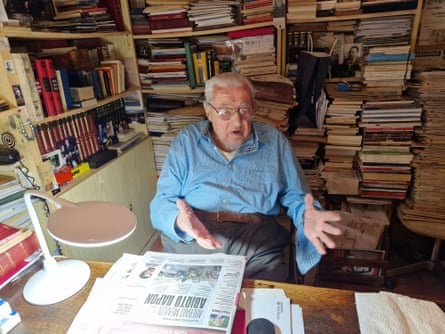
In his book-filled office, Vangelis Sakkatos took in the images of the men lined up before a firing squad. The executions on May Day 1944 have haunted him since he was a boy.
“Their heroism was the stuff of myth,” said the veteran leftist, casting his eyes over the photographs that have dominated Greece’s press in recent days with a mixture of fury and awe. “The years may have passed, but I haven’t forgotten.”
At 96, Sakkatos never imagined the time would come when he would be able to “put a face” to the protagonists of a tragedy that would go down as one of the worst atrocities of Nazi occupation. The 200 communists, executed by machine gun fire in the Kaisariani shooting range, barely a mile away from his first-floor flat, were killed in retaliation for the fatal attack on a German general ambushed by communist guerrillas a few days earlier.
The pictures depict the men walking into the firing range in Athens, their heads held high as they stare, seemingly unafraid, into the camera. Famously, they went to their deaths chanting partisan songs in a final act of resistance.
“That is what we have always heard,” said Sakkatos, who for years lobbied with other leftists for a monument to be erected in their honour. “And now we can see that courage before our eyes.”
Until last week, when the photographs were posted on eBay by Tim de Craene, a Belgian collector specialising in Third Reich memorabilia, it was not known whether the images existed.
In the absence of pictorial evidence, testimony of the communists’ last moments rested on the handwritten notes the men had thrown out of trucks as they were driven to their deaths from Block 15, the notorious camp in Chaidari, on the western fringes of the Greek capital, where political prisoners were detained.
On Friday, after days of outcry in the wake of the pictures’ emergence, the Greek culture ministry said it had signed a preliminary agreement with De Craene to buy the photos and he had withdrawn them from sale.
The prints, believed to have been taken by Hermann Heuer, a Wehrmacht lieutenant, amounted to “a monument of exceptional historical importance”, it said.
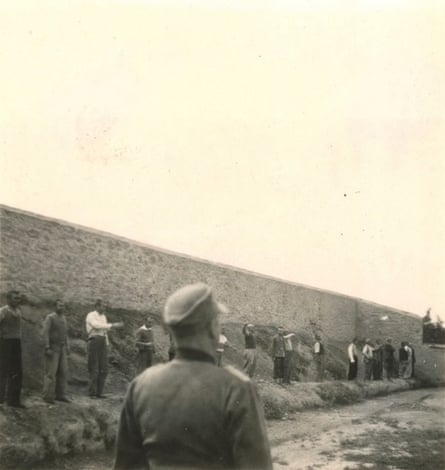
Few events in the collective memory of a nation that endured more than three years of German occupation have held such sway. The May Day executions – seen as the high point of the country’s communist-led anti-Nazi resistance – would inspire some of the country’s greatest contemporary artists. Poets, songwriters, painters and film-makers have all drawn on an episode that ever since has gripped the popular imagination.
“It’s one thing to hear about their bravery and quite another to see it,” said Yiannis Eris, a communist party volunteer who gives guided tours of the firing range and national resistance museum in Kaisariani. “Now we know they faced the firing squad not only with immense pride but raising their fists. The night before they had made sure to wash and shave. They weren’t afraid of what was about to happen. They saw it as an honour.”
The executions occurred months before Hitler’s defeated forces began withdrawing from Greece in October 1944, more than three years after the Wehrmacht marched into Athens and four after Mussolini ordered a full-scale invasion of Greece from Italian-occupied Albania.
Heuer, who was stationed in the country from 1943 was probably part of a unit dispatched by Joseph Goebbels’ ministry of enlightenment and propaganda to document daily life in territories under occupation. “The images allow us to frame the drama of occupied Greece also through the eyes of the occupier,” Lina Mendoni, the culture minister, said in a statement.
The collection is thought to include 262 photographs. Some bear the handwritten note “Aten 1.5.44” – the date of the massacre.
Greek historians, who have long lamented the paucity of archival material from the period, have described the pictures as exceptional, saying their unexpected discovery will not only help research into Nazi-era atrocities but “open up the space” for further discussion into the bloody 1946-49 civil war that followed the country’s liberation.
For decades, Greece’s communist KKE party was deemed illegal and commemoration of events such as the May Day executions was prohibited, in part because access to sites such as the Kaisariani firing range was off-limits. Until the collapse of military dictatorship in 1974, successive rightwing governments marginalised the role played by the leftist-led resistance during the second world war.
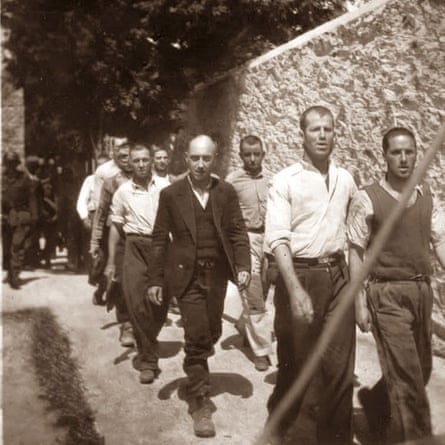
In recent days, relatives who have recognised ancestors in the photographs have come forward demanding that the events of a period steeped in such trauma be finally acknowledged.
“At last, we have pictorial confirmation of what has haunted the Greek left for decades,” said Kostis Karpozilos, a professor of history at Panteion University in Athens. “These images will open up the space for much-needed debate around the politics of memory in contemporary Greece which for so long have been overshadowed by the divisions of the civil war.”
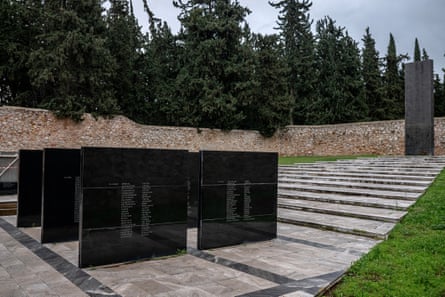
Indicative of that rancour, the marble plaque commemorating the 200 was vandalised and smashed by far-right vandals within hours of the photographs coming to light last weekend.
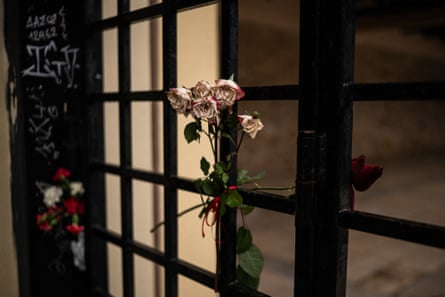
On Friday, the memorial honouring the dead, in front of the wall where the men were shot, was covered with a mound of red carnations, testimony, say officials, to the surge in visitors wanting to pay their respects.
“There has been a huge emotional response to these images,” said Anastasis Gkikas at the history department of the communist party’s central committee. “We’ve been inundated by calls from descendants of our dead comrades asking for the photographs to be returned to Greece. This is where they belong and this is where they should be put on public display for all to see.”